A Christian Lens on “Cloud Atlas”

“Our lives are not our own. From womb to tomb, we are bound to others. Past and present. And by each crime and every kindness, we birth our future.”

No one is an island. Our actions now have an effect on others well beyond our own time and place.

No one is an island. Our actions now have an effect on others well beyond our own time and place.

Last weekend, a few of the student friars watched what I found to be one of the most interesting and thought-provoking movies I had ever seen: Cloud Atlas. Besides being an ascetically imaginative movie with incredible scenery, special effects, and makeup, the directing of the story was truly fascinating. Unlike most movies that have a protagonist, a conflict, and a resolution, and present events in the order in which they happened, this movie interlaces six different stories, each based in different places and spanning multiple centuries, and progresses thematically, not linearly. Added to the peculiarity of the plot was that the small cast of 13 actors played a total of 65 characters, some even playing a different character in each time period, often transitioning age, race, and gender. One minute Tom Hanks is a greedy doctor stealing from his patients on a Pacific trading ship in the 19th century, the next he’s a physicist working at a San Francisco power plant, the next he’s a shepherd in a primitive society years after an alleged fallout in society; he is at one moment the protagonist, the next an extra in another character’s story.

Like any great piece of art, the medium is the message in Cloud Atlas, and the message is as complicated, and profound, as its medium: humans are inescapably linked to one another, in person and across human history, and the decisions made before us have a profound effect on our ability to act. What the movie displays so powerfully is that no one is an island and no one’s actions affect only them. Everything we do affects people around us. Even the most subtle gestures or the most minor of insults can have lasting impacts on who we are and what we choose to do. And it doesn’t stop with us. Having affected someone with our decisions, this other person will inevitably do the same, passing on what they have felt from us to another person. Everything we do to another, whether it be love or hate, heroism or cowardice, charity or greed, inclusivity or racism, can and will be passed on to the next. What one does in one time period, for better or for worse, can be passed on to other times, crossing many generations, geographies and even cultures. In the movie, generations of people continued to make the same mistake, acting towards another as someone had acted to them, inadvertently passing on the decisions of those that had come before them.

An example of the character complexity

An example of the character complexity

While not intending to make a Christian statement, what Cloud Atlas does is present the clearest example of the power of sin to limit our freedom I have ever seen. This was a major topic of discussion with my spiritual director during novitiate. For him, Family of Origin was the answer to almost everything. For any issue I brought up in myself, he worked with me trace it to its origin, the place where I learned to think or act in a certain way. Did I get it from one of my parents, a close friend? And where did they get it from? Their parents? How far back does it go? For him, and other Family of Origin proponents, our values, desires, goals, fears, strengths and weaknesses do not pop out of thin air and they are not systematically chosen by us. No one has the freedom to choose their personality or their fears, but they do have an origin, and left unattended, they will be passed on to others.

All of this may sound rather simple to some, and if you’ve gotten this far, you might be wondering why I’ve used up 635 words to say that we’re influenced by our parents. As a religious blog, does this have anything to do with Christianity? Yes. The point I’m working to make, the most thought-provoking part of this movie and my time with my spiritual director can be summed up in one line he said during one of our sessions: “So now that you’ve discovered a defect in yourself that is likely to have been passed down to you through many generations, wouldn’t it be something if this defect stopped with you, if you could resolve it in yourself so as to not pass it on to anyone else? Do you think you could bring redemption to your whole family?” Wow. What a thought. Like the characters in the movie, I realized that I was intimately connected with those who had come before me; like the heroic characters in the movie, I realized that I had the ability to bring resolution to potentially hundreds of years of a particular character defect or action by not passing it on myself. In the movie, one racism is passed down for hundreds of years unquestioned until one character chooses to act differently. Done. It will not be passed on to the next generation in that family. What if I could do the same with the fears, insecurities, and inordinate desires I had acquired form others, family or not?

This is where Christ comes into the picture and I depart from the movie. While the movie presents reincarnation as the ultimate principle guiding human souls and potentially offering resolution to sinfulness, we as Christians know that Jesus Christ is the only one capable of breaking our cycle of sin in an absolute sense. Whereas we will inevitably pass down some form of alienation due to sin, alienation from God and from ourselves, Jesus was and in the resolution to all sin. Faced with everything that we face, experiencing all that humanity experiences, Jesus acted in perfect obedience and returned nothing but love for all the hate he received. He did not perpetuate the sins of our fathers (and mothers); he transformed them into love. Rather than acting as the world does, returning violence for violence, he freely accepted his death, allowing God to transform death into life with the resurrection. In him, and through his grace, we are given not only the example of how to live, to transform the errs of those before us into love, we are given the strength and ability to do so perfectly. When we act as Christ did and bring resolution to a complex world of sin, it is in fact Christ working in us, bringing resolution and redemption to hundreds of years of alienation and defect, transforming opportunities for sin into opportunities for love and grace. While Cloud Atlas does not take the message of redemption to this extent, it does an incredible job of showing the effect our actions can have not only on ourselves, but all of history.

***

If you’re thinking about running out right now and getting this movie for the next family night, I do offer a strong disclaimer. This movie is rated R for a reason, and I would not recommend it for all audiences. The overall message is a powerful one, but often the way that message is depicted is through less than admirable actions.

The Paulist Pub

Few things bring brothers today like a cold beer at the end of a long day!

Few things bring brothers today like a cold beer at the end of a long day!

This year, the friars at Holy Name College here in D.C. have been a part of quite a few gatherings. There was the beginning of the year social of all the religious, the recent Franciscan prayer and dinner that brought together OFMs, Conventuals, Capuchins, and TORs (which you can read about here), and the yearly lecture for students in formation. Some, like the “Capuchin Cafe,” have been completely spontaneous and wildly successful: more than 100 students/religious/formators/professors come out each time for a holy hour, great music and coffee each month!

Last night there was something completely new. Not as well attended at the Capuchin Cafe and certainly not organized, it was by far the most creative: The “Paulist Pub.” An obvious play on the Capuchin Cafe, the Paulists decided for a slightly more “adult” way of bringing people together than the Capuchins, replacing coffee with beer and an basement packed with undergrads with an intimate courtyard full of seminarians.

But this was no kegger of cheap light beer, let me tell you. No, in keeping with the history of religious orders, this was a beer brewing competition. That’s right, homemade beer straight from religious houses. You don’t get any more medieval than that! And it was delicious! The Capuchins made a Scottish Ale, a common flavor that was a bit more of my preference, while the Paulists, going for innovation and creativity, decided to experiment with putting mangos in an IPA as it fermented. As someone who does not like that style of beer, let alone never-before-attempted styles made in someone’s basement, I was skeptical. But they proved me wrong. Both were crisp and refreshing, making the vote very difficult indeed.

But lest this become a food and drink blog, I’ll say that I loved the creativity and spontaneity of the event and that we need more of this in our formation experience. No one was forced to be there, there were no formators or evaluators organizing the event, and there was no agenda for our conversation other than to have a good time.  together in a setting that had nothing to do with formation or training.

And yet, how critically important such an experience is in our formation and training. In a time when vocations are “not what they used to be,” (although actually growing in the past decade!), it’s really important that we be around people that share our experiences and trials, that we have peers and friends not just “brothers” and wisdom figures. There is a lot we can learn from our older brothers who have lived this life longer than us, but there is just no replacing learning with those who are also new. Here in D.C., we have the luxury of being surrounded by hundreds of men in their 20s and 30s who have chosen to step away from the world and to walk with God in a different way. Each of us has recently struggled with discernment, made major life decisions, and stepped into unchartered waters. To know that there are men life me, who struggle with the same things I do and want what I seek, is very comforting indeed; to actually get to know these people, especially when it is over a fresh brewed beer, is irreplaceable.

So cheers to all my fellow formation students out there and let’s raise our glasses to all those discerning our way of life. It’s a great life that I wouldn’t trade for anything. For me, it’s not about the beer or the coffee, not about organizing orchestrated events with elaborate prayers and planned entertainment, it’s about guys who share a common hope and dream for themselves and the world coming together to get to know each other, support one another, and have a great laugh. With the right group of guys, it could be anything; what better place than the neighborhood religious pub!

***

As far as our beer brewing goes, we’re considering getting in on the action! One of the Capuchins gave me a book about brewing beer made easy, and we might just have to make our own Holy Name Province lager! Stayed tuned next fall for developments!

More of the Same

With the exception of the full-year hiatus when I wasn’t allowed to write during novitiate, these past two weeks have been the longest period of time without posting something. For all my avid readers out there, and by avid readers I mean my parents, I apologize for leaving you hanging for so long. One of the goals of the blog when I set out was to post regularly, but it just wasn’t happening last week.

For starters, school is really kicking up right now. I had a 12-page paper due on the 10th, a 15-page paper due this Wednesday, another 8-page paper due next Friday. That’s not to mention all of the other 3-page reflections papers, the regular reading assignments, and of course, the five exams or papers I will have in just two weeks. But nobody wants to hear my sob stories…

In reality, the bigger issue in not writing lately is that, frankly, life has been “more of the same” for the past couple of weeks. It’s been great, don’t get me wrong. I’ve enjoyed myself and trust me when I say that I’m not bored. But when I was trying to think about something to share, there was nothing that I had not already shared in some other fashion before.

Three Sundays in a row I have played in a softball league with the same diocesan seminarians as I mentioned in Death, Pickaxes, and Home Videos: A Franciscan Feast. I’m happy to report that we have won all of our games so far and will hopefully be playing in the playoffs next week!

I continue to teach English at the parish next door as I mentioned in The View From the Periphery, and that is still the most exhausting yet fulfilling thing I do. Getting to know the people a little better over the past few months has really been great, and seeing their fortitude and progress in such a difficult situation is inspiring.

On Thursday our Vicar Provincial (vice president of the province) visited the house last Thursday for us to renew our vows for another year, as I wrote about in Renewal of Vows. While the one receiving my vows, the two witnesses, and the guardian of the house were all different, the words I spoke and the commitment I made are the same: I wish to live the life of a friar for another year. Given that it’s something that I’ve done now twice and that I plan on living this life until I die, there was just something very pedestrian about it and not worth sharing.

On Friday, we had our monthly fraternal gathering, as in Don’t Fear Fraternity. This month we celebrated the birthday of four of our guys with a “Game Show” theme, complete with the Price is Right, Jeopardy, and Charades. I took video of almost everyone’s acting ability, but unfortunately promised not to share outside of the house. Trust me when I say that “Airport security” and “Police Officer” were pretty funny though.

And lastly, last night was the third edition of the Capuchin Cafe, the holy hour and concert I mentioned in Frat Party with Hillbilly Thomists. It was another successful evening had by all, and arguably even better than the first: lay people and diocesan seminarians replaced the Dominicans, and one girl played Gotye’s “Somebody That I Used to Know” and Lorde’s “Royals” on a ukulele. She was pretty dang awesome.

All in all, the past few weeks have been an experience of the familiar, and that’s not a bad thing. Much of life is simply the same situations we’ve faced before; the difference is that we have changed and thus experience it in a new way (if you’re having deja vu, this, too I have blogged about!) There’s nothing wrong with this. It’s not boring. It’s not monotonous. It’s not even remotely repetitive. Sometimes experiencing what’s familiar, especially when it’s good and fulfilling, is a welcome rest from the ever-changing unpredictable world out there and a time to simply have the confidence that everything is going to be great: I’ve done it once, I can do it again. In these cases, I guess I just have to count my blesses and hope for a  little more of the same!

Sometimes We Fail

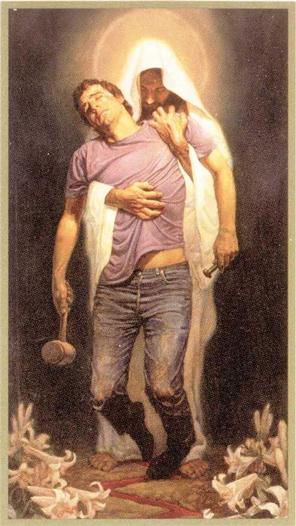
Easter is realizing that Christ is carrying us

Easter is realizing that Christ is carrying us

Last year, I wrote The Joy of Our Salvation as a candid recount of the Easter Vigil calling it, “hands down the best liturgical experience I have ever had.” I was amazed by the transcendence in the liturgy, the energy in the congregation, the faith in the catechumens. Last year, everything went exactly as planned. It was an incredible success.

This year went a little differently.

Now a theology student with a little experience preaching, I was asked by the pastor of St. Camillus Church to give the English “reflection” for Good Friday, the celebration of the Lord’s passion (since it’s not a mass someone other than a priest often gives it.) I was honored. I was excited. Those who know me know that I love big liturgies and I love to preach. Come Friday morning, I felt really great about what I wrote and couldn’t wait to share it with a packed church on such an important day.

But things did not go according to plan. Starting around 4:00 that afternoon, I developed a headache which turned out to be a migraine. I was in pain and confused for a few hours. I felt dizzy and disoriented for much of the afternoon. I could see, but part of my vision was blurry. I took a long nap, got some medicine and right before the service started I felt a little better. Rather than have the pastor stand up and have to make something up, I decided to give it my best. I would be in a little pain, I thought, but that I could still do a decent job.

I didn’t.

In front of my fellow student friars, four priests, and an almost packed church that included friends, strangers, and even one of my professors, I failed miserably. Within twenty seconds I lost my place. After a few sentences, I became downright confused. Looking directly at my written reflection, I could see the words but they meant absolutely nothing to me. I said one sentence a few times because it seemed completely incoherent. Three times I stopped, caught my breath and tried again. I looked at my paper again, but they were only nonsense words. I couldn’t do it. After three tries and about two minutes of embarrassment, I looked at the pastor, said “I’m sorry,” and began to cry as I walked away. I made it to the sacristy, fell to the floor, and cried as hard as I ever had.

I had failed.

I hope that this doesn’t come off too dramatic or even privileged, but it was easily one of the top three most painful experiences of my life. Not only was I in a good bit of pain, I embarrassed the heck out of myself, messed up the liturgy, and back in the sacristy, my classmates, two priests, and some strangers saw me crying, something I have not let people see in many years. How could this night have went any worse?

But then a friar sent me a text and my perspective began to change ever so slightly:

In no way should you feel embarrassed. It was incredibly brave for you to try to do it. I’m very proud of you for trying to tough it out, but also knowing when to ask for help. While I’m sorry you had to go through it, I think for most folks it was a rather poignant demonstration of what carrying the cross looks like in real life. Several people said to tell you what a beautiful homily it was. And it truly was.

By most definitions, what I did up there was anything but a success. I stumbled. I lost my place. I didn’t even get 1/3 of the way finished before I quit. And yet, the result was anything but a failure. There before me, I witnessed my brother stepping in to finish my words for me. I felt my classmates and random members of the choir come to bring me water and console me (like ten people crowded in the sacristy within seconds!) Some even mentioned later that the abruptness of the situation broke them out of the predictable pattern and awoke them to something more before them. How could it be that I was unable to do anything right, that the plan failed miserably, and yet Christ’s message came through?

God transforms our failures into his success.

I stood up, relying on my own strength, thinking that I was going to talk about the pain Jesus went through, the humiliation He experienced, and how He even wept, but my strength was not enough. I couldn’t do it by myself. And I didn’t have to. There we were celebrating the moment in history when Christ triumphantly took our pain and weakness upon himself, subsumed our failures into his perfection, and it began unfolding once again before our eyes. I wanted to talk about this event, but God wanted to show it. My weakness was turned into strength, my failure into success. The Paschal mystery could not be contained by words.

To say that this year’s Triduum celebration went off without a hitch would be far from the truth. Before my Easter this year, I had to experience one of the most difficult crosses of my life. Nobody likes to realize that they are not strong enough. Nobody likes to admit that sometimes we fail.

But we do. And that’s okay.

It is in our weakness that Christ is our strength. It is in our failings that Christ is our success. It is in the crosses we bear that Christ is our Easter joy. May we never be ashamed of our weaknesses, despairing over our failures, or refuse to carry our crosses. Sometimes we fail. Every time Christ succeeds. Happy Easter! Alleluia!

“It is Finished”

Jesus' final words are as an artist marveling a new masterpiece: it is finished.

Jesus’ final words are as an artist marveling a new masterpiece: it is finished

It is finished. These are the climactic words of Jesus’ life. Everything he did and said leading to this final moment: It is finished. But what did he mean by these words? How might those around him have heard them; how do we hear them? For some, like the Pharisees, these words mean that the nuisance is over and we can go back to the way things were before, unchanged and unaffected. Lent is behind us and now we can go back to eating chocolate. For others, like Peter, these words mean that we’ve run out of time, we have let him down. Maybe we didn’t live up to our Lenten promises; maybe we feel like we haven’t “earned” Easter. For some, like Mary, these words mean that at least the suffering is over. As someone who lost his grandmother to cancer this year, I know exactly what this feels like: at least she’s not in pain. It is finished.

In each of these interpretations, there is some truth, but it is not the complete truth. Jesus may be gone, but what he did was so profound that we cannot help but be changed; we may have fallen short and missed our chance, but we know that he will rise again no matter what we did; we take consolation that at least he is not in pain any longer, but really, we know that he has entered into his glory.

Because of this, I think Jesus meant something very different with his final words: “I have done what was mine to do. God the Father has sent me to be the perfect manifestation of his self-sacrificial love for the world. In my life and in my death, I made visible what could not be seen, made clear what was not fully known, that God is by God’s very nature self-emptying love. I have lived with perfect obedience and have poured out everything that I had to give. I showed the way. I revealed the truth. I have given life. [deep breath] It is finished.” His words are of great relief and satisfaction as in a job well done.

What Jesus did with his life and death on the cross was pure gift: freely given, unmerited love for the world. There is nothing we did to earn it; nothing we did to cause it. Jesus did not come because we sinned, we did not place the cross upon him as a burden he must carry. It was not given to us so that we would owe him something or be forced to love him in return. No. “God so loved the world that he gave his only Son so that everyone that believes in him might not perish but have eternal life in him.” Jesus was completely free, and he chose to give of himself, to take up his own cross, and to hand over his life. He did this not out of guilt or obligation, but because he loves us. His life was both the example and the source of strength for us to follow him.

In this way, the grace of Jesus’ life and death is all around us. Everywhere we look we can see him if only we have the eyes to see. He is in the mother or father that gives up what they want for the sake of their children; He is in the person that chooses love, not revenge, when they are insulted; He is in those who give when they know it won’t be noticed or reciprocated; He is in those who care for people who cannot or do not give them thanks; he is in those who suffer greatly but do not despair because they have hope in God; He is in those who are forgotten, unwanted, and misunderstood. When we encounter these people; when we choose to give of ourselves in a self-sacrificial way, not counting the cost but simply giving everything we have because God has loved us, Jesus is anything but dead: he is living among us.

May we be a people that lives what we celebrate today: at the end of each day and when our days have come to an end, may we look back on what we have done and how we approach our death with the relief and satisfaction of a job well done, a life lived in perfect obedience and self-sacrificial love. On that day, we too may say and understand the climactic words of our Lord Jesus on the cross: “It is finished.”