After forty long days of Lent—a period of intense introspection and conversion focused on prayer, fasting and almsgiving—we kept vigil Saturday evening and celebrated the resurrection of our Lord all day Sunday. Alleluia! He is Risen! For many, Easter is a wonderful day of rejoicing, both liturgically and socially; it’s a day of celebration, fellowship, feasting, and relaxation after such a long an arduous journey of Lent. Alleluia!

So… what do we do now?

For many, Easter is a celebration that lasts but a day, an experience of rejoicing that ends in an instant. Monday comes and it’s back to school, back to work, back to the normal grind. Whereas Lent was ever on our minds for forty days, reminding us of the things we were giving up or taking on to prepare for Easter, Easter itself—the very thing we spent an entire season preparing for—gets our attention for one day.

Liturgically, this is certainly not what we celebrate as Catholics. For 50 days we are an Easter people, recounting the events of scripture that took place after Jesus had risen and interjecting “Alleluia” anywhere that it will fit, we intently focus on our renewed lives as baptized Christians who are sent out with the gift of the Spirit. Our celebrations are positive, lively, and aimed at lighting a fire in our Church and world. The emphasis on Easter is so strong, in fact, that the entire first week of Easter is called the “Octave” of Easter, a time in which the Church treats every day as if it were Sunday.

And yet, it’s been my experience that this is hardly lived out in the regular lives of people, religious and priests included. Sure, the liturgies are about Easter and we say “Alleluia” a lot, but compared to the intense focus of Lent, the Easter season seems like any other period of the year, and makes some of us wonder:

“Why do we spend so much time doing penance in Lent but only one day of celebrating during Easter?”

This was a question a classmate of mine raised in one of our weekly meetings during novitiate (the second year of our formation). “Why do make such an effort to come together as a community more in Lent and not Easter?” It was a poignant question, a question that did not really have a great answer. Why didn’t we?

It was as a result to that question that we decided to institute a new practice: every Friday for the entire Easter season the community would come together for some form of celebration. It didn’t have to be quite as extraordinary as Easter Sunday, but it was expected that our liturgy, meal, and recreation would have something special about it. We each took turns, and the nights varied, ranging from a movie with the whole community to an elaborate talent show with a stage and colorful lights to make us feel like we were at a theatre. Some nights were “party” nights with alcohol and nice appetizers before dinner, others were more community oriented with sharing and reflection. The whole point was that our days and weeks, just as in Lent, would be oriented towards the season: how is my daily life reflective of the joy of Easter?

For us as Easter people, living in the joy of the risen Lord, it is a question that we all need to answer. Is Easter just a day, a holiday on the calendar that we breeze through as we march through the year, or is it an entire season, a mindset even, that dictates the way we live our lives? Just as our sense of penance and conversion was evident to people around us in Lent, our joy and thanksgiving should flow from our lives during Easter.

So… what do we do now? I say, because the things we do during Lent are often defined by negative statements—don’t do this, stop bad habits, no more complaining—Easter should be defined by positive statements: I want to be more thankful, show affection more, look on the bright side of things, count my blessings, and share good news with everyone I meet. With Easter joy as our inspiration, the possibilities are endless!

The Galileo Myth

The “debate” between religion and science is not new. It’s been alive and well in the world for centuries, and even a topic that I have written about before. For Catholics, it’s a tired argument, one that has no place for us because we don’t see science as the enemy of religion. Science is yet another way, along with divine revelation in Scripture, Tradition, and magisterial teaching, that we can learn about God. As Pope John Paul II said when he gave a speech to Vatican scientists, “Truth cannot contradict truth,” and so we are called to use the intellect and ability God gave us in every way we can.

In the back of our minds, though, we often wonder how true this has been in our history. “Sure, we believe that now, but what about Galileo?” This was a thought of mine even when I wrote the post about science two years ago. “At least we got it right in the end, but we were kind of in the “Dark Ages” for a while.

That was until I learned about Galileo in one of my seminary courses this fall. (As some of you may know from this article, the Catholic University of America received a grant some years ago to incorporate scientific study into seminary courses.) While Galileo was in fact condemned for holding a belief that we know to be true today, what I learned was that he was not condemned on the basis of contradicting Scripture and that Church did not condemn him because it did not like science. No, he was actually condemned because he failed to produce enough proof for his claim prior to teaching, broke his own oath, and then to top things off, led a smear campaign against those who funded him and his fellow scientists. (The last bit is not illegal but it certainly didn’t help his sentencing!)

Check out the video above or click here to learn about what actually happened to Galileo, where the myth came from, and how the Church has viewed science for centuries.

It’s an election year in the United States, which means that we’re still eight months away from voting and people are already exhausted from all the campaigning and fighting! November 8 can’t come soon enough! And yet, I think there’s a lot of work to be done before that day comes. Election day may be far off, but there is a lot that we can and should be doing as Catholics today to prepare.

1. The Gospel is political

For some, the thought of politics gives a stomach ache. Many would prefer to ignore discussion or arguments, and even more would prefer that the Church not get involved with politics. And I agree, if by “politics” we mean partisan endorsements or campaigning. That’s illegal. But if by politics we mean voicing our opinion, shaping the conversation, and working to build a better world… then the Church absolutely needs to be involved in politics. In that sense, the Gospel is inherently political. In 1971, the United States bishops even went as far as to say, “Action on behalf of justice and participation in the transformation of the world fully appear to us as a constitutive dimension of the preaching of the Gospel” (emphasis mine). In other words, one cannot fully live the Gospel unless one acts on behalf of justice.

2. We need to prepare

This is no easy task, however, and we can’t simply show up at the polls one day and act on behalf of justice (although, just showing up at the polls would be better than 45% of Americans who did not vote in 2012.) Who do we vote for? What do we vote for? Why do we vote for this or that? Questions like these take lots of preparation for Catholics. We are not a Church that defines the way someone should vote. There is not a “Catholic ticket” of issues because the Church does not set forth policies; it sets for values. This is an important distinction. The Church says, “Care for creation,” or “respect life,” but it does not say whether to support Carbon taxes or emission limits. There might be a good reason for both. Or neither. For every issue, there are many ways to respond with the Gospel, not just the two that the main parties support, and certainly not one perfectly correct one. Being active in our world and participating in the development of our communities, states, and nations—something that is required by Catholic Social Teaching—requires that we be informed enough in our faith and in what’s going on in the world to choose what best fits our conscience. This takes time.

3. We are all the body of Christ

The reason this takes time is because we don’t live in a vacuum. We live as a community, and although we may wish otherwise, we are not uniform in mind and spirit. We face disagreement and opposition all around us, even in our own parishes. This is not a bad thing: the Spirit speaks to different people in different ways, and there might just be something to learn from or to teach to our brother and sister in the pew next to us. This can, however, make it a very difficult thing. How do we talk with one another? Often, we tell “them” that they’re wrong and that they should believe the truth, by which we mean the opinion we hold. This happens even among the best Catholics; Facebook can be a breading ground for name-calling, religious superiority over others, and divisive smears. This is not productive and we as Catholics need to be held to a higher standard. Listening is a skill. Tolerance is a virtue. Respect is a requirement. It’s all well and good to say that we respect the human dignity of all people as a political stance, but another thing to recognize that the person who disagrees with us is still the body of Christ, and to uphold their human dignity with our words and actions.

These are just a few of the things I discuss in this brief video about being Catholic in a political world. If you have any questions or would like to discuss something further, leave a comment here or on my Facebook page.

For email subscribers, click here to watch the video.

“If it takes a village to raise a child, it takes a village to abuse them.”

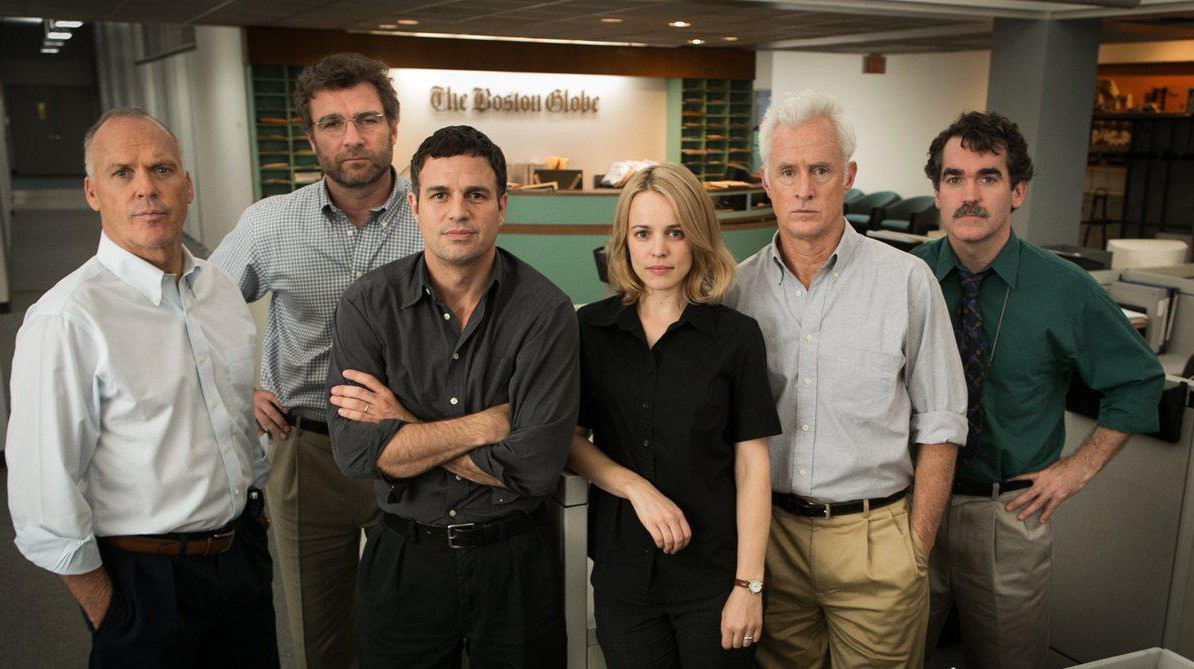
This modification of the often-used African proverb is the driving force of the recently awarded film, Spotlight, a movie that tells the story of the The Boston Globe investigative reporters that broke the story about the priest abuse crisis of the Catholic Church in 2002. While the movie obviously centers around the major legal and ethical violations of the Catholic Church—the repeated abuse of children by some priests and the subsequent coverup by some bishops—the movie indicts more than just the priests and bishops of the Catholic Church: it indicts everyone. “How could this have happened without anyone knowing?” the movie asks. It couldn’t. And it didn’t. While priests were abusing children and bishops were covering up their misdeeds, there were police officers overlooking misconduct, judges refusing to hear cases, defense lawyers profiting from settlements, reporters failing to do investigations, and a whole city of neighbors, parishioners and family members discouraging victims from coming forward because they couldn’t bear the embarrassment. Beyond the terrible deeds of the actual abusers, there was a system in place that prevented victims from receiving the justice they deserved.

“If it takes a village to raise a child, it takes a village to abuse them.”

What I think the movie very powerfully points out, and what I mean to say in writing this post, is that this “crisis” is not something that involves only those who abuse and those who have been abused. We live in and support a culture that allows for this to happen, even still.

An example.

One night, I met some people at of one of our ministry sites. Besides the adult parishioners, there were also about six minors in the building with us that night, all either children of the adults present or friends that had come with the adults. There was no problem with the situation, neither from a legal or diocesan standpoint. As we were finishing up, though, all of the adults gathered their children and began to leave. “Hey Br. Casey, (child’s name) said his mom is on the way. Would you mind waiting with him until she arrives?” On the surface, and from the parent’s perspective, it was a natural, harmless question; he didn’t want the child to be left alone and he trusted me enough to leave the child in my care. In reality, though, this was a major misstep, a violation of diocesan rules, and the sort of question that puts children (and people like me) at tremendous risk. Given all that has happened, and all that continues to happen to children in schools, churches, and activity centers, what he was asking was basically: “Would you mind remaining with this unaccompanied minor, inside a building with no windows, on a property with no one else around, at night?” Um, yes, I most certainly do mind.

In telling this story, I don’t mean to vilify this parent; he was a nice guy and his actions were not malicious in the slightest bit. But that’s the problem: one doesn’t have to be malicious to be complicit in something terrible. Yes, it was the priests (and many others) that did the abusing, but there were also countless parents, teachers, friends, and neighbors that trusted without question, put children in unsafe situations, and failed to see the signs after an abuse had taken place.

This may seem like a defense of or deflection from the priests and bishops who committed terrible crimes against defenseless children. I assure you it is not. What they did, especially considering their office, expectation of a higher standard, and power they held over their victims, both emotionally and spiritually, is not something that can ever be overlooked or excused. Spotlight does not hold back about what it thinks of these institutional actions of the Church and neither do I. The fact that even today, after years in the public eye, bishops and priests are still eluding criminal trials because they were moved to another position in another country, a “promotion” as it were, is absolutely detestable.

What I write is not a defense of or deflection from the priests and bishops who committed terrible crimes against defenseless children, but rather a call to action for all of those who didn’t. While some may have lamented the idea of such a movie like Spotlight, fearfully asking, “When will this just go away?”, I applaud it. Using a powerful and popular medium, at the quality worthy of attention and awards, this film reminded us that the reason this won’t “just go away” is because we still have work to do. That’s right: weWe need to continue to push the issue in our Church communities so that bishops and priests are held accountable for what they’ve done. We need to be humble enough, like the journalists in the movie, to recognize when we have failed to protect children and were complicit in what happened. We need to make sure that we set up, and follow, protocols that will prevent things like this from ever happening again.

I think Spotlight got it exactly right: “If it takes a village to raise a child, it takes a village to abuse them.” What happened was the result of many problems coming together. But now we can act differently. Now we can change the story for the children of today and tomorrow. I say, “If it takes a village to raise I child, it’s takes a village to keep that child safe.”

When we think about “traditional” weddings, there are a lot of things that come to mind: a bride in a beautiful white dress being escorted down the aisle by her father, the “Bridal March” song (known as “Here Comes the Bride”), bridesmaids and groomsmen, a flower girl and ring bearer, a reading from The Letter to the Corinthians, the bride and groom being separated before the wedding, and common phrases like “speak now or forever hold your peace,” and “I now pronounce you husband and wife.”

But there’s a reason that I put “traditional” in quotes: for Catholics, none of these things are essential to the ceremony, while a few of them are actually forbidden.

The fact of the matter—and I can say this because I’m writing on the internet, very far away from the angry glares and fists of brides—the wedding is not about creating a fairytale in which everyone marvels at the “princess” being married in a fantasy world. Weddings are not all about the bride. *gasp*

And there goes my female readership.

But really, a wedding is about what the couple is doing, not just about what the bride is doing. What the couple is doing is profound: they are exchanging vows to one another with God as their witness. In other words, they are entering into a solemn, life-long covenant with God and each other. Their saying of the words, “I take you to be my husband/wife,” is arguably the most profound thing either person will ever say. It is the essence and height of the whole ceremony, and everything else should point to this moment.

Which is why, despite the confusion of many Catholics and non-Catholics alike, many of the “traditional” aspects of weddings are left behind in Catholics ceremonies. That’s the focus of the newest installment of “Catholicism in Focus.”

What’s with Catholic Weddings?