An Experience Like No Other

For those of you who followed me this summer here on the blog or over on my Facebook page, it should not come at any surprise that my time in Mexico will have a lasting effect on me. How could it not? While I certainly wish I could have spent less time learning Spanish and more time using it with the migrants at La72, I can still say that I left having met some extraordinary people, heard some moving stories, and with a changed perspective that will no doubt effect my life as a Franciscan. Naturally, I couldn’t share everything in one video, but here’s a brief glimpse of what the trip meant to me and how this next year will be unlike any other as a friar.

Shortly after the end of the school year in May, a fellow seminarian at Catholic University posted a picture on his Facebook of a large pile of books, evidently his reading list for the summer. Piled more than ten high, the ambitious stack had some great books about the liturgy, history of the Church, and popular expressions of Catholicism in today’s world. Objectively speaking, it was a great collection and I’m sure he benefited greatly from it.

And yet, I couldn’t help but shiver when I saw it.

Despite the wide variety of topics and perspectives, his stack was all the same: academic, theological, non-fiction. They could have just as easily been his textbooks for the following year of seminary, all packed with information for study, meant to fill the mind with thoughts and facts and ideas.

At face value, there’s absolutely nothing wrong with this. As Catholics, we know that God gave us the ability to reason and understand Godself and the world, and so are not afraid of intellectualism or study in faith. Thoughts and facts and ideas are incredibly important to our faith, and I plan on attending two more years of seminary to engage them more deeply.

But there is a reason that I shivered when I saw this picture (and, no, it’s not just because my brain is fried after three years of full-time graduate study.) While God certainly gave us a mind to reason and understand, God also gave us a heart to feel and a spirit to imagine. After three years of seminary training in which I’ve read dense books on philosophy, theology, Church history, and pastoral care, I’ve realized that there is something desperately missing from my life and formation: fiction. Where are the novels? Where are the short stories, plays, poems?

For some, such things are often seen as more leisurely, “softer” activities one does in one’s free time or when one needs a break from “real” studying. For others, fiction is simply a waste of time altogether when one could be learning about “something that actually happened.” I couldn’t disagree more. Just because works of fiction do not contain many—if any—details that are factually accurate does not mean that they are devoid of truth. In many ways, I would argue quite the opposite: novels use lies to tell the truth (paraphrase of Alan Moore, V for Vendetta). Using characters, places, and situations that do not exist in our world, writers use their imaginations to speak profoundly about the human existence in a way that biographies and treatises simply cannot.

It is with the use of this imagination—the ability to dream and believe and create—that writers help so many see beyond the mundane happenings of life and into the transcendent experience of God. Even when works of fiction do not convey an immediate or underlying Christian message, the reader is offered a glimpse into the transcendent simply because s/he is experiencing beauty. The eloquently chosen words on the page, the palpable emotion flowing from the actors, the disturbing/inspirational/unbelievable/mesmerizing images that the writer evokes are all gateways into God if the reader allows it.

What fiction lacks in historical accuracies is often more than made up for in what it reveals about the human experience. I think of the incredible precision with which F. Scott Fitzgerald wrote The Great Gatsby, telling such an emotive and visually packed story with so few words; I think of how terribly defeated I was after reading Ralph Ellison’s Invisible Man, as if it had been me who had had all of my hopes and dreams crushed and cast aside; I think of how taken away I was by the imagery and storytelling of Yann Martel in Life of Pi, as if I were sitting at the feet of a wise old master telling about his life (which does not make me a Hindu relativist, fyi…) These stories moved me. They touched me. They evoked something in me that, despite being about people and events that never took place, helped me to relate to and understand the world in a new way.

That is what I want to recapture this year as I take a break from formal studies. While Karl Rahner, official papal documents, and classical treatises are certainly useful and have been fruitful in many aspects of my life, and I will most certainly not abandon them completely as I will be teaching many classes this year, having to read hundreds of pages of them each week has left a major imbalance in my life that needs fixing.

And fixed it will be.

Starting just after the road trip in May, I began to reread my favorite series of all-time, Harry Potter (it took me only 25 days to read all seven books… That is an emotional roller coaster I do not recommend!) Over the summer in Mexico I read The Little Prince in Spanish. And upon arriving here in Durham I signed up for a library card and checked out my first two books within twelve hours of arriving: A Good Man is Hard to Find by Flannery O’Connor and Jazz Age Stories by F. Scott Fitzgerald, two collections of short stories.

Like my friend from seminary, my stack of books is quickly piling up as I try to fit as much in as I can, making up for the lost time during school. And even though our stacks look completely different and it would be easy to say that our goals are quite different, I don’t think they are. Both of us, in our own ways, are seeking to know God and God’s people better so that we can be better ministers today and in the future. The difference is a matter of perspective: while he has chosen to read books about God and God’s people, I have chosen to read books that help me experience God and God’s people firsthand. Now that’s a novel idea.

As hard as it is to believe, Christian and I had our last Spanish class yesterday. After a little more than seven weeks, our time is up at La72, and we’ll be heading to Mexico City  on Wednesday for a few days of tourism, reflection, and much needed relaxation before heading back to the United States on Sunday. It’s been quite a trip, and I will definitely not go home empty handed.

Some Spanish

My primary goal in coming to Mexico was to improve my Spanish and that definitely happened. I would be lying if I said that I’m not a little disappointed in the amount I learned, but I never intended to leave the country fluent in just two months; this experience was always supposed to be the first of many along the road to fluency and I am happy with the foundation that it offered. We learned some basic vocabulary, ten different verb tenses (yeah… our teachers lied to us when they said there’s just “past,” “present,” and “future!”), and many common phrases, enough to get by in many situations.

Malas Palabras

As many of you know, though, language is much more than asking for things and calling objects by their correct name. It’s about knowing situations, being informal, and yes, knowing when and how to swear. And let me tell you: Mexicans know how to swear. Whereas English has only a handful of rude or vulgar words that are repeated over and over in rap songs and movies—the only “creative” ones being horribly offensive and filled with hate—Spanish, or maybe more accurately Mexican Spanish, has a plethora of hilarious, playful, and powerful “bad words.” For some, this might seem like a strange thing for a friar to be talking about. Swear words? Two things: 1) knowing something bad doesn’t mean that one has to use it, but it’s important to know what’s going on, 2) “bad words” in many places here depend on context, and it is often completely acceptable to call a friend a terrible word in jest and to use that same word as an incredibly offensive slur in another situation. Will I use these words often? Probably not, but it was worth a few laughs.

Minority

As I wrote a few weeks ago about race and privilege, this experience has partially opened my eyes to things I never knew, partially solidified thoughts I already had. In many ways, it has been such a contradictory experience. On the one had, I have felt marginalized and left out in ways that I had never known before. Not knowing the language, the culture, the sense of humor, or the way things normally go, I was constantly bombarded with feelings of being different and inadequate. I was never “in,” but rather stuck out like a sore thumb in every situation. And yet, that very sticking out was in fact a sign of privilege in other situations. Even though I was different, being the only white guy among people of color is not the same as being the only person of color in a culture of white people. Even though I was someone different and outside, I was at the same time “special,” looking like the people on tv, the heads of of companies, and those leading the nation in politics. Despite how awful and excluded I felt sometimes, how different and “minor” I thought I was being, others around me were still experiencing minority and powerlessness in a way I never could. This was challenging to navigate as a “friar minor,” and I will have to do a lot more reflecting once I return.

Some unwanted lines

Waist and tan, that is. This trip was by no means a day at the spa. While Christian and I certainly had some great excursions to the river and some of the popular sites of Mexico, the regular day-to-day activities were pretty mundane, pretty unhealthy, and pretty lethargic. Ranking nearly as high as the US in obesity rates, the major problem for people in Mexico is not that they have appetites like we do in the US but that much of their food is low in nutrition and fried. Vegetables are very expensive and uncommon, replaced instead with a diet of rice, beans, fried meat, and corn tortillas. Delicious, don’t me wrong, but not sustainable. You add that diet to an American appetite and a daily routine that involves sitting in a classroom and laying on our beds studying, and you end up with two friars returning to the US with a little more “cushion” than we left with. As far as I can tell (and hope) the extra pounds aren’t that noticeable. I can’t say the same about my tanlines…

A Fraternal Experience

Above all of this is a powerful experience of fraternity. Despite the fact that Christian and I lived in the same house two out of the last three years, our paths never really crossed for very long. In a house of about twenty very busy and scattered people, it’s impossible to spend quality time and connect with everyone on the same level meaning that, honestly, we were not very close.

There was no shortage of quality time this summer.

Besides the time we spent in class each day, Christian and I made it a point to pray together, go out of the house to share a meal, and reflect on the theological, social, and human aspects of our trip everyday. Our discussions were frank and thoughtful, challenging each other when we saw something differently and supporting each other when the trip through us bumps in the road. And there were bumps. In many ways, this has easily been the most difficult experience of my life, feeling disappointment, frustration, sickness, isolation, and inadequacy on a regular basis, and I don’t know how either of us would have done it alone. We got through it, together, on the foundation of our Franciscan fraternity.

For many, it is this very fraternity that attracts people to our way of life, the oneness that we share in life as brothers. What many don’t realize, though, is that just because we’re in this life together with similar values and professions doesn’t mean that fraternity will naturally come. It is not something that can be taken for granted. It requires humility. It takes work. It cannot exist without love and commitment to one another, knowing without a doubt that you are willing to sacrifice for the other and that they are willing to do the same for you. In our relatively comfortable lifestyle in the US, in our potentially institutional lives with separate space and time and jobs and money, this is not always felt so strongly. Just as Christian and I were able to live together for two years without a particularly intimate experience, fraternity within comfort and privacy is not always challenged, and thus, not always realized. More than any other time in my life as a friar, I have been dependent on my brother and seen the need for true fraternity, that is, not just living and working together but being vulnerable, intimate, inter-dependent and committed to someone that I did not hand pick. That’s what I experienced this summer, and that, more than anything, is what I will take back with me. If you ask me, even if I don’t remember a single word of Spanish the minute the plane lands, this has made the whole trip worth it.

As regulars to Breaking In The Habit will know, road trips are fairly common for me. Four times in the last two years I have found myself on trips of over 1000 miles, once driving from California to Washington, D.C. to pick up a friend, another time driving all throughout the Southeast to meet the friars and see our southern ministries. Two years in a row I’ve driven roughly 1200 miles on my vacation. It’s apparently what I do, both for work and for pleasure.

Apparently the friars wanted to continue to this tradition. Late last week one of the friars approached us and “asked” us if we were going to accompany him and the other friars on a trip to Cancún to move his stuff to his new assignment. I say “asked” in quotes because the question was less interested in our desire to go on this trip and more a question of us being ready to go in a few days. You can imagine our initial confusion. “Um, what now?”

For some, this might sound like an amazing opportunity, one that we should have felt excited about. And it was, for sure, and I’ll get to that in a second. But mind you, Cancún is not right around the corner. It’s a nine and a half hour drive—without stops—on a mix of highways, local streets, and yes, even a few gravel/dirt roads, sitting three across in the backseat of a pickup truck. Add that to the fact that we were never really asked, and that we would be missing a week’s worth of Spanish classes and contact with the migrants, and Christian and I were a bit, shall we say, less-than-excited about the trip.

Alas, at 5:00am Monday morning (a time that was negotiated away from the original 3:00am start we were first told), there we were crammed into the back of a truck on our way. Obedience at work, my friends! The drive was as expected, long and very uncomfortable, filled constantly with the thought, “What the heck am I doing here?”

Photo taken by Christian SenoAnd then we arrived to the beach. Suddenly my back pain disappeared, my frustration faded, and my wondering stopped. Just, wow. I have been to beautiful beaches in the US and I’ve seen clear blue water. But not like that. All I could think when I saw the water was that it had been photoshopped: “There’s no way that’s real. Mexico messed with the color settings of this beach.” Standing in the water we could see our feet clearly (and a handful of fairly large fish), the water was just below bathtub settings, and the sky had just the slightest touch of clouds brushed upon an incredible blue ceiling. After just one day on the beach, laying in the shade and drinking beers, the discomfort of the trip was suddenly all worth it.

And then we were gone. Just as quickly as we were “asked” if we wanted to go in the first place, we were “asked” after 24 hours to have our stuff ready to go in the morning when another friar would be arriving to take us some place else. Huh? Why? But I want to go to the pretty beach! Where are we going? The messenger did not know. And so we packed.

This ancient Mayan pyramid has 365 steps all the way around, just one of many astronomical features of their culture.

The following morning we awoke and packed back into the truck for a much shorter, two-hour drive into the heart of the Yucatán Peninsula, where we would be going to… somewhere. (Yeah, communication wasn’t really great on this trip.) Our first stop was the  historical site of Chichén Itzá, an ancient Mayan city. A major tourist stop for both Mexicans and foreigners, the complex was huge, complete with pyramids, temples, an arena for an ancient sport, domiciles, and even an observatory for star-gazing. As the friar that lead the trip was himself an anthropologist, we didn’t need to pay extra for interesting details or cultural feats, they came free!

IMG_3483

John Paul II visited this church in 1993

After a few hours we were on our way again, this time knowing where we were going. Or at least we thought we did. Told that we were going to Izamal, a town where the friars of this province have their provincialate at a large monastery, I pictured a larger city with a fairly new monastery tucked away in the corner somewhere. What we found was that the monastery was the city. Completed in 1561 (yeah, that building is more than 200 years older than the United States…), the monastery was built by the Spanish friars on top of the Mayan acropolis located in the middle of the city and has served as the focal point of the city ever since. The building itself was pretty extraordinary (probably the oldest building I’ve ever been in, come to think of it), especially from the view on top of the roof, but the city itself was quite a gem. Originally deciding to level only the acropolis for the use of the church, the Spanish left a number of other pyramids scattered around the city, maintained even until today. It was very cool to walk down an otherwise normal city street and see ancient pyramids between stores and houses.

The final surprise of the day (yes, we’re not done with surprises!) was when we packed up our things and got back in the car. This time I was legitimately confused. Wait, we’re not staying? Where are we going? Have I mentioned that communication wasn’t great? I was sad to leave the cool little city because I really wanted to walk around with my camera, but alas, we were gone before I knew it.

And I’m glad we did.

Unfortunately I didn’t have my camera with me, but here is a stock photo of the Cathedral in the city square.

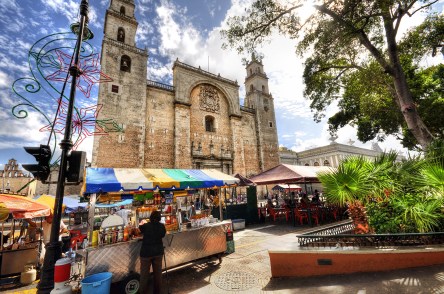
The final stop on our whirlwind, unplanned, miscommunicated tour was hands down my favorite: Mérida. Located on the western shore of the Yucatán Peninsula, Mérida is the capital of the state and the largest city in the region, making it by far the most cosmopolitan. Within seconds I was taken away by it. While I’ve never actually visited Spain, all I could think about was Barcelona. The city streets, the culture, the old buildings, the night life, the art, the food. It was just so nice, an amazing blend of historic landmarks and modern living. We arrived just after sunset and the city was absolutely gorgeous. The city square had both the Cathedral and the governor’s building (the latter of which was absolutely stunning, filled with two-story tall paintings all the way around the top floor), live music and dance, restaurants galore (both local and international), and plenty of people taking in the warm summer night. We stopped at a bookstore to get some materials for our Spanish education (The Little Prince and The Curious Case of Benjamin Button, both in Spanish), and were off to dinner.

Little did we know (duh) that the “doña” of the restaurant was a close friend of the friars and we were in for a treat. Not only was the food and drink amazing (fresh, healthy, vegetarian menu), their was live music, a comfortable atmosphere, and a host that kept us laughing the whole time (at one point Christian and I got an unsolicited lesson in Spanish swear words, so there was that!) After a few free “tastes of the Yucatán,” courtesy of our gracious host, we began working on our friar-host to convince him to have us stay another night rather than leaving first thing the next day. Surely we can’t see it all tonight. This is a very important cultural experience. Why rush back, they’re not expecting us until Friday anyway. Very funny, but had it worked?

The next morning we met for breakfast and the friar began loading up the truck. Apparently not. Over in just a few days—the best part in mere hours—we were back in the truck for our seven-an-a-half hour trek back to La72. To say that the trip had its moments of discomfort would a complete understatement, but to say that it wasn’t worth it would be lying. I may have been surprised many times along the way, but I can tell you this: it would not surprise me one bit if I found myself in Mérida again one day, only for a lot longer.

There was much more of the trip to share, so make sure you check out my Facebook page for more pictures!


The other day I saw a video with an interesting message. In it, a presenter at a conference held out a glass partially filled with water. While one expected her to ask, “Is this glass half-full or half-empty,” she actually asked the audience, “How much does this weigh? Does it weight a lot?” People responded with their guesses, all giving quantitative measurements—10 ounces, 1/2 pound, 200 grams—all concluding no, it was not heavy. But she wasn’t looking for quantitative numbers. She said, “Well, actually, it depends, doesn’t it? If I hold up this glass for ten seconds, it’s pretty light. If I hold it up for thirty minutes, my arm is going to get pretty fatigued. If I try to hold it up all day, my arm will suffer permanent damage because of the weight.”

Her point was that little stresses at home and at work may seem like nothing—say, as “light” as a glass of water—but if they go unattended and are carried for long periods of time, even the smallest things can cause major health problems and psychological distress.

Besides being a helpful example for busy people in the corporate world to understand and combat stress, it is also the perfect example to describe something far more pervasive and much less discussed than stress: racism.

Race-RacismWhen we think about acts of racism, my guess is that many people—at least many white people—think of extreme and historical examples: Martin Luther King’s civil rights movement, the Holocaust, Rwanda, apartheid, the Klu Klux Klan, and the treatment of Native American nations, to name a few. When we think about racism, we think about the large, conscious efforts of one group to suppress another with violence, making it easy for the majority of us to distance ourselves from it, or worse yet, to deny that it still exists today.

For most people, though, racism is not conscious and it is not violent. It’s found in the small and seemingly insignificant events of daily life, unnoticed by the majority.

Here in Mexico, this is felt in the near-complete absence of people of color on television. When I first noticed this, it was sort of humorous: being the only white person in a store or restaurant, I found it out-of-place to see only white faces on the screen, ironic dissonance. Now, however, it infuriates me. Telenovelas. Music videos. News casters. Even the commercials. All you see is white face after white face.

You may think to yourself, “Well, this isn’t really racism, is it? It’s not saying people of color are bad or anything, it’s just choosing to show other people.” It’s just a glass of water. But imagine it the other way around. Imagine that, when you turned on the television, all of the faces were different from your own. Imagine not seeing anyone like you. The glass feels a little heavier. Now imagine experiencing this as a child… as a teenager… for years and years; imagine never seeing someone like yourself on television. What does that do to one’s image of self? How does that make someone feel within the community? Now, something as light as a glass of water comes to weigh your whole person down and define who you are: different, not good enough, absent, silent, unimportant.

It is through this lens that I now experience the recent tragedies in the United States, the killing of two non-violent black men who were shot and killed by police officers when violent force seemed unnecessary, followed by the events that took place in Dallas last evening. It is through this lens that I look beyond the immediate injustice of the killings, as terrible as they are, and see the long term effects of these repeated occurrences. What does a situation like this do to the psychological stability of a minority? One occurrence is tragedy, for sure, but for many it is ultimately just a glass of water. But then another. And another. And you begin to notice that these sorts of things are not isolated to a particular place or situation, they happen everywhere and have happened for a long time. The glass gets heavier. And every time situations like these fail to bring justice to the victim and the police officer is let off with but a warning—a sentence unthinkable if the victim were white—people are forced to hold the glass up longer. That is the glass of water that many minorities carry with them throughout their entire lives, a glass of water that many white people will never even have to pick up.

It’s because of this, I truly think, that race relations fail to happen constuctively. When tragedies like this happen, or even when it’s simply acts of micro-aggression or minor inconveniences that affect people of color, people who are not forced to hold up a glass of water their entire lives fail to see the whole story. They can’t understand the stress, the anger, and the feeling of defeat that people bring to the situation in the first place. When Arab-speaking Americans are kicked off of planes because of a perceived terror threat simply because they were speaking Arabic (happened twice last year on SouthWest), Hispanic-looking citizens are required to verify their ID on demand because they “might” be illegal (thank your Arizona and Georgia), and African-American children on a field trip to the zoo are called “animals” by a stranger (actually happened at one of the friars’ elementary schools), it’s never about just the situation itself, no matter how difficult; the reaction is always the compounded effect of constantly dealing with an identity of other, different, less-than. “Here we go again…” many think.

Sometimes, the response is not so nice. Sometimes, it’s not civil and respectful. In 1988, the rap group NWA famously released a song entitled “F*** the police.” Vulgar? Yes. Angry? You bet. But rather than writing it off as “angry black men,” or “thugs,” rather than being offended by it or demanding that they be sensible, I ask myself, “What’s behind this song? What drives someone to feel so angry and trapped that this is how they need to express themselves?” I absolutely do not condone violence as a response to violence and surely don’t want to condone their message some 28 years later, but I do want to affirm their anger and their right to express it even if it doesn’t make me feel comfortable. While it would be wonderful for us in the majority if all reformers endured their injustice patiently, were polite to those who denied them rights or failed to come to their aid, and ended up being saints like Martin Luther King and Gandhi, the moral character of the oppressed really doesn’t matter. It is completely unfair to tell someone how they are allowed to get angry, and worse yet, to dismiss the injustice they endure (and turn them into the culprit) because they don’t meet the majority’s standard of morality. One does not need to earn the right to be free from racism and injustice by being a good person.

whiteprivBut some still expect it. When issues of race occur in this country, as is the case right now, the first thing that some people do is analyze the character of the victim. Did he have a criminal record? Was he a nice boy? If not, then he was just an angry thug. “I realize you’re angry,” some will say, “But why can’t you speak civilly? Why didn’t you follow the law rather than rioting and causing violence?” The words of someone who has never had the system fail them. The words of someone who has never had to hold up the glass for more than a few seconds and so cannot understand what is behind the anger.

And so the injustice is dismissed. For many, it’s not out of malice or hatred for another but simply out of shear ignorance or indifference. When one is a part of the majority, it is very easy to see only what benefits oneself without seeing how the current system may not be the best for everyone. “There are a lot of people that look like me on tv.” “I’ve never been pulled over for no reason.” “I’ve never had to prove my identity while at a park with my kids.” The world must be fine.

For many others, though, such injustices are dismissed actively and defensively because they pose a threat to one’s own way of life. There is no racism in America, they say. To recognize an injustice in the world opens us to the possibility that we might somehow be involved, that we might have to do something about the problem, and worst of all, that we might have to give up some of the undue privilege we exercise at the expense of others. Those who benefit from the status quo never want the status quo to change, even if it’s not good for everyone.

How do we as Christians feel about either of these responses?

For me, it is an issue that I have struggled with for many years as I’ve tried to live the life of a Franciscan friar. How does someone who is not a minority in any way (white, male, straight, young, middle class, etc.) live the life of a “friar minor”? The more I experience of the world the more I am sure that I have been given privileges as a white man that others do not enjoy. I have been sheltered from so many of the hardships that people of color deal with, not because of merit, but simply because I won the “womb lottery.”

This, to me, is not the Kingdom of Heaven that Jesus announced to us. This is not the will of God that Mary proclaimed in her Magnificat. A world in which people are consistently held down and made to feel inferior while a majority class enjoys special benefits is not the Kingdom, it is the Roman world in which Jesus lived, spoke, and denounced.

Maybe you don’t see it that way and this post is a long, activist-driven rant that has more to do with party politics than it does Christianity. If so, thanks for reading. I promise the next post will be lighter (and shorter). But maybe you do see it that way. Maybe you do notice that the world is unjust and that certain people carry heavier burdens than others. As a Christian—as a white person, perhaps—what are we do to?

Short of taking experimental sun-tanning pills and getting a perm so as to experience the world as a person of color (the plot to the 1986 movie Soul Man), if we are white, there is likely no way that we will ever be in true solidarity on the issue. We simply cannot know the full extent of what the system does to people. But we can do something.

white-privilegeWe can begin to notice. Maybe we have been so sheltered throughout our lives that we simply don’t know what people go through. It all starts with a relationship, getting to know someone different on an intimate level. When we do that, stepping outside of our world to enter into another, we learn things and we change. In my own life, I find it amazing how differently I saw the world when I started attending a black church in college, forced to hear other people’s perspectives and enter into their experiences. At first, it was jarring because it told me that my narrow worldview was not complete. But then I began to see a little wider, to see with their eyes (to a very small extent), and I began to notice so much more of the world. I saw things that had always been there but never seemed important because they didn’t affect me (e.g. an all-white cast in a tv show or movie.)

Having our eyes opened is a start, but it needs to go further. For those of us who do not share in the pain of minorities, we need to begin to share in their anger. When tragedies like these happen, it cannot be only a group of black people that mourn a casket; it cannot be only a group of black people that feel crushed and helpless. When tragedies like this happen, they happen to one of our brothers, a member of the human family. And maybe we do when they get tremendous press from the media and we’re inundated with the stories. But these are spikes on the radar, effects that don’t always reveal the underlying issues and the countless other, smaller events that led up to it. Do we get angry at the micro-aggressions and minor inconveniences, the fact that many stores and banks won’t build in black neighborhoods, the distrusting looks or snide remarks, the slightly racist joke that’s “just a joke”?

Once we’ve seen and begun to share in the anger that is already present, we as Christians, those meant to build the Kingdom of God, need to be a voice for change. In many ways, this is a black and white issue: if we have had our eyes opened to the injustices people endure, we have to do something about it. We have to. It is not politicking, it is not liberal activism, it is not communism. When there are those who have rights and privileges that others do not, and these rights and privileges prevent people from authentic human develop free from undue burden, the Gospel calls us to fix the situation. Sometimes it means questioning and removing the structures that keep people apart, as Jesus did with the Pharisees, with the ritual purity laws, and in the Temple. These things are easy for us to conceive, and the don’t require us giving anything up. The change is out there on a large scale. But sometimes the answer is quite the opposite: it is close to our lives and requires a major change in us. Sometimes it means imitating Jesus’ kenosis, acknowledging that we, white people, have something that others do not—a privilege that we did not earn and do not deserve that protects us from so much of the frustration and humiliation that others have—a doing our best to give that up. Jesus did not want to be treated special, he came as a lowly peasant. He did not demand rights that others didn’t have. And maybe we shouldn’t either.

This last part is particularly difficult and some will argue that it is impossible for white people to give it up anyway; what we possess is a universal currency that cannot be renounced. Maybe that’s true. But that doesn’t mean we shouldn’t try, and that starts with acknowledging that it exists. Acknowledging that the world is not the way it should be, and just because something seems light to us, just a glass of water, does not mean that it is such for other people. We may not be able to hold up the glass for people, but we can work to make sure everyone knows that the glass exists and do everything we can to make it disappear.