History is always more complicated than what is popularly believed. Besides the shear volume of information that has to be oversimplified to be understood by the general public, what we popularly believe is often a combination of facts, legends, opinions, misconceptions, and errors. Because of this, one of the dangers of many years of theological study is a tendency to “deconstruct” stuff, to tear down what people accept as true with statements like, “That never happened.”

On the one hand, it is important and necessary. While it can be jarring for people at first to realize that what they have believed to be true is actually not true, ignorance is not a virtue and it does not build up the kingdom of God. We have a duty to understand the truth, not perpetuate “nice stories” because people like them, and sometimes that means going through the painful profess of tearing down closely held falsehoods. What’s the point in believing something if it’s just not true?

On the other hand, deconstructing history without building it back up with something else is an act of violence to faith. As much as we would like to think that we compartmentalize parts of our experience, the fact of the matter is that everything about us is interconnected: our sense of faith is built upon the stories we heard as kids which is tied to the way we relate to our parents which influences our approach to life and so on. When we tear down those parts of history that are false but people have always believed to be true, it has an effect on the rest of the person. Like a controlled implosion of a building or pulling out a few Jenga pieces from the stack, deconstruction without reconstruction runs the risk of bringing the whole building down. On more than a few occasions I have seen well-meaning people destroy another’s faith in this way, dismissing something that intellectuals know to be superstition, legend, or misinterpretation, failing to realize how central it was to another and ultimately leaving a gaping whole or missing link in the other.

Why do I say all of this? Well, because I am guilty of this from time to time with Catholicism in Focus. With the intention of bringing people to greater clarity about topics Catholics think they know, there is often a good deal of deconstructing that has to take place. Behind each episode is a sentiment of, sorry, no, that’s not what we believe. And like I said, this is an important part of growing in one’s faith. Why would we want to persist in error?

In most cases, it is not just about tearing down but also about building back up, giving people something new to believe in that is more factually accurate. Usually the videos are not negative in tone, doing more than just pointing out what’s wrong. Usually. One video stands out to me as breaking this rule. You may remember back in the fall an episode called “What Did St. Francis REALLY Say?” The purpose was to get at some of the popular quotes attributed to the saint, point out how he absolutely couldn’t have said them, and replace them with things he actually did say. Only… I never got to the last point. All I did was pick apart the quotes people use today without offering anything in their place! This is not good scholarship, and it is terrible catechesis. And for that, I apologize.

And since words are cheap and apologies mean little without real action, I present a new video this week to make up for the first one: “Things St. Francis ACTUALLY Said.” Starting with a foundation for understanding the sources themselves, I not only give an overview of the things St. Francis wrote, but also offer a number of shareable quotes to replace the ones we know he didn’t say. I hope you enjoy the video, but more importantly, I hope that you will help me introduce the real St. Francis to the world by sharing the pictures from below on social media. There is a lot out there that is wrong about St. Francis and we should definitely deconstruct it. But instead of just saying, “No, that’s wrong,” we are now able to put something better back in its place.


Longtime readers will know that I wear my habit everywhere. It’s kind of my thing… School, church, airports, stores, wherever. It’s a great way to evangelize, and I never miss an opportunity.

Well, I guess not never…

This week, I went to one of the few places I will never wear my habit. Turns out its where one of our friars works. Where is this place? Check out this week’s new video!

I firmly believe that the Catholic Church is a sacrament of salvation and holds the fullness of truth. I love its mission of sharing the Good News of Jesus Christ with the world, am inspired by its many amazing examples of holiness, and could never imagine being a part of any other Church.

And yet… I’m okay pointing out that it is also a human institution with a complicated history, sometimes leading to peculiar ends. And trust me: there are some peculiar things about the Church!

This week, I want to share to one of my biggest “soapbox issues” within the Church, something that I can hardly hold my tongue about when the topic surfaces. It is such an important issue for me that, if I were ever unfortunate enough to be made bishop, it might be the first thing I would change in my diocese (one among many reasons why I should never be ordained a bishop!) It is an issue that affects everyone in the Church, and unknowingly, has probably caused a lot of confusion over the years.

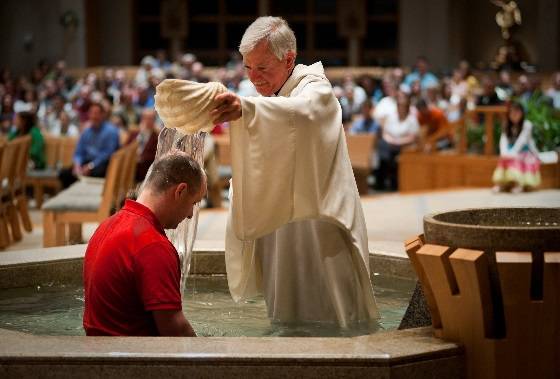
That issue? The order of the sacraments of initiation. Is it baptism, eucharist, and confirmation? Or is it baptism, confirmation, eucharist? For adults entering the Church, the Church says the latter; for children, it’s generally the former.

Why the discrepancy?

Why so many different understandings of Confirmation?

Where did confirmation even come from?

Why do some dioceses have different rules about this order?

These questions, among others, are the reason that I have jumped up on my soapbox this week for a very long, very complicated, and very controversial episode of Catholicism in Focus. While I strongly believe that the Church is a sacrament of salvation, I also believe that human decisions within the Church are not always the most systematic or consider all of their implications, and sometimes, unknowingly, lead us to a place we never intended to end up. When we’re able to look to history and understand the origins of our sacraments and how they developed, it’s clear to me, at least, that we might just need a course correct. Whether you agree or not, hopefully this video will help your own understanding of this complicated story!

https://youtu.be/zluubyIRbI0

I think it’s safe to say that 16-year-old me would be very surprised to see what 28-year-old me is doing these days. Nowhere on my radar was the idea of joining religious life or becoming a priest. The thought of going to college for religious studies would have been preposterous. Heck, at 16, getting me to Church and enjoying it would have been almost unimaginable. And as for social media… WordPress was less than two years old and there weren’t too many “bloggers,” Facebook was a year old and not open to the public, Youtube was in its first year and mostly unknown, and neither Twitter nor Instagram existed. My life has amounted to things that I could not even have conceived of at the time.

And yet, here I am. What a journey it’s been with God so far. As I share in this week’s video, the road was not always straight and it wasn’t always lead with the greatest intentions. God had a way of guiding even my most selfish decisions to work out for the glory of the kingdom.

It’s because of this that I have a very simple lesson to teach from my journey: start doing, figure things out later. While I don’t mean that we should be reckless or thoughtless in our actions, I think we put way too much trust in our own ability to shape our future and not enough trust in God’s ability to shape our decisions for good. It is certainly important to take discernment seriously and prayerfully engage the questions of our day, but too often we worry about finding the “perfect” answer that we never act at all. Truly, I believe, God would prefer that we be running in the wrong direction than sitting lifeless, worried about which direction to go. Sometimes, we have to just start running and let God change our direction if necessary.

When I talk to Catholics “of a certain age” who have either left the Church or wish to return to the Church of their childhood, the practice of abstaining from meat on Fridays—or more accurately the Church’s decision to abandon the practice—comes up with an interesting regularity as to one source of their dissatisfaction. (For those unfamiliar, Catholics used to abstain from meat every Friday of the year, not just during Lent, and it became a strong social marker of one’s identity as a Catholic as it brought us together for fish-frys and separated us from Protestants who did not follow the practice.) Longing for the days of old and disillusioned that the Church could just change what was considered a sin depending on how it felt, this devotional practice remains a point of contention for them.

Frankly, I find the issue to be very complicated and absolutely fascinating.

This week, I’d like to start with the video itself and expand on it. If you haven’t had a chance to watch this week’s Catholicism in Focus, placed above, take a minute to catch up on that before continuing. Don’t worry, I’ll wait.

Okay, great. What’d you think? Actually, no, nevermind. Moving on.

As I showed in the video, the Church did not abandon the practice, as some think, but actually sought to grow deeper in its penitential acts on Fridays by—get this—treating us like adults and letting us make decisions for ourselves! Instead of just “obeying the law of the Church,” Pope Paul VI wanted us to obey the law of our hearts, prayerfully listening to the Word of God and putting our faith into practice in a personal way. For a world that wants to personalize everything and only do things that we’re passionate about, he was ahead of his time.

There is also a sense that no matter what he did, all that was being changed was a discipline of the Church, the lowest level of Church teaching. To leave the Church because of or spend too much time complaining about a changed discipline suggests to me that many did not quite understand the teaching of the Church. This was not a radical move in which everything was now on the table and it was only a matter of days before Jesus was going to be declared “only human” or the Eucharist “just a symbol”; unlike Dogmas that cannot change and Doctrines that develop slowly over time, disciplines can and should change as our Church and world changes, ever reflecting the faith of the people in a current situation. In this case, the overall spirit of the Church remained the same, in continuity with the whole history of the Church. Only the specific practice changed.

Unfortunately, what resulted from this decision was not what he intended. For the most part, people just abandoned the practice altogether. As a result, there is definitely a sense that something has been lost in the process. While on paper it was both “fitting and right” to change the law, something the Pope had the authority to do and in the best interest of the faithful to help us grow deeper in Christ, one has to wonder if it was ultimately the right decision: although not free to choose the practice, at least people were doing something before, and in doing so, we formed a valuable corporate identity in the process. For better or for worse, there was an ethos to being Catholic prior to 1966, a common sense of identity through uniform practice. Sure, it may not have meant much to many people, just a law to be arbitrarily followed without much understanding of the reason, but it was something we did together. Through mutual submission to a common action, it formed something greater than oneself and brought people together.

Ultimately, this is what our Sunday worship is supposed to do, so it is not as if we no longer have a corporate identity at all. And doing something that is meaningless or even detrimental to one’s faith in the name of community is not spiritually beneficial. But it does raise an interesting question: might we have lost something in the process worth recapturing? In the search for more personal meaning, might we have sacrificed the equally important sense of togetherness? I’m not suggesting that we return to the practices of 1965 or that we arbitrarily impose new rules on the faithful just so we can do something together. I’ve been through novitiate… I know that that doesn’t always go well. But I am suggesting that we take this issue seriously. Let’s recognize that something truly was lost in 1966, and make sure that it was not lost in vain. Our practice may have changed, but the Tradition that guides it has not. Maybe this Friday will be the week that we take up our crosses again. Maybe we’ll even come together with a friend or in groups to do something together.