A little while ago, I was talking with someone about how the Church cares for the poor, works for justice in our world, and does all that we can to promote peace. I said that we do these things not because we’re “do gooders” or hippies, but because it is our responsibility as Christians.
I forget the context of the conversation, but it was a pretty standard response to whatever was asked, straight from Catholic Social Teaching 101. I will never forget the response:
But why should we care about this world? If we believe in heaven, who cares if people are poor or die? Shouldn’t our only focus be on getting souls into heaven?
Rarely am I caught off guard by a question, but this one certainly got me. I could see what the person was getting at, I could see why they would ask this, but there were just so many problems with that way of thinking that I didn’t know where to start. Luckily I have a good internal filter and regrouped, because my first thought was, “So, are you suggesting that we just mercy kill everyone who has a tough life so that we can ‘send them to heaven?'” That would not have been a pastorally appropriate response.
I can’t remember exactly what I said at the time, but it got me thinking, theologically, how to best answer this question. In this week’s Catholicism In Focus, I offer three reasons why we care about protecting life, and really, the entire physical world:
1. Creation was created by God, it is good in itself, and is a vessel for experiencing God.
2. The human person is more than just a “soul” or spiritual body, but is fundamentally a physical being.
3. Salvation is not simply an other-worldly experience, one completely removed from our reality.
Is this a complete list? By no means. But I think it offers a foundation for a Catholic view of the world that must be behind everything we do. Unless we accept these three points as a basis for our faith, we might struggle to understand much of what we do and why we do it, leading us to ask tragic questions like, “Why should we care about life at all?”
When does the Mass begin? It might seem like a silly question, but liturgically, there really isn’t a clear answer. If we say that the sign of the cross by the priest is the beginning, then does that mean that the opening hymn and procession really weren’t the Mass? Well that’s not good (and probably why presiders shouldn’t start “we begin in the name…”) So, what if we say that the opening hymn is the beginning? Well, a few problems. For one, a hymn technically isn’t required, so, at some masses that would mean that mass never officially begins… Besides this, it still ignores the important things that happen before this point—blessing ourselves with holy water, praying silently in our pew, greeting those around us.
To answer this question, it can be helpful to ask a more general one: what is the purpose of the Introductory Rites in the first place? The answer to this question is obviously to gather us in and prepare us for what is about to happen: we join our voices together, greet one another, call to mind our sins, give God praise, and declare our intentions through a singular prayer. Beautiful and important in themselves, for sure, we can see that none of these acts are necessarily the reason we come to mass, but rather prepare us for that purpose.
So, if the point of the Introductory Rites is to gather us in and prepare us for what is about to happen, when does the Mass begin? Some will suggest, and I tend to agree, that the Mass begins when we leave our homes and start our journey to the church. From the moment that we make it our intent to go to church, leaving our lives and secular responsibilities behind for a short while, we being the process of gathering together and preparation needed for the Mass. Those individual journeys we all make are our own processions to the altar.
The reason I find this a significant question to ask is because it changes our whole approach. If we believe that the Mass begins with the sign of the cross, then we might be tempted to skip the song, to not care about reverence in the Church, or to simply act inappropriately walking in the church. But if our mindset is different and we view the entire journey to the church as part of the Mass, think about how different our experience will be in the car, in the parking lot, walking through the doors, greeting those around us. These actions are not just normal, ordinary, boring events, but the very act of communion.
What causes someone to convert? Who has the ability to inspire another to leave their old life behind and take up the cross as a disciple of Christ?
Okay, yes, the Holy Spirit is ultimately the only one who can do either of these things. But I mean besides God: who are the most effective evangelists?
At one point in my life, I would have looked to our public figures, people like Bishop Robert Barron, Pope Francis, James Martin, Mike Schmitz, and the #MediaNuns. Being sort of “experts” in their fields, devoting their lives to evangelization, and reaching thousands (or millions) of people, they seemed like the obvious choice.
But I’ve begun to wonder: are they really? Do these, say, 10-20 elite evangelists, the most recognizable public figures, actually account for the thousands of people who enter the Church each year? Is this handful of people the reason that so many begin to question their lives and look for something more?
Honestly, I don’t think so. As good as their work is (and as much as I would like to see more people like them) I don’t think that they have anywhere close to the same impact as the collective work of regular believers. In simply living their Christian lives with hope and love, there are millions upon millions of people giving witness to the faith everyday. In the way they act, what they say, and how they treat others around them, they represent the faith of Christ to far more people than any social media evangelist could.
But this isn’t necessarily always in a positive way. When I say that the regular believer represents the faith of Christ, sometimes it is through a bad example that drive people away from the Church. I hear it all the time: “Christians talk about love but they don’t live it.” More than anything an official teacher of the Church could say, a bad experience at a parish or with an individual Christian can be all that’s needed to imprint a negative view of our religion on someone, keeping them away from faith for their entire lives.
It’s because of this that I offer my reflection this week in the form of an exhortation: please take seriously how you represent Christ and the Church in your life. You, more than anyone else, have the ability to evangelize the people around you. You, more than anyone else, have the ability to alienate the people around you from the faith. The world is watching. What do you want them to see?
Everyone knows St. Francis of Assisi and St. Anthony of Padua. They’re arguably the most famous saints in the history of the Church. Most people know of St. Clare, if for nothing else, that she was associated with St. Francis. And all throughout the world, the name Padre Pio has become more and more popular after being canonized a little over a decade ago. When most people think of the Franciscans, these names come to mind.
But… we’re an 800 year old movement. We are by far the largest religious family that has ever existed in the Church, and we’ve had some holy people along the way. Surely we have more than four saints, right?
Coming up with the exact number was hard to find (typical Franciscans, right?). If you include all of the saints who were professed as Secular Franciscans before becoming associated with another Order, the number is around 177, but even conservatively estimated, we’re well into the 100s.
That’s a lot of holy men and women. And I think we should remember them. In this week’s video, I’ve selected seven Franciscan saints that I think everyone should know, and offered my take on the holiness of our charism. If you stick around to the end, you might even get a quick joke at the expense of the Dominicans (no offense Dominicans!)
Going to church… can be a bit boring. Look out into the congregations of many churches and you will not find hoards of smiling faces, upbeat and excited about what they are doing. No, quite unfortunately, you will find many dour faces and low energy. The problem is so common, in fact, that Pope Francis even addressed it in one of his apostolic exhortations, bemoaning the loads of “sourpusses” he sees coming up for communion.
What a tragedy!
For me, there is nothing more life-giving in all the world than the community gathered for this sacrificial meal. It is the “source and summit” of our lives as Christians, the inspiration and strength we need to go out into the world. Catholics do not attend mass simply to get into heaven, as if it were something to be endured before we received our reward; no, we attend mass because it is a small taste of heaven itself. For those who know what is happening at the mass, it is the highlight of their week.
And I think that’s the key: “for those who know what is happening.” When you know what is happening, when you can follow the internal logic of the rite and can enter fully into the mystery before us, the experience is anything but boring. While the execution of the rite (stylistic choices, skill, personality, ability to follow rubrics) can obviously have an effect on the congregation’s experience (there are such things as bad presiders and choirs…) the Mass itself will always give life to those who understand.
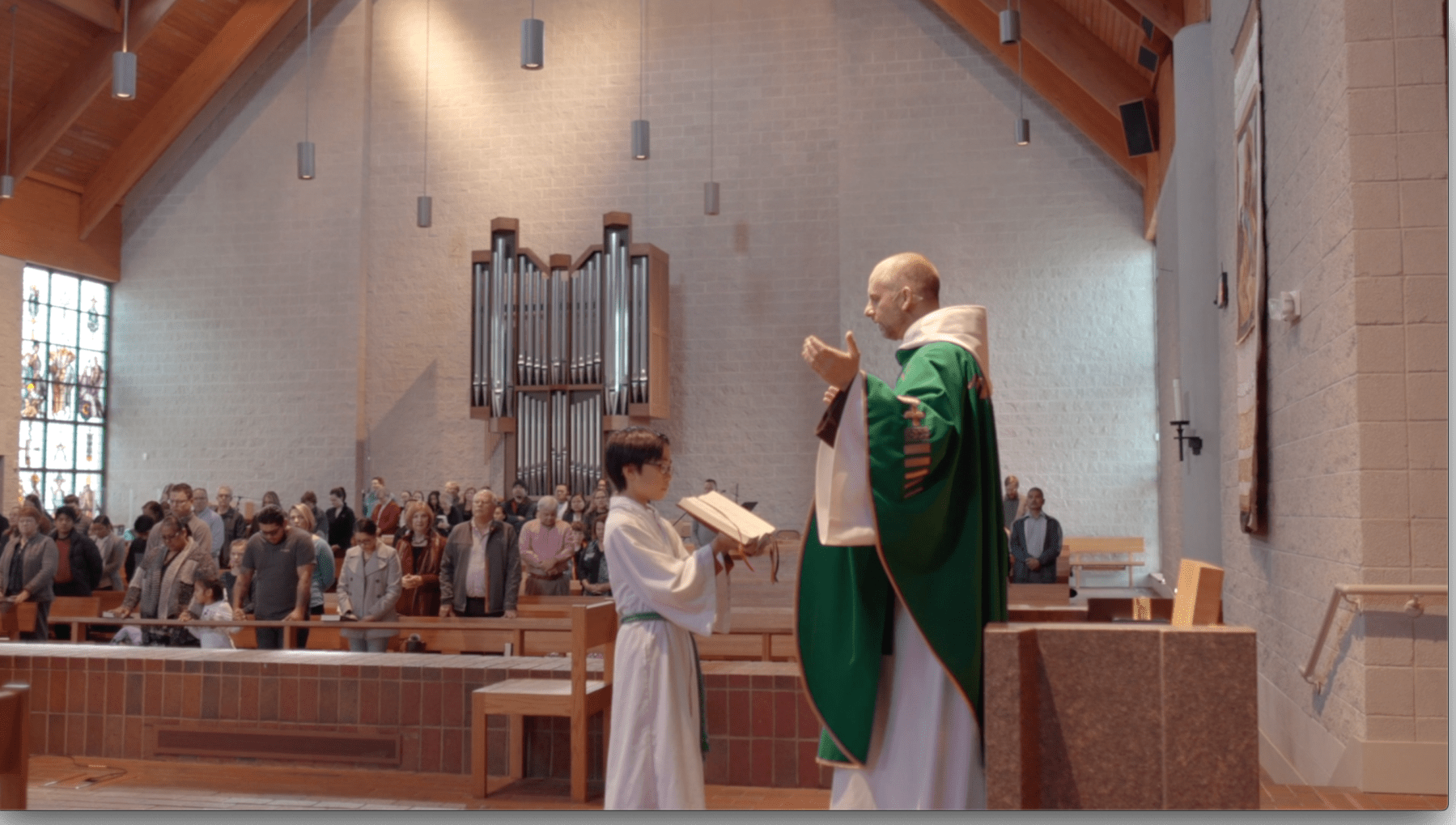
And since I cannot fix every presider and choir or force every parish to be filled with joy and energy… the only thing I can do is shed some light on the rite itself, hopefully instilling in others the same love for the Mass that I have. With this series, my goal is to break the whole liturgy down to its individual parts, explain what each mean, and put them back together to reveal a coherent, artfully crafted act of worship that gives glory to God.
There are many ways that this can be accomplished. Some would explain the Mass in two parts, separating the Liturgy of the Word and the Liturgy of the Eucharist; others would build the series around the three processions found in the mass; others still might focus entirely on the complexity of the Eucharistic prayer, breaking that down into four parts, with the Liturgy of the Word and Concluding Rites as bookends. All of these would make for fine explanations of what is going on in the rite, but they are not what I have chosen.
This series will be divided into six parts, a double series of three, following the same structural arc: Called in and prepared, Given a gift, and Sent out.
Beginning first with the Liturgy of the Word, the first arc will begin with the gathering, call to worship, penitential rite, gloria, and collect. Through this series of actions, the congregation will be called in from their disparate lives and prepared to enter the worship. This will give way to the reading of Scripture and the recitation of a psalm, reaching its pinnacle in the reading of the Gospel. In this way, the congregation will be given the gift of Christ’s true presence in the Word. Bringing the first arc to a close, the homilist will make sense of what has been given, offering practical applications for lessons, and the congregation will respond with the prayers of creed and prayers of the faithful. All three components focus the attention of the congregation to the outside world where they are sent out to live what they’ve heard.
The structural arc will begin again with the preparation of the gifts, in which the congregation literally prepares for what is coming next: they not only prepare the altar for the physical sacrifice, but prepare their hearts for a spiritual one. The Mass then reaches its high point in the Eucharistic Prayer and reception of communion, in which the congregation is given the gift of Christ’s very presence in sacramental form. Having received this gift, the congregation has not just eaten a meal, but has become what it received: they constitute the body of Christ themselves. In this way, then, they are sent out to live as such in the world, announcing the Good News with their lives.
Called in and prepared, Given a gift, and Sent out.
Obviously, the Mass is a complex act of worship filled with more rubrics, history, and symbolic significance than can fit into a six-part series of 10 minutes videos. In preparing for this series, I read multiple Vatican documents, three different commentaries on the mass, consulted liturgists, and built upon my four years of theological study. Regrettably, there was a lot that I had to leave out, and decisions had to be made as to what to keep in. This series will not be the end-all-be-all of mass commentaries, nor will it be without its own flaws and personal biases. Since I had to choose what to include and what to leave out, this series, like any project, will ultimately be incomplete.
And I’m completely fine with that. My goal in sharing this work is not to provide the most complete, objective recitation of facts possible. No, my goal is to share the love that I have for the liturgy so that others may have faith. I do my absolute best to stick to the facts, never outright sharing my opinion on any topic, but there’s no question that my own experience and theology is behind the whole creative process. This series is about telling a story, not about reciting the official rubrics one by one. My hope is that, in sharing my passion for this great communal worship and offering the foundation for its logic, that others will be inspired enough to study the documents themselves and come to their own conclusions of what each part means, why they’re important, and how to share that experience with others.
If that sounds like something you’re interested in, or maybe something that would benefit someone else, I encourage you to join me each Friday for a new installment.



 Breaking In The Habit