Click here to listen

In the movie Dumb and Dumber, there is a scene in which the two main characters weep uncontrollably while watching television. On the screen, we see two children carrying bags, united with an older male figure, walk towards a house as the camera slowly zooms out. One of the children is heard saying, “Do you think he’ll let us stay?” It’s clearly a touching “happy ending” to a sad movie.

Until the scene ends with the logo for Pacific Bell and a narrator promoting the company. What they were watching—and weeping uncontrollably to—was a commercial.

The movie is, of course, a complete farce, and this scene further highlights how “dumb” the two characters are; they are completely out of touch with reality. And yet, what makes this scene so funny is that I think it resonates with each one of us: we know what it’s like to get sucked in by an emotional commercial.

It’s sort of a remarkable feat, isn’t it? Commercials have less than 30 seconds to introduce characters, develop a plot, and resolve a conflict, and yet can tell some amazing stories. Many make us laugh. Some can actually be quite profound.

And all of them are trying to manipulate our emotions in some way.

That’s what Br. Tito and I decided to discuss this week on our podcast, Everyday Liminality. Looking at some of our favorite—and least favorite—commercials, we look at the power ads wield over us and suggest that we should always be on our guard for the tricks companies try to use against us.
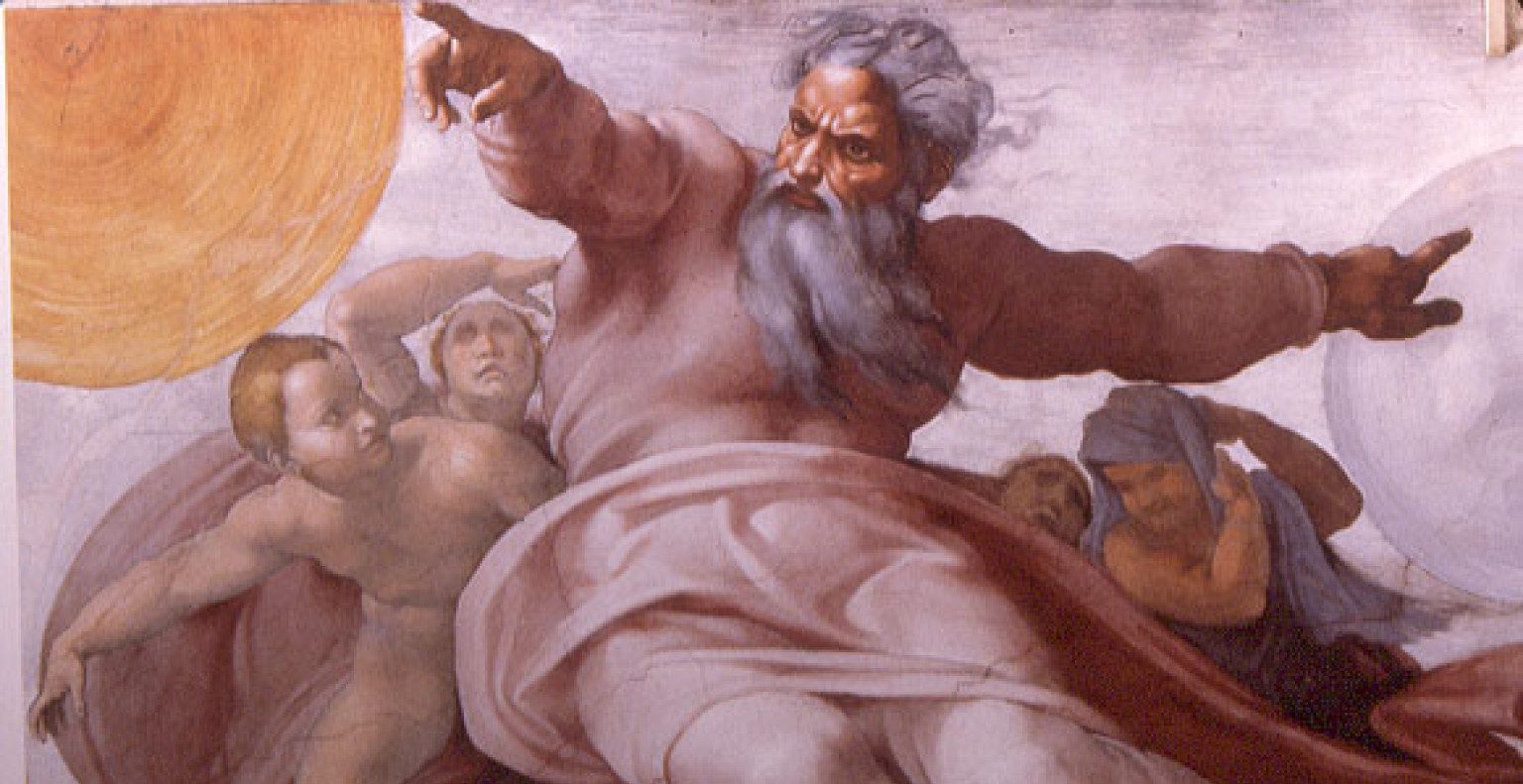
In the early Church, some proposed that the Old Testament be entirely removed from the canon of Scripture, stating that it had nothing to do with the call to follow Christ. Some, taking this to an extreme, believed that there were actually two gods in the Bible: the angry, evil God of the Old Testament that created the world and tortured creation, and the loving, good God of the New Testament who came to set us free from the tyranny of creation and save us from the angry God.

Naturally, both of these stances were condemned as heresies, as there is but one God, but there is a part of me that thinks that these ideas live on even today. Ask yourself: would you prefer the God of the Old Testament or the God of the New Testament? If you think you can actually choose… we have a problem on our hands. They’re the same God.

But most don’t see it that way, at least not implicitly. Even among faithful Christians, there is this innate sense that the Old Testament God is angry and wrathful while the New Testament God is loving and merciful. This is not only unfortunate, but a complete misreading of the Bible, and something that I want to address in this week’s Catholicism in Focus.

Click here to listen

When I was growing up, my parents had an interesting perspective on what we were allowed to watch: some violence was okay but not a lot, nothing with sexual content, and as longs as it didn’t use the “f-word,” the language wasn’t a big deal… as long as we promised not to repeat what we heard.

For the most part, I think it worked out pretty well! With the exception of accidentally saying a swear word to my friend’s mom (not knowing that it was a swear word!), I can’t remember either of my siblings getting in trouble for bad language. Hearing swear words did not seem to have much effect on us.

Over the years I’ve thought a lot about this approach, and even the very idea of “bad” language, and wondered… is it really the best to take with kids?

Now, naturally, I have no intention of actually critiquing my parents, one, because their job was harder than anything I will ever do, but two, because they read this blog and I still want a place to stay over holidays. So, yeah.

But that’s not to say that Br. Tito and I don’t have opinions on the matter. In this week’s episode of Everyday Liminality, we look at the power that language has to both express and shape our world, suggesting that we should be careful how we use our words. Of course, the reason that we think this is probably not what you think, as it has little to do with being polite or avoiding sin…

On October 14, 2018, Pope Francis canonized seven new saints, including one of my favorites, Oscar Romero. Romero was one of the first Catholic figures that truly inspired me, playing a significant role in my growth as a young Catholic, and I, like the people of El Salvador, had considered him a saint long before Pope Francis made it official. His life was exemplary in the way he heard the cry of the poor, allowed their pain to change his life, and turned around to be a prophetic voice for justice, leaving his own life behind. Like Dorothy Day a few decades earlier, I did not have to wait for the Church to tell me of his holiness; his commitment to the life of Jesus spoke for itself.

But it does raise an interesting question: how does someone go from being a holy person venerated by a small community to a universally recognized saint? In the early Church, saints were canonized by popular devotion—if their cult of following was great enough and their reputation endured, the Church accepted it. Naturally, this could not last forever, and in the 6th century, the Church began to require the investigation of the local bishop to approve devotion. By the 10th century, eyewitness testimonies began to be required, biographies were written, and a more formal process of canonization began. In 1588, with the reorganization of the Roman Curia, an administrative body was established to oversee, among other things, the recommendations for canonization to the pope. The process continued to grow in strictness, with the 1917 Code of Canon Law compiling 145 separate canons on the causes for canonization, only to simplified in 1983 with the current code, leaving us with what we have today.

Which is…?

A five (or so) step process including death, investigations, voting, and numerous titles, all of which is outlined in this week’s Catholicism In Focus.

And while this is all very interesting and no doubt important, I do want to leave it with one final thought. As beneficial as it is to have an official list of saints, verified and assured by our leaders, we mustn’t diminish sainthood to those canonized. Each and every one of us is called to be a saint, for a saint is merely one who resides for eternity in heaven. The Church may have 10,000 or more who are officially recognized, the actually number of people in the presence of God is astronomically higher. Regardless of whether or not we are every universally recognized, it should be our goal, each and every day, to grow in holiness like those we call “saint,” and to one day reach their level of holiness in Christ.


Longtime followers of Breaking in the Habit will know that the relationship between science and religion is an important topic for me. While I have never considered myself a “scientist,” I have always had a great interest in the knowledge that it shares. If everything is created by God and God gave us the ability to reason, then studying the word empirically (with our senses) cannot contradict or undermine anything that we believe by faith, it can only make our faith stronger.

Unfortunately, scientific literacy is not very high among Christians. Time and again I hear faithful and well-meaning people share an understanding of a scientific concept that is completely incorrect, exhibit apprehension towards scientific inquiry, or outright reject it as a field worth studying. Even among some of our Church leaders, those with graduate degrees in Theology, given great authority over others, I am often disappointed in the misunderstandings of science that influence their decisions.

While Catholicism in Focus is a show focused on theology, its scope must at times include historical, literary, and yes, even scientific topics. Not being a science teacher myself (or particularly all that trained in the field!) I cannot speak intelligently on many issues or with great depth, but it is my hope to help raise the bar a bit with some basic overviews (and to provide links to scientific explanations far better than mine.)

In the past, I’ve talked about the common myth we all accept of Galileo as well as the Big Bang Theory, and today, I present a video on the topic of evolution.