Identity

The following is the fourth installment of a seven-part lenten blog/video series sponsored by Franciscan Media. For the previous reflections, click here. For those subscribing by email, click here to watch the video.

Guilty by association. While a concept that does not stand up in a court of law—one cannot be charged with a crime simply by being associated with a criminal—we know that it is a very powerful force in the court of public opinion. When someone does something bad, the moral character of everyone around them is called into question.

No clearer example of this can be seen than that of social groups in high school. Cliques. Despite the fact that each and every one of us is a unique set of thoughts, feelings, and actions, transcending simple categorization or affiliation, we cannot escape the corporate identities we take on. Nerds. Jocks. Preps. Partiers. Liberals. Conservatives. Religious. And so on. In our association with others—superficial or meaningful—our individual identity is unavoidably and irreparably shaped by the people around us: like it or not, who they are, how they act, and what people think of them will tremendously influence what people think of us.

While our lives as followers of Jesus cannot fairly be compared to a high school clique, the effect it has on our identity is spot on.

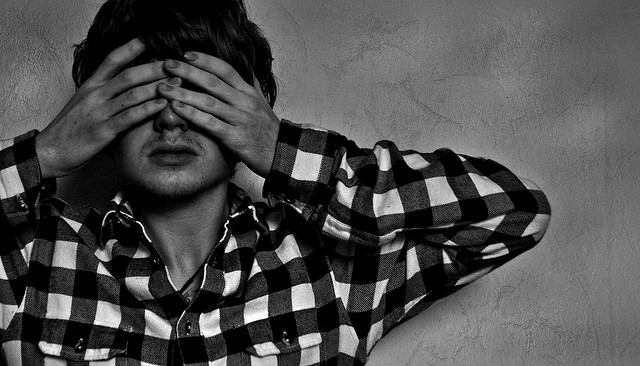
In our Gospel reading this week, we hear of a man born blind. Blind since birth, everyone has assumed that he is so because of sin, either his or his parents. Jesus does not agree: the man was born blind in order reveal the glory and power of the Father. Spitting into the ground, he forms a muddy substance—truly getting his hands dirty in the man’s life—and smears it on his eyes, an act that one would expect to further inhibit sight. Instead, in a miraculous gesture, Jesus gives the man the ability to see, symbolic of the light of faith that Jesus brings to the world.

And while that is extraordinary in itself, the most interesting part of the story is what comes next: Jesus disappears and lets the formerly blind man be the protagonist. Interrogated by everyone around him, his identity, moral standing, and allegiance are all called into question. Who are you and where did you come from? How was this miracle performed? Do you accept our authority as Jewish leaders? There the man stands, with Jesus nowhere to be found, taking on the exact ridicule and questioning that Jesus faces all throughout the Gospel of John. It’s as if the man is standing in for Jesus. It’s as if the man, in some strange way, now represents Jesus in the world, taking on the identity of the one who healed him…

The story of the man born blind is meant to typify the experience of the anyone who is given the light of faith to follow Jesus. For those who enter the faith and bear the name ‘Christian,’ not only are they able to see in ways they could never see before, they unavoidably adopt everything that goes along with Jesus’ identity. A Christian, we could say, is not just one who likes “the Christ” (from the Greek christos meaning “anointed one”), but is in fact one who embodies all that the Christ does, receives the Christ into their being, and then goes out into the world as Christ themselves.

In other words, the story of the man born blind is the story of our baptism.

When we enter the font and cleansed with water, our old way of life—our blindness—is washed away. In an act of miraculous grace, we are touched by Jesus and given grace upon grace, called from an experience of death to new life.

But that’s only the half of it.

After leaving the font a new person in Christ, we are anointed by the priest with oil on the crown of our head. Yes, in the image and likeness of the true anointed one—the Christ—we are crowned with oil and anointed into His identity and mission. Although essentially the same person we were before, with the same unique set of thoughts, feelings, and actions, our association with Jesus and the indelible mark that He puts on our soul forever changes our identity: now, not only free from sin but marked by Jesus, we enter the world in the image and likeness of the one true Christ. After our baptism, we are nothing less that “christs” in the world, called to live out His threefold ministry of being priest, prophet, and king.

That is what we celebrate during Easter and what we prepare for in Lent. While it is a season of prayer, fasting, and almsgiving, a season to focus on our sinfulness and call upon God’s mercy, our ultimate focus in this season is to call to mind the identity we share in Jesus and to prepare ourselves to renew our baptismal promise to be who Christ has anointed us to be. Like it or not, when Jesus touched us and gave us the light to see, we became guilty by association, defined by and treated in the way that He is treated: Glory. Love. Ridicule. Confrontation. Praise. Persecution. Death… and Resurrection.

Distorted

The following is the first of seven weekly Lenten reflections written and produced by Br. Casey and sponsored by Franciscan Media. Each Friday, a new blog post and video will be published here and on Franciscan Media’s blog. Feel free to share these reflections on social media, and check out all that Franciscan Media has to offer! 

Pleasure. A delicious meal of our favorite food. . .  a beautiful symphony at the theatre. . .  a hot shower after a long day in the cold. With five senses and billions of nerves in the human body, there are an infinite number of ways to experience pleasure from the world around us. What a wonderful part of the human experience, am I right?

A little over a century ago, the prevailing moral norms of Victorian culture would not have agreed. Closely associating pleasure with sin, leaders sought to remove pleasure completely from normal life. If it felt good, they thought, it was morally bad. Pleasure was from the devil. Adherents avoided meat and filled themselves with bran and coarsely ground wheat flour; sleep was often brief and interrupted; exercise was regular and excessive; clothing was restrictive and covered as much as possible; and anything that might lead to carnal desire was removed from their routine. In every way possible, pleasure was to be avoided, repressed, and mitigated, and replaced with austerity and denial.

Now, far removed from these external practices (and arguably on the other end of the spectrum), I can’t help but wonder if the mindset of that age still has a hold on us. Even in the midst of a pleasure-seeking culture today, I get the sense that many people still associate pleasure with sin. There is a part of us, I think, that still feels guilty when something is too good.

Is pleasure really from the devil? Is it something that we should be concerned about?

For an answer to this, I look to one of my favorite books of all time: C.S. Lewis’ The Screwtape Letters. Imagining a corporate world of demons whose sole purpose is to lure people away from God, the book consists of 31 letters of advice from an experienced demon to his nephew, offering insight into the human experience and tips as to how the young demon can best tempt his assigned human. In one such letter, Screwtape, the experienced demon, offers a discussion on pleasure and how it might be used to exploit the human, but also warns against it:

“Never forget that when we are dealing with any pleasure in its healthy and normal and satisfying form, we are, in a sense, on the Enemy’s [God] ground. I know we have won many a soul through pleasure. All the same, it is His invention, not ours. He made the pleasures: all our research so far has not enabled us to produce one. All we can do is to encourage the humans to take the pleasures which our Enemy has produced, as times, or in ways, or in degrees, which He has forbidden. Hence, we always try to work away from the natural condition of any pleasure to that in which it is least natural, least redolent of its Maker, and least pleasurable.” (The Screwtape Letters, Letter 9)

In other words, the purest form of every pleasure—that which is most original and most pleasing—is actually from God, and is quite good; what the devil offers us are easier, cheaper knockoffs that are only a distortions of the gifts we have been given, and eventually leaves us dissatisfied. Things like food, drink, reputation, power, money, authority, pride, comfort, and yes… sex, are all gifts that originate in God and are in fact good in themselves. But sometimes, rather recognizing that these great things come from God and have been given to us to share for the sake of the world, we can seek them solely for the sake of pleasure, separate from an experience of God and at the expense of healthy relationships. Nothing the devil offers us can ever be better than what we are already offered by God.

As we begin Lent and enter into a period of sacrifice and simplicity, often giving up some of the pleasures of our world, I think it is important to keep this truth at the center of our focus. When we sacrifice things during this season, we do not do so because pleasure is bad and we need to purify ourselves of it. We sacrifice things so as to restore what has been distorted in us, to strip ourselves of the bad habits we’ve created and the false truths we’ve accepted so we can return with perfect vision and utmost focus on the one who created the pleasures in the first place. For a moment, we give up all that is extra in our life so that we can truly know and rely on what, and who, is most essential: our relationship with God.

For the next reflection in this series, click here.

Taking a step back from the normal focus of these blog posts, I want to address an issue that may at times seem overly simplistic yet fundamentally important: what is faith?

By its very nature, faith is a rather elusive subject. It is difficult to define, lacks a lot of agreed upon evidence, and is held by people with diametrically opposing opinions on some of religion’s most fundamental qualities. Some people have a lot of faith. Some people have no sense of what faith even is. And that’s just among those who claim to have it.

On the pendulum of perspectives, I find the two poles to be very common, and very dangerous.

On the one end, there are those who will say that faith is something that can and should be proved. What scientific, verifiable evidence does one have the the existence of God? In the group, there is a desire for certainty, a desire to know without a doubt that God exists and what we’re doing is what God wants. Naturally, this is a group populated by agnostics and atheists who find faith absolutely absurd because they have yet to see the credible evidence, but oddly enough, it is also quite common among the strongest of believers: there are people of all faiths who want (and sometimes believe they have) undeniable proof of their beliefs. Expeditions to find the lost ark of Noah; looking for scientists to perform tests on the consecrated host, relics, or the famous Shroud of Turin; sucked in by articles that begin, “Science has unlocked the mystery of…” For people in this category, faith is simply a subset of fact: there is enough evidence to convince you and another of its truth.

On the other end of the extreme are those who believe faith to be something entirely up to the individual, completely independent of objective reality or evidence. I can’t say why I believe, I just know that I’m right. In this group, there is no desire to test what one believes or “has faith in” against the experience of others or empirical data. I believe what I believe, and nothing could ever change my opinion. Faith, then, is simply believing something despite any evidence to support it, an assent to a doctrine or belief simply on principle. For people in this category, faith is simply a subset of opinion: there is not enough evidence to convince you or another of its truth.

Naturally, I find both expressions to be lacking. Faith is by no means a subset of fact, something merely waiting to be proved correct: what would there to have faith in if we could simply know it with scientific certainty? And if faith was simply a personal set of beliefs with no connection to experience or reality, then faith is merely a construct of the individual and has no connection to the lives of others. Surely, neither answer can be correct.

For me, the answer lies somewhere in the middle. There is evidence to guide us in understanding, but not so much on the scientific/certitude level. We have the confessions of others, we have our personal experience, we have a world that points to order and intelligence. Can any one of these things be verified beyond even a shred of doubt? Of course not. Does that mean that they don’t exist. Of course not. Thus, statements of faith are those things for which there is enough evidence to convince you, but not enough to convince another of its truth.

So, do we have evidence that God exists? Yes… and no. That’s the topic of the newest “Ask Brother Casey,” found below or by clicking here.

The last couple days have been… shall we say… grim. Besides the official election of a controversial and volatile president sparking protests and further tearing our social cohesion at the seams, an ambassador was assassinated in cold blood and on live television in Turkey, twelve people were killed at a Christmas celebration in Germany as a crazed truck intentionally drove into the crowd, and the evacuation efforts in Aleppo continue to reveal to the world just how terrible the Syrian situation is. Before that, the State Congress of North Carolina (led by a lame-duck governor) held a secret, surprise session effectively changing the rules of the state before the new electors take office, the CIA and FBI agreed (a rare, unsettling feat in itself) that Russia hacked the US with the intention of swaying the election, and the Vatican’s newly-issued statement about homosexual clergy served only to reignite angry debates in the Church. Oh, and there was of course the 10,000 children of the world under the age of five who died from preventable causes, the 28,000 people in the US who were physically abused, and the 4,600 US residents who were diagnosed with some form of cancer, all of which happen every day.

Yeah, it was a grim day.

If you’re an idealist like me, someone who takes our collective “created in the image of God” seriously and thinks that we’re but one human family, days like these can be extremely troubling. How can there be so much wrong in the world? When days like these happen—when the reign of God seems further away than the day before—I find myself pulled three different ways.

Look away 

Especially this time of year, it can be really easy for me to disengage from the problems of the world. At a time when we’re supposed to be merry and celebrate “peace on earth,” the existence of cruelty, sadness, and downright evil can overwhelm me and ruin the atmosphere of the season. Other times, I’ll admit, I’m just too exhausted to care about anything else—my heart simply can’t handle more bad news. I know that there are bad things in the world, but I can’t do anything about it but weep, and so all I can think to do is look away. Turn off the news. Sign out of Facebook. Don’t read the newspaper. Just pretend it doesn’t exist.

Give up

At the same time, there is a part of me that can’t look away… but also can’t do anything about it. I’m a silent, helpless spectator watching a car crash. At these times, there is a strong temptation to resort to cynicism. The world is messed up. Nothing is ever going to change. What can I really do? Whether it’s enormous, systemic problems like global poverty, or minuscule, petty problems like the unrelenting bad habit of a roommate, my frustration and dissatisfaction can get the best of me and I can be left in a state of emotional and spiritual paralysis, unable to work or hope or live for something better. The only thing left to do is give up trying.

Trust

But there is a third voice that calls to me. Beyond the initial defense mechanisms of denial and learned helplessness, deeper than my gut reaction to run from pain, there is a voice that is not guided by fear, but by trust. In the midst of a torn apart world, it calls to me not to look away, but to let my heart be broken by what I see. When it feels like nothing can be done, it calls to me not to flee, but to go down with the sinking ship. Letting myself be truly moved by the horror of the world—to the point of anger or tears—is not time wasted. It is time spent converting my heart to the heart of God. Refusing to give up in the face of imminent failure—potentially losing something in the process—is not futile stupidity. It is an act of solidarity with those who cannot run away, who cannot give up, who cannot stop trying. There are some who are not afforded these privileges. All they can do is trust. Trust that reminds me that there’s more to the story than I can see and more being down that I can know. Trust that reminds me that, even in failure there are opportunities for growth and love and progress. Trust that reminds me that the world has survived much worse in the past, and yet keeps turning. Trust that reminds me that God created all that is, came to be a part of it, and never left us alone to figure it out.

It is from that trust—something, I will admit, is not always present—that I am able to see through days like yesterday into a greater world. I am able to see that it is this world, our broken and imperfect world, that Jesus chose to come into. Despite the chaos and the disappointments, the tragedies and confusions, the messiness and defects, God chose and still chooses to act in this world. It is tempting to turn away and not look, to give up and no longer try. And I get that. I’m chief among those who shut down when things aren’t perfect. But I also know that when we look away or give up, we fail to see God entering in our midst.

Don’t look away.

Don’t give up.

Trust in the God who is with us.

In the Catholic and Orthodox Churches, Mary the Mother of Jesus has a place of prominence among the saints. Throughout the liturgical year of the Western Church, we celebrate her conception, birth, presentation, annunciation, visitation, motherhood, sorrow, immaculate heart, assumption into and queenship in heaven, and her intercessory power through the rosary; we commemorate her many apparitions throughout history in Lourdes, Fatima, Mount Carmel, and Guadalupe. In all, there are more than 17 feasts and memorials, two months of popular devotions, and countless prayers and novenas devoted to Mary throughout the year.

That’s a lot of face time.

For many Protestants, and even a few Catholics like myself, this can be the source of a bit of heartburn. With the amount of time we devote to her and the elaborate statements we say about her, Mary the “Mother of all” becomes less like us—someone who shared in our experience and so offers us a path to follow—and more for us—a being of heavenly origin with special power and authority to act on our behalf. The existence of the “Co-Redemptrix” movement (the controversial, yet unofficial, idea that Mary was essential to the salvific actions of Jesus), the title of Queen (the complimentary title to that of King, the position held by God), and the replacement of female deities in native religions with the image of Mary, only heightens the concern. As a result, many like myself revere Mary and acknowledge her significance, but do not really have the “high mariology” that is so popular in our Church.

For me the issue comes down to something very simple: I already have a mother. I’m glad that Jesus had a mother, and I think anyone who gave birth and raised our Lord and Savior is worthy of respect, but I don’t need her to be everyone’s mother. I need her to be Jesus’ mother.

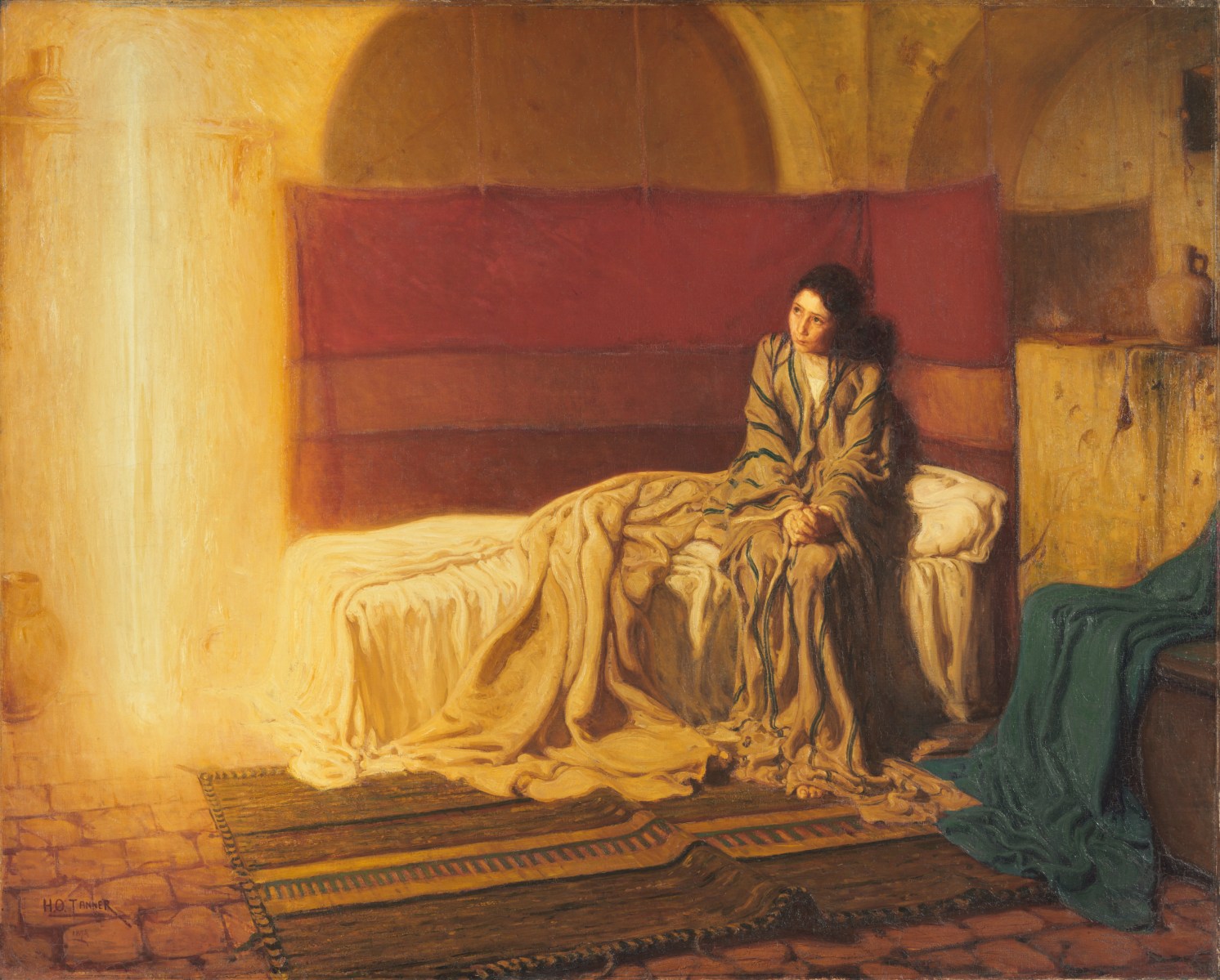
Which is why, I think, my devotion to Mary has grown of the past few years in the season of Advent. Before Mary was seen as the mother of all, before the countless devotions of Mary spread throughout the world, before she was crowned the Queen of heaven, before statues, shrines, effigies, and paintings were constructed in her honor, even before she gave birth to Jesus, the Son of God, Mary was a little girl with a call:

The holy Spirit will come upon you, and the power of the Most High will overshadow you. Therefore the child to be born will be called holy, the Son of God.

There she was, a little girl from a small, insignificant town—a nobody—and through an angel, God was asking her to take part in something beyond her ability or comprehension. “How can this be?”

Like any of us in that situation, Mary was unsure. Like any of us, Mary was afraid. Like any of us, Mary sought wisdom and refuge with family and friends. In remembering her annunciation and visitation, Mary is not the exalted Mother from on high that we so often celebrate today, she was simply a faithful member of a community trying to find her way through the normal difficulties of life. At least in the way she understood herself at the time, she was just someone like everyone else, faced with a big task.

Thus, it is in this season of Advent as we await the coming of our Lord, that a different title for Mary comes alive for me: sister. In these four weeks, Mary is not a queen on her throne to be revered and looked up to, she is a peer to be walked with and inspired by, an equal with gifts and flaws and idiosyncrasies. While the image of “mother” is usually one of reverence or submission, the image of “sister” is a bit more relatable: friendship, rivalry, maybe even conflict. We are reminded in this that her experience is so very much like our own, that what she did in the most significant and literal of way—carrying and making God present in history—we are also supposed to do in our own lives. We are reminded that saying yes to God is not always an easy or safe task, but it can be done. It should be done.

Mary, our sister, shows us so.

That is the Mary that I remember in Advent. That is the Mary that I have a great devotion to. Maybe, like me, the amount of attention the Church gives to her and the elaborate statements it says about her make you feel uncomfortable. That’s okay. Praying the rosary and having a regular devotion to the “Blessed Mother” are great acts of piety, for sure, but they’re not things for everyone’s spirituality. But just because you don’t have that spirituality or are called to those devotions doesn’t mean that Mary can’t be important to you.

We may not need another mother, but we can always use another sister, friend, or inspiration to help us get to who really matters: her son. I can’t think of a better person to have in our lives in Advent.