In a galaxy far, far away… there were a lot of theological statements and themes of life that apply perfectly to our own!
In this extra special (and extra long) episode of Everyday Liminality, Br. Tito and I take a deep dive into the world of Star Wars, looking, as we always do, for an answer to some of our own questions of faith. While the casual observer will undoubtedly sense a connection to the “force,” we think that this intergalactic drama-series actually has a lot to say about hope, pride, scripture, tradition, and our relationship with God.
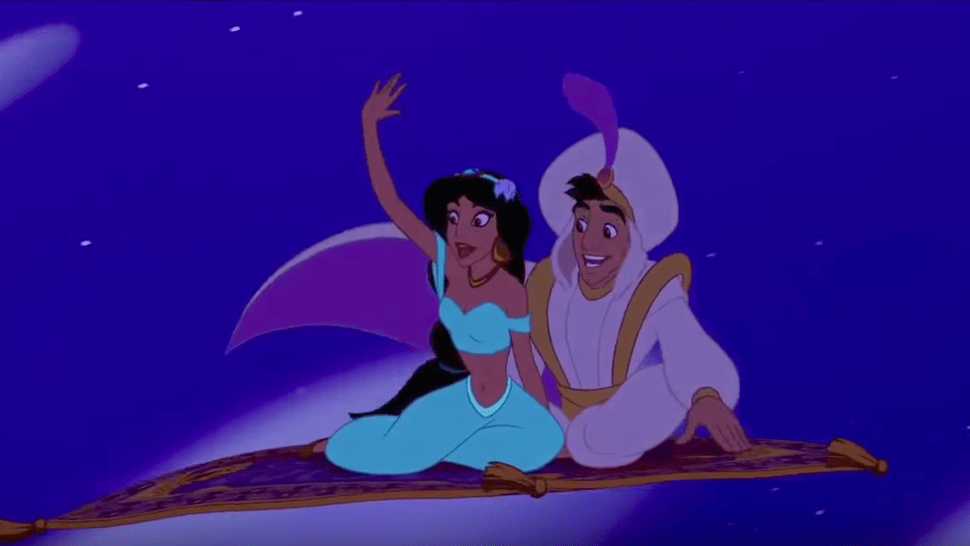
With the new live-action Aladdin movie recently announced, Brother Tito and I decided to revisit the original animated movie to discuss its hero. You know, the guy who lies to everyone about who he is, uses a genie to control the world around him, gets caught in his lies, but then by the end of the movie ends up with the girl, a palace, and tremendous power, all without every showing remorse or saying he’s sorry.
You know, the sort of heroic behavior we want to instill into our kids.
For Br. Tito and I, this is just one example of many of “cheap grace” in entertainment, happy endings and character resolutions that just don’t seem “earned.” The character gets everything they want without changing or making any sacrifices; the horrible things they’ve done are forgiven without contrition or attempt at reconciliation. It’s “forgiveness,” and I guess a “happy ending,” but it’s just not that satisfying.
Real forgiveness, we contend, the sort of forgiveness that flows from the grace of God, is completely free, but it has a cost. It takes time. It takes effort. The reason that “cheap grace” in entertainment leaves us so unsatisfied is because we know that’s not the way the world works. Change does not happen immediately or completely, nor is it a magical property that happens to us without our knowing or willing. It takes sacrifice. It takes contrition.
While our culture may not privilege religion as it once did, Hollywood has not shied away from rolling out a number of big-budget biblical movies in recent years. Why? Because they make money! Darren Aronofsky’s Noah grossed more than $360 million; Ridley Scott’s Exodus: Gods and Kings made over $265 million; and Mel Gibson’s The Passion of Christ? More than $600 million (making it the most profitable R-rated movie of all time!)
And while the profitability of these movies (and the influence that money has on their production) could be a topic unto itself, I bring this up simply to point out an interesting fact about our time: despite the lack of religiosity in our world, secular society continues to make mainstream movies about the Bible. The average person with no background in religion and who never attends church can still know the stories of the Bible by virtue of Hollywood’s interest in them.
Which presents an interesting question for us as Christians: is this a good thing? On the one hand, it’s great that people are taking an interest in the Bible and that our story is reaching people who would otherwise not hear it, but on the other hand, what version of the story are they actually hearing? When Ridley Scott is our evangelist, there’s no telling what people will walk away thinking about the Bible.
This week on the podcast, Tito and I discuss a few notable biblical movies we’ve seen, what we think of them, and how we can go about evaluating the effectiveness of movies in the future.
On our podcast, Tito and I discuss art and entertainment as a way to find greater meaning in the everyday “escapes.” Movies and television captivate so much of our time and imagination that it only seems fitting that it be consumed with purpose.
But there is another, and arguably more influential, form of entertainment that we have yet to discuss: sports. The original entertainment of our world, sports and athletic competitions speak to a primal desire to compete and work as a team. Even more than an ongoing television show with captivating characters, sports touch us on an emotional level and seemingly turn us into different people. Given the amount of time (and money) people invest in particular sports or teams, Br. Tito and I felt it best to make it the topic of show this week.
Why do sports matter so much to people, and what can we learn from them?
I have a friend that only reads non-fiction. He likes biographies, news articles, and reports published in academic journals. Why waste time, he wonders, with things that are not real, with stories that are made up? For him, one should just stick to the facts.
Naturally, I don’t agree with him. Quite obviously, given our previous episodes of this podcast, I find that fiction can actually capture truth in ways that non-fiction cannot, helping us to enter into a reality far from our own to learn something new about ourselves and others. But I think it’s more than that. Not only can fiction capture the truth, but there is a misconception about non-fiction that just because it is “factual” that it is without bias or subjectivity. This is patently false.
Unfortunately, many viewers/readers of non-fiction tend to approach these works of art without a critical eye; they tend to accept what is shown as the truth without reflection because, well, it’s “non-fiction.” In documentaries, for example, one is able to see with their own eyes the primary sources. They can watch the actual events, hear the actual historical figure speak. It must be true, we tell ourselves.
The fact of the matter is that works of non-fiction and fiction—while using opposite approaches—essentially seek to do the same thing: they tell stories to transmit truth. They choose what to be included and what to leave out. They build story arcs, build drama, make arguments, and seek to evoke a response from the viewer/reader. Works of non-fiction may use nothing but factual pieces of information, but in choosing what to present, and more importantly, what to leave out, they inevitably share a truth that is incomplete. No one is able to share everything about every situation that influenced the topic at hand.
That’s where things get interesting, and what Br. Tito and I discussed in this week’s podcast. How do documentaries reveal much-needed truth, but how do they also leave us with more questions than answers?





 Breaking In The Habit