Summer Plans

This about sums it up...

This about sums it up…

All papers and exams are finished, grades are in, and I’m outa here! It’s been a long and tiresome year (with a lot of fruit to show for it, I will add) and it’s on to the next thing. What is the next thing? It doesn’t matter as long as it isn’t school for three months!

Actually, the first all of the friars did immediately after finals were over was to go on a retreat. From Monday to Friday of last week, the seven temporary professed, two directors, and one visiting friar, enjoyed a relaxing and rejuvenating time at PriestField Pastoral Center in West Virginia. Among the least structured retreats I have been on since joining the friars, the purpose of the retreat was less about deep spiritual encounter or conversion, and more about fraternal time and simply processing all that went on in the year. While there was a lot of time for communal and personal prayer, guided reflections and personal quiet time, there was also a lot of time for talking, joking around, having fun, and just enjoying each other’s company. Prayer and quiet are great things, but there’s something to be said about setting up intentional time away from home to be with one’s community in a mostly-prayerful environment. Definitely a great way to end the year.

From there, we’re off to our summer assignments. While we’re not in school, friars are sent to one of our many ministries on the east coast to gain pastoral experience in real-life situations. The process of picking an assignment is very open, and follows a dialogical process: the director meets with the student friar to discuss the desires of the student with the possible openings, the two think and prayer about the best fit for the student, and once a decision has been made, the provincial council is asked to approve or deny an assignment. In almost every case this year each student was given his first choice. You can read about each of the assignments here.

My assignment is at St. Anthony of Padua Church and School in Camden, NJ. It is in a rough part of town (as if there is a nice part!) that is largely Spanish speaking. Those who know me well will note that no hablo Español, and those who know anything about a normally functioning human being will note that I’d prefer not to be shot. Just saying. In any event, despite the obvious drawbacks for the normally functioning human being (oh, and did I mention that the church doesn’t have air conditioning?) I have to admit that this was actually my first choice. Ever since I visited St. Anthony’s back in the postulant year I have been attracted to this community in the way that the friars work with the poorest and the most outcast people you can find (both immigrants and people from New Jersey), live as simply as anyone in our whole province, do incredible work in bringing a broken community together, wear their habits as much as I have seen (not that this is a high criteria, just something I prefer) and they have a dog (and no, this is not secretly the only reason I chose Camden… although I list it for a reason.)

I’m not entirely sure what I’ll be doing throughout the summer, but I know that I’ll be busy. The church has a community garden, a house for AIDS patients to come for food and the dignity of touch/friendship, an active youth leadership group that empowers students to take action in community government, and services to the poor, not to mention the regular activities such as bible study, faith sharing, and liturgies.

With all that said, the real reason I picked Camden was its ministry of presence. As odd as it sounds, I am looking forward to being in place where I have to struggle to communicate, where I will be with the less-than-popular people in a less-than-glamourous town living a simple, even dirty lifestyle. I am sure that there will be a lot for me to do, and I look forward to all of that, but what I am really looking forward to is simply being present to a people and place that has so much to teach me.

But before all of that, there is something much more important to be done: vacation! I’ve chosen to split my two weeks of vacation in two, taking one week starting tomorrow and one week in August before school, both of which will be in Raleigh, NC with my family. I’m not sure if I’ll find the time or inspiration to write while there, but check back throughout the summer for what I hope will be rich (and more frequent) reflections! Please keep me in your prayers!

We Are in Need of a Good Shepherd

This weekend I was in Raleigh, NC giving a reflection for Vocation’s Sunday and Franciscan Formation weekend as an attempt to raise interest in and support for the friars, the shepherds of so many. I ask that you take these petitions seriously, that you may follow Jesus more closely and in return, share with others what Jesus has given you.
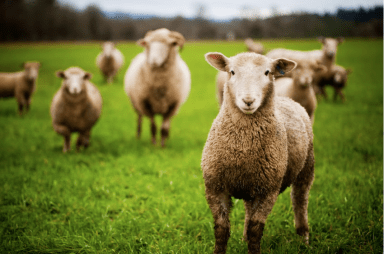
Without a shepherd, the sheep are lost.

Without a shepherd, the sheep are lost.

Sheep are interesting creatures. Born without horns, claws, strength, speed, or really any way of defending themselves, the only thing sheep have is each other: when frightened, they clump together as a giant flock protecting each other through a strength-in-numbers technique. Their instinct to look to one another for safety is the very thing that keeps them safe; unfortunately, and quite ironically, it’s also their greatest danger. Sheep are natural followers, having no instinct whatsoever to lead. When clumped together, any movement from the heard is interpreted as a sign of leadership and the rest blindly follow along. It’s no wonder, then, how sheep have been known as entire flocks to walk right off a cliff.  In turkey a few years back, 1500 sheep ran right off a cliff, one after another. How could an animal be so stupid, we wonder. They act without thinking, are often lost or confused, and go with the crowd because they’re afraid to be different.

You wouldn’t happen to know of any other animals like this, would you? I wonder… Have you ever intended to do one thing and ended up doing another; got distracted with what you were doing, went with the crowd, and ended up somewhere you never wanted to be; have you ever been tempted to do things that were not good for yourself or others, led astray by something or someone that didn’t care about you? We can be just like the sheep sometimes, can’t we, wandering through life looking for help in all the wrong places.

We are a people in need of a Good Shepherd, someone to guide us and protect us.

Luckily, we have one: his name is Jesus, and he has risen from the dead, alleluia! He is the Good Shepherd because he knows his sheep and cares for them. He loves his sheep so much that he gave up his place in heaven to come down and be a sheep himself. He has walked the life we walk, suffered the pain that we suffer. He took on everything about us but our sin. Jesus Did this because he loves us; because he loves you. He cares about you. He wants to know you. Jesus is the perfect Good shepherd because he is at the same time shepherd and sheep, God and human, because he was willing to lay down his life for the flock. His life, death, and resurrection remind us of the great love he has for us as his flock.

We are in need of a Good Shepherd, and we have a Good Shepherd.

If we follow Jesus, we will never be weak for he is our strength; we will never be lost for he is our guide; we will never be alone for he is our great love! With Jesus as our Shepherd, there is nothing we shall want. He guides us where we need to go and gives us everything we would ever want. We have no need to fear because we know he is with us by our side. If you think about it, our cups our truly overflowing with his many blessings. How can we even begin to count the many ways he has loved us?

We are in need of a Good Shepherd and nothing more.

Where do we find Jesus? In our brothers and sisters. In this community of faith. Jesus may be the Good Shepherd, but we are his hands and feet. From him, through us, and to the whole world Jesus loves his sheep. It is through you and me, the humble and lowly, the lost and confused, that Jesus brings strength, guidance, and love to the whole world. Because of this,

We are in need of good shepherds, people to do Christ’s work.

Some people, like myself, have been called to religious life, and one day to become a priest. God has called me to lay down my life for his sheep, to give up my own life for the sake of others. What does this mean? I think pope Francis has it exactly right: at the end of the day, a good shepherd smells like the sheep. This is what I want. This is what Franciscans do. We are called to live a radical life with the poor, for the poor, as the poor. When we enter, sure, we give up our money and possessions. But it’s much more than that: when we accept Jesus as all that we need, vowing to live a life for him and for others, we are truly without worry. What could there possibly be to worry about? Seriously. Advancement in our careers? People won’t like us? Wouldn’t have enough money to buy the latest clothes or get the coolest technology? In this life, all that I ever have to worry about is how I’m going to love God’s people for him. That’s it. It’s a remarkable life being a shepherd in this way.

We are in need of a good shepherds to devote themselves entirely to the Church as priests, brothers and sisters.

Others, no less important, are needed as shepherds in other ways. Where would we be without teachers that take care of our leaders of tomorrow; police officers that keep us safe and together; public servants that lead us to where we need to go as a society. As the laity, each of you is called to a special vocation, to be a shepherd in a way that we friars simply cannot be: you are called to evangelize people outside of the Church with your lives. Since you live and work in the world, you interact with people of all faiths and backgrounds, people that do not know or believe in Jesus, people that would otherwise never enter these walls to hear us preach, to be guided in faith or by the Church. Everything you do is a form of evangelization. This is a vocation truly your own.

We are in need of good shepherds to live by example, evangelizing everyone they meet with love.

And lastly, how can we forget the greatest group of shepherds we know: mothers. Mothers are the shepherds of the family, the ones that guide us from the time that we are very little and keep us safe. Without mothers, I’m fairly sure that by the age of five we would have all been like the sheep wandering straight off a mountain. If you want to talk about a person that lays down their life and smells like the ones they serve, there’s no better example than mothers. [I actually have the interesting, and frankly terrifying, opportunity today in that my mother is actually here. So, whether she wants the attention or not, I have to say that] My mother has meant the world to me. She has worked hard to give me everything I have and supported me in everything I have done, including becoming a friar. Before I had even considered it, one of our friars said to me: You’d make a great friar. I laughed at him. I thought it was a great joke and so I told my mom that night. Can you believe what father said to me today? Her response: you would make a good friar. If that’s what God is calling you to do, I would definitely support you in that. Trust me when I say that that was not the answer I wanted to hear… but it was the answer I needed to hear. My mother’s support helped me in my vocation.

We are in need of good shepherds that will raise good families and encourage their children like my mother has.

So I leave with you a threefold petition:

The first is easiest but most significant. Please pray for more good shepherds in our world. Make it a daily practice to pray for vocations to the friars, to communities of sisters, and to the diocese. Pray for good men and woman to take leadership in the church, society, and in their homes, to live lives worthy of following. And pray for the people who have already chosen to be shepherds that they may have strength and be guided by the Holy Spirit. If we are a people that believes in the power of prayer, I beg of you that you take this petition seriously.

The second petition is that you support our way of life with a monetary donation. The friars have many men who dedicated their entire lives to the Church, giving up everything they had for the sake of others, and are now growing old and infirm, no longer able work. On the other side, we have 17 men like myself training to be the shepherds of tomorrow. So that we can be the shepherds that the world needs and deserves, we need your help paying for the six years of school and character formation each of us goes through.

Lastly, I ask that you consider being a shepherd yourself. Maybe God is calling you to lay down your life for others, either in society or in building a family. These are incredible vocations we desperately need. On the other hand, we can’t ignore the face that there is a tremendous shortage of able men and women running the Church today. Which makes me wonder: is God calling fewer people today than he did before, or are fewer people willing to answer that call. Maybe, just maybe, God is calling you to live a radical life with the poor, for the poor, as the poor. Why not you?? Mothers, the shepherds of our families, why not your son or daughter? Have you ever encouraged your son or daughter to a life in the Church, to become a friar, sister, priest? Why not? I know that I would have never even considered it had it not been for the support of my mother, and trust me when I say, I couldn’t be happier.

We are truly a people in need of a Good Shepherd and we have one. Jesus is there to be our strength, our guidance, and our love. All we need to do is follow him, and to share what he gives us with others. And so I ask you: how has Jesus called you to be a shepherd today?

If you would like to learn more about partnering with us in mission in any of the ways mentioned above, please visit the province’s development website here.
The Joy of Salvation

This was hands down the best liturgical experience I have ever had. Second place hasn't even finished yet this is so far ahead!

This was hands down the best liturgical experience I have ever had. Second place hasn’t even finished yet this is so far ahead!

All around the world, Christians are celebrating! Christ has risen from the dead! Our salvation is at hand!

How does one even begin to celebrate such a moment? At St. Camillus, we celebrate in the way of the Roman Catholic Church with the night watch of the Easter Vigil:

Just after sundown, turn off all of the lights in the church, and sit in the physical and spiritual darkness, awaiting Christ’s coming in joyful anticipation. We retreat outside of the church where a candle is being lit, the Paschal candle, the light of Christ in our darkness. With great praise, Christ illumines the night. From the One true light, everyone keeping vigil lights our own candle and processes into the church, now illumined by 1200 or more flames. What can we do but sing? Lumen Christi. Lumen Christi. Lumen Christi. There is anticipation of the joy to come in our voice, but our celebration is yet subdued. Three of the four priests approach the ambo, and taking turns in English, Spanish, and French, sing the ExsultetIt is emotive, haunting, and joyous all at once.

With only the light in our hands, we now sit for a journey through salvation history. Six readings, proclaimed in four languages, recall our journey from darkness into light, from Adam to Abraham to Moses, from sinfulness to forgiveness, from diaspora to reconciliation. We journey as a people in need of the light. Between each reading we sing a response, praising God, using many tongues to express our praise: Latin, French, Hebrew, Spanish, and Bangla are among them.

And then, all at once, there is a great light. The church lights are thrown on and the whole multicultural community cries out in joyful exultation the best way we can: Gloria Deo in excelsis, Gloria Deo sempiternam, “Glory to God in the highest.” From English to Spanish to French to Bangla, repeating the response in Latin, we are united in our diversity, made one from many in our great praise. An epistle from Romans is read, the Gospel and a homily is proclaimed in three languages, and the liturgy has just begun!

Those wishing initiation into the church are presented, so many they stretch the whole width of the church. We kneel and invoke the intercessions of the saints in a prayerful litany, Pray for us. Twenty eight people step into a pool of water for baptism, and each in their native language, have three buckets of water poured on them: “In the name of the Father, the Son, and the Holy Spirit.” With each there is an eruption of cheers and a joyful Alleluia sung. The rest of us are renewed in our own baptism with our own “sprinkling” of water, chanting Wade in the Water like you’ve never head it before. The other catechumens are then received, either into full communion or through the sacrament of confirmation. 98 sacraments are received throughout the evening.

And as if this were not enough, it was then, after two and half hours, we begin the liturgy of the Eucharist. The gifts are presented with a traditional Bangla dance, and the Holy Spirit is invoked upon the gifts to make them new. A wonderful blending of cultures and languages, the Eucharist was blessed and communicated, uniting people from all around the world in the utmost pinnacle of our faith, the real presence of our Lord, now risen, here among us.

Throughout the whole liturgy, I was overwhelmed with the overflowing, almost tangible, emotion that I felt and witnessed. The absolute tipping point was after everyone had received communion, the whole church stood up and began to dance, shout, sing, and embrace one another as if a war was called off and we now knew we were going to make it; it was as if we had just been reunited with someone lost many years ago; it was as if we had been given an unexpected day to live when we had lost hope. And in a way, it was all of these things. Although we receive Christ in the Eucharist every week, even every day, there was something even more being celebrating among the more than 1200 people last night: we were celebrating our salvation. Christ has RISEN! The darkness is no more! The true light is with us, and dwells with us! Death has been conquered, our fear has been taken away.

If you’d like to see what I mean by overflowing joy, click the link below to see one of the baptisms, the “sprinkling” of water, the Bangla offering of gifts, and the communion song:

Our Lady of Superstition

I present to you a situation shared with one of my classes this week:

A professor of mine was in a small town in France some years ago and visited a church with a beautiful image of Mary on the outside wall. It was apparently a great pilgrimage site for the locals, and many people stopped and prayed daily, including the town prostitutes. The fact that they were prostitutes at the church was not a problem. The problem was that these prostitutes prayed to “Mary” each day, knowing her to be a good example on earth, close to God, and believing to have some power here on earth, for the purpose of getting more customers. I kid you not. Prostitutes were praying to the virgin Mary for more customers.

This story is ironic, a bit funny, and quite sad all at the same time. Most of all, it epitomizes an interesting situation we find in many of our churches, one of severely misguided faith, but faith nonetheless. Like the person that comes to mass to pray the rosary, receives the Eucharist (holy communion) as a purely private act between “me and God,” goes to confession but refuses to stop doing what they confess, or spreads the Gospel with violent tactics or divisive rhetoric, there is a clear disconnect from what the larger Church is doing and what the individual is doing. Particularly in the Catholic Church, we find many people more concerned with rules than they are with the Gospel. In a very clear sense, these extreme examples represent a faith that is so misguided and self-perpetuated that it is hard to label it as anything but wrong. 

And yet, there is an obvious sense that these individuals have at their core something guiding them, something pointing them to the transcendent. With all of the things we could fill our lives with, there is something to be said about the person that continues to come to church, continues to pray to a saint, continues to ask for forgiveness, or continues to share what they find important, even if what they are holding onto is in fact the product of their own mind or situation.

What does a pastor do in such a situation then? To be honest, I’m not sure. There are clearly at least two answers to this dilemma. The first is to realize that the “faith” on which their actions are built are nothing more than superstition, that the recognition of the transcendent is nothing more than carrying a rabbit’s foot or wishing upon a star, and it is best to squash this “faith” in an attempt to rebuild something a little more in touch with reality. There is a great danger in this, quite obviously, in that there is a great possibility that no new faith will be rebuilt. This is the problem with arguing with fundamentalist Christians: to tell them that they are wrong in believing the world is only 6,000 years old will not bring them to the light, but in fact, will cause them to question everything about their faith, and most likely drop everything as a result. “If that’s not true, what can I believe in?”

The other solution, one that I do not necessarily pose as the correct answer, is the “Good, Better, Best” model. In this way, we look at the fact that someone is at church, no matter the reason, as a good thing. Even if severely misguided, there is still a recognition that there is something outside of the individual that is greater than the individual, even if that is simply luck, superstition, or Santa Claus. From there, we can gradually call the individual to a better faith, and ultimately, to the best faith, the ideal. This solution requires much more patience in meeting people where they are, a tremendous amount of frustration because of lack of progress, and even the crippling realization that you are supporting some people that will never change. Even worse, we run the risk in the larger Church of letting these people be our ambassadors to the outside world, negatively evangelizing the world about a Church that does not actually exist.

I guess the answer I give at this moment is that we are called to love each person on an individual basis and to remember that love is not necessarily supporting and encouraging. Sometimes we are called to tough love, sometimes we are called to patience. Regardless, we are at all times to engage the people with the most authentic faith we can live, to evangelize not by what we say but how we say it and how we welcome people, leading people to “true” faith by example. While many people may be devoting themselves more to “Our Lady of Superstition” than to the actual Mary, spending more times with rules than they are with the Gospel message, I think that this ultimately makes our job a bit easier. Sure they may be running in the wrong direction, but at least they’re running; I think it’s much easier to change someone’s direction than it is to get someone moving who doesn’t want to run.

Sunday Reflection: Drink From Living Waters

This weekend I will be traveling to the University of Georgia to visit with the students at the Catholic Center and to give a reflection at each of the masses. My reflection is based on the readings for the day, found here.

While there are few things more exhilarating than a ride like this, we need something more in our life to remain fulfilled.

While there are few things more exhilarating than a ride like this, we need something more in our life to remain fulfilled.

They say that money can’t buy happiness. But then again, money can buy wave runners, and I dare you to find a sad person riding a wave runner. Am I right? Probably not the opening line you expected from a Franciscan, but I stand by it. The reason I say this is that there are a lot of good, physical/temporal things in this life that make us happy and keep us going. While riding a wave runner might be a bit of an exaggerated example, our lives are often focused on fulfilling these physical/temporal needs, and this is not necessarily a bad thing. For those of us in school, getting good grades is among our highest priority, and it’s good to do so. For those of us in the working world, earning a good paycheck helps us to eat, pay the bills, and provide the general necessities of life, which are all good things. Eating is good. Having fun with friends is good. Looking nice is good. Going to college football games is good. In a lot of ways, these physical/temporal needs, eating/drinking, work/play, accomplishments and status, are not only good to have, but also necessary to our survival.

In my life before becoming a friar, I was filled with more blessings that I can count. Like the Israelites wandering in the desert, I was often unable to see all that God had done for me and was often ungrateful. Although I never had an abundance, God continued to bless me and stand by me, to keep me safe and well-nourished. I was blessed with great parents that supported me. I played baseball for our club team in college and even had a chance to go to the Club Baseball World Series; I had a beautiful girlfriend that made me happy; I got good grades in most of my classes; and I had friends that made me laugh and joined me in never missing a party. For all intents and purposes, I was living it up, and very happy with the life I had. 

That is, until the summer after my sophomore year when I was invited to live and work at the church run by the friars in Greenville with three other students. What started out as simply an opportunity for free room and board turned into the most life-changing experience of my life. The four of us prayed together twice a day, ate meals together, and really, grew together. We spent each day serving the church and community, and then each night sharing our lives, talking about faith, and becoming amazing friends. It was an intimacy of friendship that I had never experienced, and an intimacy that was life-giving. It was because of that powerful experience in community that I found myself able to be poured out day after day for others and yet never tired of what I was doing.

The following year, I realized something had changed in me. For spring break, sixteen friends and I found a house in Key Largo on a private beach; the weather was perfect sunshine and 85 all week; we had no cares in the world except to grab a drink and sit in the sun. For most of us, that’s paradise: we could do that all day, every day. What could be a better life than to sit on the beach all day? To this day I’ll never be able to explain it, but by the third or fourth day of the week, I found myself a little restless. There was something unfulfilling about it, and I started looking forward to going back to school. I know, it sounds absolutely crazy. It was a tremendously fun time, and don’t get me wrong, I’d kill to be back there, but there was something about it, and something about the majority of my life, that was completely unsustainable. I longed to be back at church, living in community, serving people who needed help.  There was a thirst in me that couldn’t be quenched by a day on the beach, no matter how fun. I longed to be doing what truly fulfilled me: serving others.

As I continued on my journey, I spent a summer with the friars in Philadelphia where we have a soup kitchen. There, I met a friar with a similar story. Owning his own business with an office in New York and Atlanta, making incredible amounts of money, and working with celebrities like as Elton John and Bon Jovi, he says that his life was like the most expensive, rich and creamy dessert you can imagine: decadent, extravagant, and eventually unfulfilling. Eating a twelve layer chocolate cake is delicious for dessert, and there are times when it is exactly what we’re looking for; but what if we ate 12 layer chocolate cake every day? I imagine that even the most delicious cake in the world would get old after a while. That was how his life was: he had all the money and prestige he could ever want, but it wasn’t until he gave those things up and devoted his life to the poor that he felt truly fulfilled. There are few people I know that are happier in what they do than him.

In this time of Lent, God is calling all of us to this sort of life-changing experience. Rather than continuing to drink from wells that cannot quench, seeking happiness in things that do not last, we are called to drink of the water of eternal life. We are called to the Word, to the Eucharist, to a life in Christ. We are called to replace a life of fear, emptiness, and futile pursuits for a life of love, fulfillment, and building up of God’s kingdom.

A life like this truly is a calling, and it is a calling Christ has for each of us, each of you. Like the woman at the well, Jesus is calling you, because he knows you intimately. Just as he knew that she had had five husbands, he knows who you are and where you’ve been. He knows what you’ve done well, and where you’ve fallen. He knows this because he was walked this road with you, standing by you as you drank the water of earthly life, while always offering the water of eternal life.

What would happen if you answered this call, took in living water, and let it spring up in you throughout the whole world? Where do you think it would take you?

In the life of the Church, it has taken people to serve the lowest and most forgotten people of society, people who would otherwise never be loved or cared for; it has built schools and universities all around the world, spreading not only knowledge, but wisdom to people who need it most; it has inspired doctors, lawyers, politicians, and business leaders to put their tremendous skills toward the common good, even working for free in order to bring life to those without hope.

For some, it has moved people like me to do even wilder things: to vow ourselves to the Church in poverty, chastity and obedience. Let me tell you, it was the most freeing thing I ever did. Don’t believe me? All I have to worry about in life from now on is how I’m going to best love God’s people for him. Because I have given up the ambition to be rich, or even comfortable, the desire to have a family, and the need to be in control or have a successful career, I am free to move where I’m needed, to love without restraint. I live a life centered in prayer, poverty, and humility, and the best part about it is that we don’t have to do it alone: we do it together, living in community. Through these things, God has given us friars so much life-giving water that we can’t help but share it with the world. We work in parishes, universities, schools, retreat centers, and soup kitchens; we act as priests, teachers, artists, musicians, writers, and social workers; we have brought the gifts God has given us to serve the people of God, and we do it together, as Church and fraternity. 

In all of these ways, the seeds of living water have been planted. Jesus has used men like Father David and Father Tom, along with thousands of other men and woman, to bring living water to the world for two thousand years. Jesus tells us that the fields are “ripe for the harvest.” In this time we live, there is an incredible harvest to be had and so few laborers. The churches they’ve built, the schools they’ve founded, the soup kitchens they’ve established, and the movements they’ve sparked, all need strong men and women to keep them going. People often ask, “Why are there so few priests, brothers, and nuns today?”  I wonder: “Do you think that Jesus has called fewer people to serve or are fewer people willing to answer that call?” He says in today’s Gospel: “I sent you to reap what you have not worked for; others have done the work, and you are sharing the fruits of their work.” Jesus is calling you to this harvest. With Jesus as the life-giving water, and others having done so much of the work before us, what is ours to do but to say, “Yes” and continue what they’ve started? It doesn’t matter how old you are or what skills God has given you, the world needs what you can offer.

There is nothing wrong with things of this earth. Much of the physical/temporal things we seek are good. But are they ends in themselves? Can they satisfy us forever? The wave runner eventually runs out of gas, beauty fades, money runs out, jobs end, power weakens, and no one cares about your grades after your first job. In this Lenten season, I ask you to look at your life and ask yourself this question: am I drinking from waters that leave me thirsty, seeking happiness in things that do not last? If this is the case, now is the time to turn your hearts, to say yes to the Lord, and drink of living waters. Just one sip and you can’t help but spring up for the world; you’ll realize that it’s in pouring yourself out that God continues to fill you up. And so, Jesus is calling, “The hour is coming and is now here.” Will you answer? “If today you hear his voice, harden not your hearts.”