The following is my homily for the 18th Sunday in Ordinary Time, Year C. The readings can be found here.

Does it really matter?

When I was a freshman in high school, I decided to run for student body president. It… did not go well. The school, very wisely, did not release the actual vote tally, but it was clear after the fact from my unofficial exit polling that I had not only lost, but lost by a lot. It was pretty embarrassing.

Now, truth be told, I don’t actually remember much about the campaign or the election itself, but I distinctly remember the conversation I had with my dad that night… because it seems so ridiculous to me now. I was so upset you would have thought that I had just been sentenced to life in prison and I remember him asking me why it bothered me so much, that it was just a freshman class election. I told him that it was so much more than that. I had lost this year, which meant I’d be a year behind next year, which meant I wouldn’t win next year either, which meant that I would never be president of the school and colleges would see that and so I wouldn’t get into a good college and then I wouldn’t get a good job and so my life was basically ruined at that point.

A little dramatic, I know.

Sometimes it’s helpful to be able to take a step back and see the bigger picture. When we were younger and something went wrong—we failed a test, someone broke up with us, something embarrassing happened at school—it seemed like such a big deal, like our life was ending. Years later, with many more experiences, realizing that there are far more important things to life, we just have to look back and laugh. Why were we so upset over something that had literally no impact of our lives whatsoever?

How much time we’ve probably spent worrying, sulking, crying over nothing! Had we seen where we are now, known what’s really important, we would have realized that those things really don’t matter, and spent our time on things that actually do.

This, I think, would have been great advice for the rich man in our Gospel. On the surface, if we’re honest with ourselves, we probably identify pretty well with him. What he does actually makes a lot of sense. He’s just being prudent and responsible, saving for a rainy day. Who can really fault him for working hard early in life, saving up, and resting at the end? Seems like he’s living the dream. When we look at his actions in the moment, they seem quite fine.

But take a step back, take the longer view, look at his life from the perspective of heaven, and things appear very different. What we see is a man who is so very worried about what he will eat tomorrow, how much money he will have left, whether or not he will be safe, that all he can think to do is build a bigger barn to protect his wealth. While his story and mine might seem very different—mine of failure and his of success—they are, actually, the very same: we have spent time thinking and worrying about things that mean absolutely nothing in the long run. Just as my dad asked me why losing bothered me so much, God asks the man, what good his possessions are to him now that he is going to die. In fact, he calls him a fool for wasting so much of his time on such things… which is never good, God calling you a fool.

Rather than feeding the hungry, sharing his wealth with the poor, virtuous things that would have benefited the man after death and built up the kingdom of God, he has spent his life worrying about something that has literally no impact on his soul whatsoever. You can almost picture the man after death, standing before God, feeling the same way I do when I think back on high school. “Why did I spend so much time worried about those stupid things. I wish I would have spent more time on things that mattered to God.”

By the time he realized this, though, it was too late for him. His life was poorly spent.

Luckily, it’s not too late for us. The reason that Jesus tells us this parable is because he wants us to make a change, because he doesn’t want us to stand before God at the end of our lives and realize we wasted them on things that don’t matter. Because we often do. How true the words spoken by Qoheleth were in our first reading: “vanities of vanities, all things are vanity!”  We spend so much of our time and energy worrying about things that seem so important at the time, that make us feel like they are the only thing that matter, and yet have literally no impact on our lives in God whatsoever.

Like the rich man, we worry about money: how much of it we have, what we spend it on, who has more of it than we do, where we can get more.

Here on a college campus, we worry about grades. In the grand scheme of life, could there be a more useless form of currency in all the world? Once you graduate, maybe even before that, no one cares or remembers what you got in biology or history. And yet, how many hours of sleep are lost, days ruined, not in actual learning, but in worrying about some arbitrary letter on a transcript?

I look at the fights we have, the things we choose to fall on the sword over. I’ve seen friendships ruined because one person had this political view and the other had another, and despite the fact that it in no way affected either of their lives—they were just opinions—they refused to speak with one another.
How sad it is to see so much time and energy wasted on things that do not bring us closer to God, that do not build up the kingdom.

We get so caught up in the moment, forgetting the big picture, that we let petty and useless things convince us that they really matter, that this is worth getting upset over.

St. Paul says no: seek what is above. Do not get caught up in the things that are below, the things that distract us from what’s important. Keep your eyes on what is above, on heaven, the kingdom of God, the thing that matters above all else. Never let this image leave you. Never forget what really matters. When we find ourselves upset over something trivial, annoyed by how someone spoke to us disrespectfully, how something didn’t go how we wanted it to go, we can step back and ask ourselves an important question: “does it matter? In the grand scheme of things, if I’m standing there in heaven after I die, will I be able to say that this thing that I’m spending so much time and enter worrying about actually made an impact on my soul, on my relationship with God?”

If not, let it go! Do not waste a second of your life worrying about something that will not bring you closer to God. Do not waste a moment on something that does not make the kingdom of God more present in the here and now. It’s not worth it. It’s not worth it looking back at your life with embarrassment, realizing that you lost your temper over a freshman election, that you lost a week of your life moping over something that didn’t matter. It’s not worth being the rich man, standing before God, having wasted his life worrying about things that didn’t matter.

You do not want that.

In everything you do, keep your eyes on what is above. Commit yourself to peace, justice, mercy, and truth, treasures that really matter, and you will find yourself, at the end of your life, rich in what matters to God.

“The harvest is abundant but the laborers are few.”

When I was in college, I interned for a summer at a property management company. My job was to convert all of their paper documents to digital files. They had two large filing cabinets, in no apparent order, and it was up to me to go through everything, come up with a system of organization, and scan them into the computer. Thrilling, right? As I sat there for hours and hours at a time, I found myself thinking, “If only I had an extra hand to split up this labor, things would be so much easier.”

Having never worked a harvest on a farm, this was the closest I could get to understanding Jesus’ words: with more help, I could get more done in a shorter amount of time, which meant that I could go home. And maybe, if Jesus had been preaching to office interns rather than an agricultural society, he would have used this analogy. But if he had, I think something very critical would have been lost: a sense of urgency.

In my office job, those papers could have sat there for another 5 years and it wouldn’t matter at all. On a farm, there is a small window that crops can be picked; if there are not enough laborers to get it done by the end of the season, you can’t just go out later and put in some more work. Everything is going to rot and be completely lost. The mission that Jesus is sending his disciples on must be done right now. Do not stop to talk along the way, he says. Don’t get distracted, but stay single minded in your focus. Lives are at stake. We must hurry, otherwise we will lose them.

For us living today, those who do not live on farms and do not understand the stress of harvesting crops at the right time, the image may be a bit lost on us, but the importance, and urgency, of his mission is not. Living in the time that we do, worshiping on a college campus, we find ourselves in the midst of an immense harvest that is quickly going to waste: young people are leaving the Church in droves.

I’m sure you’ve heard the statistics, but they’re worth repeating: in 1990, the number of people in the United States who said that they were of no religion stood at around 8%. Today, that number is above 23%. Tripling in size in just 30 years, it is now larger than the total number of Catholics. And it’s rising. Among millennials that number is around 35%, and for Gen Z, those who are in high school and college today, estimates are even higher. We have, all around us, an immense harvest going to waste… and we must do something about it.

But what?

In Jesus’ time, we would have been sent out two by two, walking from town to town telling people about the Kingdom of God. This was the case even 1200 years later, as St. Francis and his brothers, filled with the same sense of urgency, went out and did likewise. Today? Not so much. For the most part, we have abandoned that practice, and maybe rightly so—our world has changed so much, and I’m not sure if knocking on doors is the best way to evangelize. But it worries me, nonetheless, that we might have lost our sense of urgency. Have we stopped that one particular practice because we have replaced it with another, more effective one, or have we abandoned the mission of evangelization completely?

Now, as much as ever, our Church needs evangelical zeal. It needs laborers. It needs witnesses to the Kingdom. How horrible it would be if Jesus came back, looking at the immense harvest all around us, and was disappointed at how little we had collected. Is this it? Is this all that you could save? Why did you not hire more hands? Why did you let so much go to waste? If we want to call ourselves his disciples, we must take up his mission.

Luckily for us, we don’t need to go very far. Right here in Athens, there are 38,000 students. I’m sure that there are few harvests in this country bigger, few places with as much opportunity as this. And I’m happy to say that I see many laborers already in the field. I arrive here on campus excited about the great things this center has done for decades. I look out and see hundreds of people with faith, inspiration, and ideas already working in the field, already announcing the kingdom.

But I also look out on this campus, this enormous campus of possibilities, and see a harvest going to waste. Think about how much more we could be doing. Oh my gosh, the possibilities are endless! If only we had more laborers. If only we had more people so overwhelmed with the urgency of the mission, so taken by Jesus’ commission, that they were willing to drop everything, just as Jesus’ disciples did, and devote their lives to announcing the kingdom.

What our world would look like… what this campus could look like…

Maybe you already have an idea of what this place needs; maybe you are passionate about something already but you don’t know how to make it happen. Let’s talk. Let’s see how the Catholic Center, how I personally, can help you be a missionary. And let’s get you going.

But maybe not. Maybe you want to do something, you want to take up Jesus’ mission, but you just don’t know where to start. Sometimes, it’s as simple as following Jesus’ own words. To his disciples, he gives three commands:

“Eat what is placed before you.” In other words, eat the food the people eat. Sit down with them, and get involved with their lives. What could be better than sharing a meal with someone, of experiencing what they experience. How easy it would be to attend a regular meal here at the center and talk with people you don’t know! Maybe volunteer to serve, to clean up.  Eat what is placed before you, getting to know the person who is before you.

“Heal the sick.” In other words, find out what ails and burdens our community here, what people are hurting with, and work to make their lives easier. That could be as simple as a financial donation, and as serious as walking with people as they face hardship and tragedy. Heal the sick, in all the ways that they are sick.

And finally, “Announce the kingdom.” In other words, once you have gotten to know someone, once you have walked with them in their distress, let them know why we do what we do; let them know who gives us the love in the first place and who sends us out. At the Catholic Center, I want to be a people that lives with so much joy and love that people notice us. They look at us and say, “I want that too. I want to go where they’re going.”
Announce the kingdom with your lives, and see how it comes to life.

Jesus tells us that the harvest is abundant, and we certainly know that. But I think the laborers are abundant as well. Each and every one of you has the potential to do something extraordinary for the kingdom, and I can’t wait to see what that is.

The following is a homily for the 13th Sunday of Ordinary Time, year C. The readings for this Sunday can be found here.

What would you give up to have the opportunity to follow Jesus? He walks in the door right now and says, let’s go, what would you leave behind?

Would you leave you credit card and all your money?

Maybe a bad habit, a sin you often commit? Could you stop it right now if that’s what it took?

What if… and I’m just throwing this out there hypothetically, don’t shoot the messenger… what if Jesus was actually a fan of the Florida Gators? Could you wear blue and orange to follow Christ?

Jesus’ words today might seem kind of hard to us at first. People come to him wanting to be his disciples, and he tells them that they can’t go home to say goodbye; he tells them that they can’t even bury the dead. It would seem, at first, that Jesus is being quite heartless, a bit insensitive.

But of course, he is being neither. What he is expressing, rather poignantly, is what God has asked of his people since the very beginning: he wants our utmost love. Nothing, not even our family, not even ourselves, should come before God. In order to follow after Jesus, he must be the most important thing in the world to us. We must be prepared to give everything else up. 

That’s exactly what was asked of Elisha, was it not? Sure, he said goodbye to his parents, but he still got up at a moment’s notice and left his home to go to another country. He slaughtered his oxen, burned his plow for fuel so that he could follow God untethered. It might not seem like much to us, but in those acts, he became a man with no family, no livestock, and no means of earning a living. In the ancient world, he was essentially nothing. He gave up everything to follow God.

And why does he do this? Why does Jesus make his disciples leave it all behind? Because God wants them to know that following after him means putting complete trust in him. There is no keeping a little something on the side in case things go wrong; no holding back in case we need to take care of ourselves.

Either we trust in God… or we don’t. Those who trust in God give up everything. Not just their wealth and comfort, but everything.

Jesus is rejected and the disciples want to burn the city down. No, Jesus tells them. You have to leave your anger, your need for revenge, your sense of entitlement. You have to leave it all behind. You cannot follow me and carry those things.

Someone comes up to him and say that they want to follow him. Okay, Jesus says, but just know that we are homeless. We have no comforts. You have to leave your comfy body pillow, your safety, your favorite foods. You have to leave it all behind. You cannot follow me and carry all of those things.

You have to leave behind anything that binds you, everything that gets in the way of true discipleship. Jesus is not being harsh in demanding these things. No, quite the opposite: as St. Paul writes in the letter to the Galatians, all that Jesus wants for us is that we be free, free of the things and people and situations that trap us, that keep us where we are, unable to follow him.

And so I wonder again: if Jesus were to walk through that door right now, what would you have to give up to follow him. What do you carry with you that gets in the way of true discipleship, weighing you down, wrapping so tightly around you that you are stuck where you are, trusting and believing in yourself and not him?

Maybe it’s money and creature comforts, sins and bad habits. Let them go.

But maybe it’s something else. Maybe for you it’s nothing in any of these readings. Maybe what’s holding you back, preventing you from being free, is a negative view of yourself, a distorted body image. Leave it behind, and begin to see yourself as God does.

Maybe you have an incessant need to be right, to be in control, preventing you from working well with others. Leave it behind, and let Christ be in charge.

Maybe you constantly struck by fear, overwhelmed by anxiety, always afraid that you are doing something wrong. Leave it behind, and trust that God truly loves and protects you.

Maybe you hold a grudge against another, filled with anger and refuse to let it go. Leave it behind, and learn to forgive others as Christ forgives you.

Or maybe… maybe what holds you back are the wounds you bear, the pain you shoulder each day and the memory of those who have hurt you. Leave it behind, and let Christ heal you.

I tell you, as long as you cling to these things, as long as you let them rule your lives, you will never be free, and you will never be able to follow Christ as he asks.

And what a shame that would be. As pope Francis reminds us, “The Lord asks everything of us, [but] in return he offers us true life, the happiness for which we were created. He wants us to be saints and not to settle for a bland and mediocre existence.” Don’t settle what what you have on your own. Give it up, leave it behind, and follow Christ wherever he may lead.

So if I’m understanding this right, now that I’m a priest of the order of Melchizedek and will be offering you bread and a blessing, I believe you all owe me 1/10th of everything you own. I think that’s what the book of Genesis said. That’s how this works…right?

Of course, we know that’s not how it works; that’s not how any of this works! The reason we gather is not for a transaction, “I give you something, you give me something.” What I do does not merit a reward or payment for services rendered.

No, the reason we gather today, the reason we gather every week, is to engage in the outpouring of God’s love for us. What we receive is gift, something that we do not deserve and for which no amount of money could buy; what we receive is not the work of my hands, not due to my ability, but the complete work of Christ, the handing himself over completely to us so that we might live.

I think it’s important for us to remember that, important for me to remember that especially today, this my first mass, this my first time offering the sacrifice, blessing the meal—that this is not my sacrifice, this is not my meal—I am but a humble servant of God, asked to play my part. As fancy as I’m dressed, as many lines as I get in this “show,” I know that it is not my show, but his. I may be up here and you down there, but our experience together is fundamentally the same: we are, together, a people receiving a gift we did not earn and cannot pay for. Together, equally in need of God’s mercy and blessing, we celebrate this feast.

And yet, as I stand up here for the first time in this role, I can’t help but be overwhelmed with how different this feels. How many times in my life I must have heard the priest say “This is my body,” and yet today, on the feast of Corpus Christi no less, (how cool is that?) something is fundamentally different:

those words become my words.

For the first time, I will stand before you, saying those words, and in my hands will be the sacrifice; in my hands will be the true body of Christ. Just thinking about it I find myself going, “Wait what…? I get to… do… that? No! …Really?” I find myself in complete awe.

More than a great power, more than thinking about it as something that I can now do, all I can think about is what a responsibility I have now, a newfound call to personal holiness, a newfound call to serve others. If I truly believe Christ’s words, “this is my body,” truly believe that he is present through the sacraments and that I am able to bring that to others, my life is not my own. This gift is not mine to put limits on or withhold; this gift is not mine to change and fit to my preferences. Even when I am tired, even when I don’t feel like it, I have a call and responsibility to uphold what Christ has established.
These hands [my hands] are Christ’s hands, entrusted with the care of his body.

But of course, there’s more to it than that, right? It is on this feast of Corpus Christi, the celebration of the body and blood of Christ, that I am reminded that Jesus’ words “this is my body” have a second and no less important meaning: we are the body of Christ. As Christians, those who are baptized into Christ, we are more than just members of an organization, more than just casual associates… we are bound together in the blood of Christ, made one through the Holy Spirit. As much as we know that Christ is truly present here at this altar, we can be equally sure that Christ is truly present in you and in me.

In our Gospel today, Jesus didn’t tell his disciples to simply perform a miracle, making his presence felt and adored in some mystical way. He said, “Give them some food.” In other words, “my body out there is hungry. Feed my people.” Christ says this is my body here at the altar, and he says this is my body out in the world. The connection between the two is so intimate, so inseparable, that the great Saint John Chrysostom once proclaimed to his congregation that if they failed to see Christ in the beggar at the door, failed to care for the lost and the broken, the hungry and thirsty, then they would truly fail to see him in the chalice. Just as the species on this altar are a free gift from God, a gift of Christ’s very self, so too are we to one another; so too are the poor; so too are the lost and forgotten. It’s why he says in Matthews Gospel that when you serve the poorest of the people, you actually serve him. He is with the poor, he dwells in them.

“This is my body.” How many times in my life I must have heard this, how passionately I have believed this for years, and yet I find myself today, once again, having quite a different relationship to these words than before. Today,

those words become my words.

Today, for the first time, I find myself internalizing them, owning them, speaking them with a newfound conviction. While I may not be your pastor, there is a distinct sense in me now that, as a priest, as a shepherd—truly, as a father—I am to care for Christ’s body as if you were my children.

Again, more than a great power, more than thinking about it as some authority that I now have, all I can think about is what a responsibility it now is, a newfound call to personal holiness, a newfound call to serve others. If I truly believe Christ’s words, “this is my body,” truly believe that he is present in you, in the poor, and the lost and forgotten, then my life is not my own. I must provide for those in need through works of charity. I must devote my life to work for the justice of the kingdom, and most of all, I must be the first to lay down my life so that others may live, just as he did. These hands [my hands] are Christ’s hands, entrusted with the care of his body.

So, yeah… today is a pretty profound day for me, no doubt a day I will never forget. But lest I give the impression that today is actually about me and not about what Christ is doing through me; lest I give the impression that all of you are somehow off the hook because there’s another priest to do the work, let me remind you: we are, together, a people receiving a gift we did not earn and cannot pay for. Together, equally in need of God’s mercy and blessing, we celebrate this feast.

Even though our specific duties, our specific roles might be a bit different, our fundamental response is the same. Having been given such an amazing gift, we find ourselves with a newfound call to holiness, a newfound call to serve others. Here before us—for you and for me—is the true body of the Christ, the real presence of our living God. How can we come to this table and not be changed? Here before us—in our brothers and sisters, in the world around us—is the true body of Christ, the real presence of our living God. How can we see our Lord broken and battered and not be changed? As much as today feels different for me, as much as this seems like a tremendous change in my life, I can’t help but be reminded that, at the core of my vocation to follow Christ, today remains the same for all of us. Today, as with every day of our lives, is about the extraordinary love that Christ pours out upon us, the gift that we could never purchase, and how our lives are fundamentally changed because of it.

Which brings us back to Melchizedek and you giving me a tenth of everything you own. You can keep it, I don’t want it. This celebration is not about me—not today, not ever—and I deserve nothing in return for what Christ accomplishes. But I have to say… I do want something. Yes, there is one thing that I hope for, one thing that is worth more to me than your wealth, something that would make my life as a priest worth ever challenge and failure. That thing is this: in all that I do in my life and ministry, you may see nothing but the love and humility of Christ, that you may be overwhelmed with the love that Christ gives you and amazed at what Christ is capable of through a useless sinner like me. And that when this happens, you may not give me any credit or feel that you owe me anything, but may want nothing more than to give everything you have, not just ten percent, but everything, your whole lives, to the one who gives you everything.

This is my body.

those words have become my words

but they are your words too. And we are forever changed by them.

Being Christian is the best, isn’t it? Before I took my faith seriously, bad things used to happen to me all of the time; people were rude to me, I had horrible luck, I got hurt often, and things just often didn’t work out. But now that I take my faith seriously, now that I’ve said “yes” to God with all my life, things are great; people are always nice, I’m always protected and cared for, and everything just seems to always works out for the best.

Okay, yeah. None of that is true.

It sounds so strange to say, right? That after going down into the waters of baptism, everything in our life would be easy. Clearly this cannot be the case. And yet, some people implicitly accept this. People ask all of the time, “Why do bad things happen to good people?” They have this innate expectation, for some reason, that bad things shouldn’t happen to good people, that being Christian, following Christ, means that everything should go right.

Unfortunately, we now that it doesn’t. Unfortunately, we face many hardships as Christians. And so on this fourth Sunday of Easter, this Good Shepherd Sunday, we are left wondering: if Christ is truly are the Good Shepherd, then why do these things still happen to us?

For me, it’s important to remember what that title means and why Jesus deserves it.

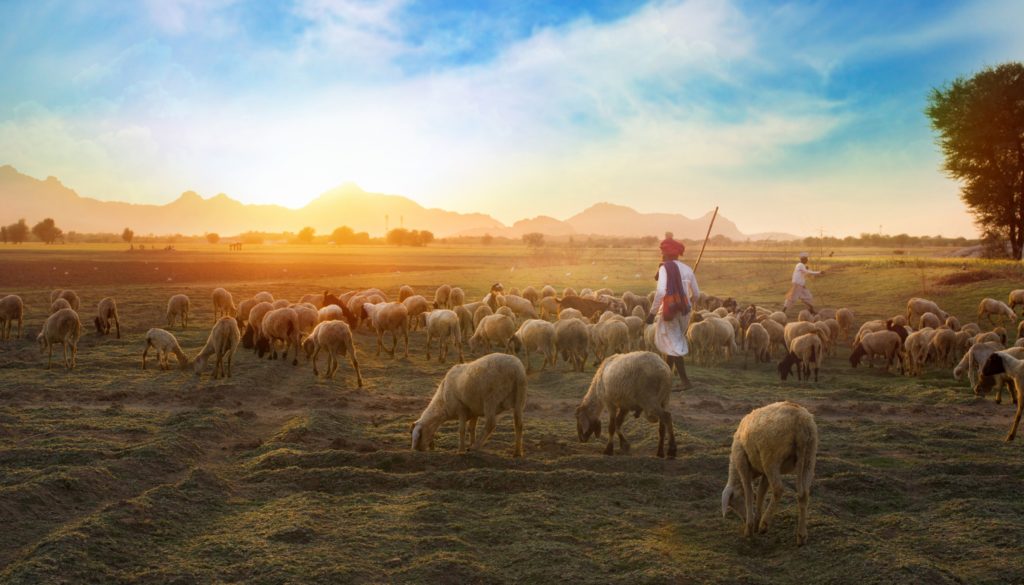
We call him the Good Shepherd because he cares for sheep. Throughout scripture we read that he heals people with miracles, feeds them with abundant food. He is concerned not only with their spiritual lives, but with their physical well being. And so he continues to do with us, feeding and healing us through the sacraments, giving us comfort in tough times, showing us his love.

Jesus is the Good Shepherd because he goes after his sheep when they’re lost. Jesus did not dine with kings and queens, but with tax collectors and prostitutes, those who were sick and unclean. He went to the excluded and forgotten to return them to the community. And so he does with us, reaching out to us even when we reject him, calling our name even when we won’t listen; he is constantly trying to bring us back to God, never giving up on us.

And of course, as the greatest of shepherds, he was even willing to lay down his life for his sheep. Jesus gave up everything, even his life, for the sake of others. This death, once and for all, set us free from our own sins, gave us an opportunity for life everlasting.

Jesus did all of these wonderful things, for them, for us.

But there’s one thing he didn’t do, one thing that he never said: He never promised that we, as his flock, would be free from hardships. He never said that everything would go well for us if we followed him. In fact, he told us quite the opposite: “you will be persecuted because of my name.”

We see this in our readings this weekend. In our first reading from Acts, Paul and Barnabas are filled with the Spirit, so much so that they preach and the entire city shows up. All that is in their hearts is a desire to share the Gospel of Jesus Christ. They selflessly go on mission for the sake of the Kingdom. And how are they repaid? Their own people get jealous of them, rise up against them, and throw them out of the city. Not exactly a comfortable or desirable situation.

The same can be seen in the second reading from the Book of Revelation. Notice how are the saints in white robes addressed: they are those who have “survived the time of great distress,” who have washed their robes in the blood of the lamb. The saints, the ones who have joined the Lord in perfect unity for all eternity, the ones who offer us an example of what we strive to be one day, did not escape hardship in their lives, did not enjoy happiness and comfort. No, quite the opposite: they bathed themselves in the blood of the lamb; they did not hide from the suffering of the cross, did not run from the pain that Christ endured, but united themselves with it, became a part of it.

It’s because of this that it has always fascinated me to hear Christians ask the question, “Why do bad things happen to good people?” I just look at them, and I look at the cross, and I say, “Let me get this straight… You follow a man who was betrayed by his followers, rejected by the religious elite, and wrongfully murdered on a cross—a man who said that if we wanted to follow after him that we had to take up our own crosses—and you’re asking why life is sometimes difficult for Christians…? I’m sorry, but what did you really expect?”

Christ is our Good Shepherd, yes, but let’s remember what that means. He came, not to lead to the nearest luxury resort, a place of comfort and safety; he came to shepherd us to the kingdom of heaven where we hope to live and serve with him for eternity. He does not live to protect us from hard work or discomfort; no, he lives to protect us from our own selfishness that leads us to hurt ourselves and others. Most important of all, he did not die so that we wouldn’t have to; he died so that our own deaths would amount to something, so that our deaths would be a participation in his.

Being a Christian is not about having a magical genie in heaven who gives us all that we want and protects us from all that brings us harm. Being Christian is about following the one who shepherds us and taking up his example. What Jesus did and continues to do for us was not so that we could continue on with our lives as normal, but was meant to guide us, free us, and empower us to do as he did, to be good shepherds for the world, people who are willing to go to the lost, protect the weak, and even lay down our lives for another. Christ is the Good Shepherd precisely because he leads us to things that will make us more like him.

This Good Shepherd Sunday, I think it’s time to get rid of the tired and cliche, “why do bad things happen to good people,” and instead ask ourselves something much more powerful: “Lord how am I being asked to be a shepherd like you today? How do you want me to care for others, go to the lost, and lay down my life, just as you did?”