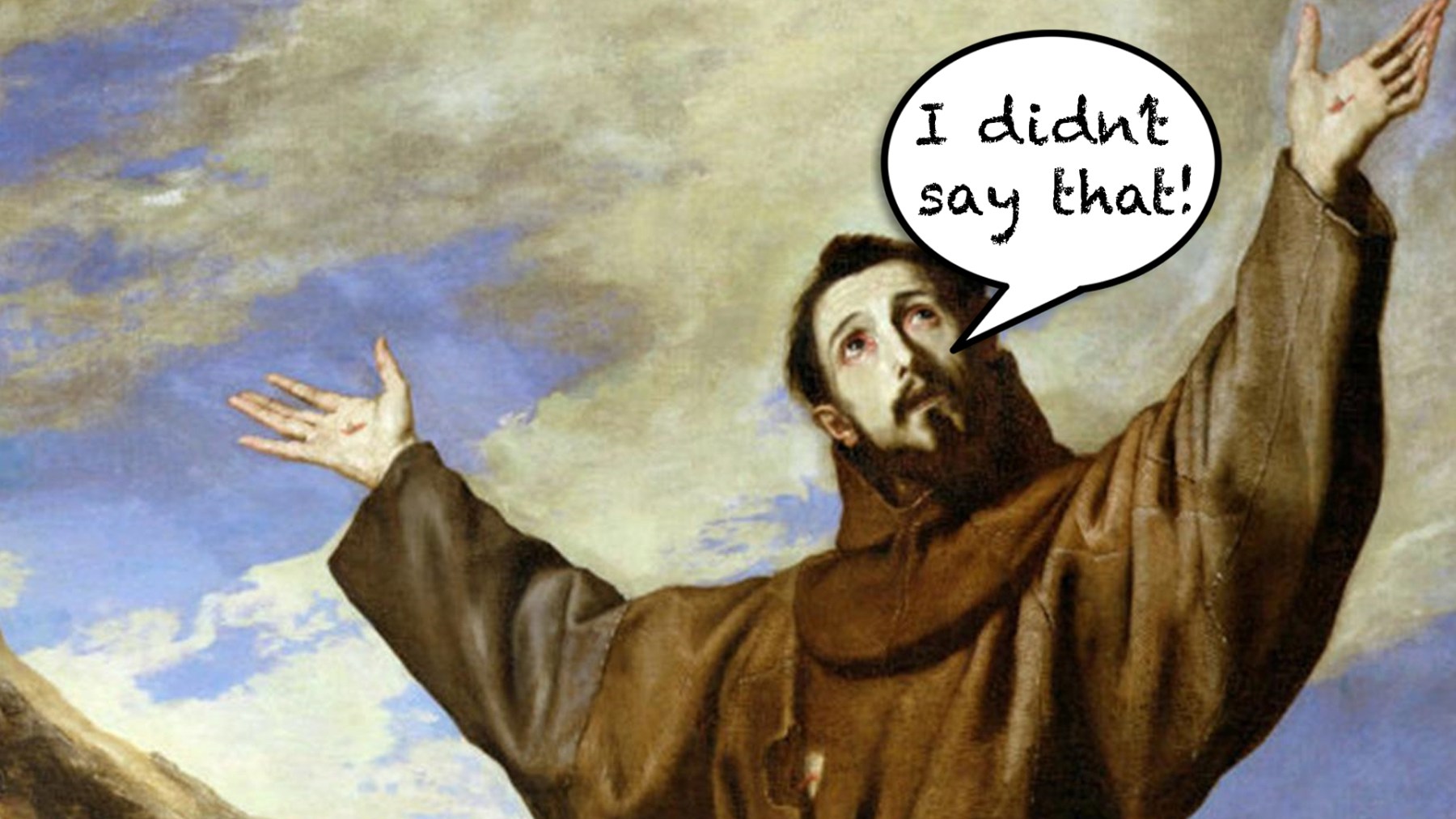
Quotes. They’re a powerful literary and rhetorical device that bring meaning to what we’re saying, strengthen our argument, and legitimize our ideas, showing that someone of significance had the same feeling about something that we have.
Or they’re completely made up.
As comedian John Oliver presented on his late night HBO show two years ago, we live in a world where the spread of information reaches further than our ability (or desire) to fact check. While presenting a number of ridiculous and obviously fake quotes from Abraham Lincoln, Marie Curie, Alexander Hamilton, and even himself, he points out, “If you have the right font and the right photo any quote can seem real.”
No doubt, we have all witnessed this phenomenon on social media, and while we probably don’t want to admit it, we have probably perpetuated it. I mean, who among us hasn’t quoted Ghandi saying “Be the change you wish to see in the world” or seen a quote from Albert Einstein and said, “Wow, I like that”? Chances are, all of us have fallen prey to at least one of these 50 common misquotations or, more to theme of these blog, a misquote of the Bible or a popular saint.
Which brings us to the beloved saint, Francis of Assisi. Arguably the most popular saint behind the blessed Mother, what St. Francis lacks in popularity behind Mary the Mother of God is more than made up for in misappropriated quotes. Sure, you can find pictures every once in a while of Mary holding the rosary (praying through herself…?) and there is no shortage of claimed apparitions, but no one matches the breadth of famously-quoted-but-never-actually-spoken lines as St. Francis. Do a quick Google search of “St. Francis quotes” and you will find tons of beautiful words attributed to the saint, many of which you have undoubtedly heard before. Many of them are great lines that touch our hearts and captures our imagination. And most of them have nothing to do with St. Francis! In researching this topic, I went to a popular quote website to see what he is credited with saying. Of the top 20, he might have said three of them (although none of them were exact quotations), but he most definitely did not say the first 16 listed.
That would not get you a good grade on an essay. Just saying.
But it raises an interesting question: what do we do with all of these quotes attributed to St. Francis? Outside of an academic setting where accuracy is paramount, I’m a bit torn. A part of me, sharing in John Oliver’s frustration, seeks for a purity of history, sticking as close to the facts as we are able and citing sources to support our claims. The spread of incorrect information is no small issue. And yet, there’s another part of me that sees the merit in even misattributed quotes. While not historically factual, there is nonetheless something true about some of them. Maybe St. Francis did not say these exact words, but he lived by their meaning, and, had he lived in the 21st century with us, might have said it just like that. In these historically inaccurate and misattributed lines we find an insight to the saint that we love and a way to carry on his legacy in a new world.
Or not. Some are just ridiculous and insulting and really frustrating and should never be said or shared or thought ever again. *Regains composure*
So, which quotes of Francis are authentic, and what do we do with the not-so-historically-accurate ones? That is the topic of this week’s Catholicism in Focus. In honor of the Feast of St. Francis this Wednesday, I look into some of his most popularly shared quotes on social media and give my take of their significance in our lives today.
For email subscribers, click here to watch the video.
As a final note, I have left here at the bottom some of my favorite quotes of St. Francis that actually have a source. Now, we can question the historical accuracy of the document (a much larger discussion for another time), but we are probably much closer to the real Francis when we quote sources from the 1220s rather than the 1990s… (All quotes from Francis of Assisi: Early Documents, New City Press, volume 1.)
“For what a person is before God, that he is and no more.” (Admonition XIX)
“A person sins who wishes to receive more from his neighbor than he wishes to give of himself to the Lord God.” (Admonition XVII)
“Nothing should displease a servant of God except sin.” (Admonition XI)
“Nothing belongs to you; you can boast of none of these things.” (Admonition V)
“Most high, glorious God, enlighten the darkness of my heart and give me true faith, certain hope, and perfect charity, sense and knowledge, Lord, that I may carry out your hold and true command.” (Prayer before the Crucifix)
“We must never desire to be above others, but, instead, we must be servants and subject to every human creature for God’s sake.” (Later Admonition and Exhortation to the Brothers and Sisters of Penance)
“When the day of death does come, everything they think they have shall be taken from them. The wiser and more powerful they may have been in this world, the greater will be the punishment they will endure in hell.” (A Letter to the Rulers of the Peoples)
“It is a great misery and miserable weakness that when you have Him present in this way, you are concerned with anything else in the whole world!” (A Letter to the Entire Order)
“The Lord gave me, Brother Francis, thus to begin doing penance in this way: for when I was in sin, it seemed to bitter for me to see lepers. And the Lord Himself led me among them and I showed mercy to them. And when I left them, what had seemed bitter to me was turned into sweetness of soul and body. And afterwords I delayed a little and left the world.” (The Testament)
“Hail, O Lady, Holy Queen, Mary, holy Mother of God, who are the Virgin made Church, chosen by the most Holy Father in heaven whom he consecrated with His most holy beloved Son and with the Holy Spirit the Paraclete, in whom there was and is all fullness of grace and every good. Hail His Palace! Hail His Tabernacle! Hail His Dwelling! Hail His Robe! Hail His Servant! Hail His Mother! And hail all You holy virtues which are poured into the hearts of the faithful through the grace and enlightenment of the Holy Spirit, that from being unbelievers, you may make them faithful to God.” (A Salutation of the Blessed Virgin Mary)





 Breaking In The Habit