Franciscan Justice: A Life of Minority

A viewing of this 1984 movie kicked off our monthly JPIC fraternal gatherings.

A viewing of this 1984 movie kicked off our monthly JPIC fraternal gatherings.

As I’ve mentioned on a few occasions, one of the defining characteristics of Franciscans (and one of the main reasons that I was drawn to this life in the first place) is our call to peace and justice in the world. Since Francis’ meeting with the sultan during the Fifth Crusade, we have been widely known as a brotherhood of peacemakers. For this reason it is the Franciscans that have been entrusted with caring for the Holy Land.

As time has passed, the world has come to realize that there is much more to peace than simply pacifism: there is a call for justice to mitigate the causes of violence. As Pope Paul VI is famously quoted in saying, “If you want peace, work for justice.” In other words, people that are respected and well fed are less likely to act with violence than are people who are oppressed, abused, hungry, or dehumanized. In this way, peace will never be anything more than the lack of violence if all we do is treat the symptoms, that is, the visible flareups. True peace is achieved by recognizing the many forms of injustice all around us and treating those afflicted with dignity and respect. This is our call as Franciscans.

This is not without conversion, I must say. LIke anyone else, we as friars must be constantly called to look at our own lives and to reevaluate the ways our actions affect the world. Without careful examination and focused initiatives, it is very easy for us to lose track of what is important or to become apathetic to the issues of our world; without constant education and thoughtful action, it is very easy to come across as ineffective in our ministries or even detrimental to those around us; without a foundation in prayer and holiness, it is very easy to lose site of why we do what we do and even burn out.

For the Order of Friars Minor, that’s the role of the office for Justice, Peace, and Integrity of Creation (JPIC) and its animators, both on the provincial and house level. In our house, I’m privileged to be on the JPIC committee, and excited for the initiatives we have in store. Recognizing that we are a very large, busy, eclectic and academic bunch, we’ve decided that the best way to go about forming a corporate identity of justice was to devote each month to a different topic for education and prayer culminating in a movie, speaker, or fraternal event.

This evening was our first of these events. With Immigration as our topic, roughly fifteen of us came together to watch the movie El Norte and to have a brief discussion. (If you haven’t seen it, I strongly recommend it. You can see the trailer here.) Filmed in English, Spanish, and Maya, the movie depicts the lives of two Guatemalan exiles that flee oppression and violence in their village for what they believe will be the answer to all of their problems: the north. After a dangerous journey through Mexico, they realize that their idealized view of the United States is but a fantasy. Despite the affluence around them, they are no better financially than they were before. Life is difficult.

What I found most tragic about this story (a story with no happy ending, I might add) is the monologue the woman gives on her deathbed. She says,

In our own land, we have no home. They want to kill us. … In Mexico, there is only poverty. We can’t make a home there either. And here in the north, we aren’t accepted. When will we find a home, Enrique? Maybe when we die, we’ll find a home.

Can there be anything more tragic? I think about all of the people who live this reality each and every day, forced to leave behind all that is familiar for a new language, new culture, new climate, new set of relationships, and a new way of life, and it breaks my heart to think about the level of dejection they must feel. They have no home. They are strangers, outcasts of society.

When I look at my own life through this lens, it devastates me. In a material sense, look at all I have. In contrast, the characters in this movie fantasized about having a house with a toilet. But its much more than that. I can honestly say that the most dejected I have ever felt was in a language class. Here I was, a confident (even cocky), intelligent, comfortable guy reduced to speaking like an infant, unable to express myself, and feeling like an idiot because I couldn’t catch on. My whole world was reduced to nothing in those moments; I felt trapped and helpless. That was for one hour a day and it could end up ruining the rest of the day sometimes. Can I even imagine what it must feel like to do that for 24 hours a day, away from friends and family all the while living in fear of being caught without documentation. Such a level of dejection and dehumanization I will never feel.

Which brings me to the JPIC reflection for the month: how can I actually be minor when I know that people live like this minutes from my house. As a Franciscan, we are called by our General Constitutions “to have the life and condition of the little ones in society, always living among them as minors. In this social environment they are to work for the coming of the Kingdom.” (Article 66) How is this even possible? In a very real sense, the most devastating thing about this movie is that it forces me to look at my own life and to realize there there is nothing “minor” about it. The material possessions at my disposal, the social connections to guide and support me, the legal status that I possess, and the comfort I have in feeling that I am “home” in my own culture and speaking my own language ensure that I will never be as minor as those I serve. There is something about being comfortable that can never be minor.

And so I reflect. I take this with me to prayer for the rest of the month (and undoubtably longer) as I try to figure out how I can see to act justly in this world and to do so as a friar minor. Part of me knows that I will never come to the answer that is perfectly satisfying in every way, but that’s okay. As a friar minor, I am called to a life of constant conversion, a life of asking these questions and evaluating my life so to actually be the person I say that I am.

Canonical Visitation

Above all else, a Chapter is a time to come together as a fraternity.

Above all else, a Chapter is a time to come together as a fraternity.

Every three years, dating back to St. Francis himself, the Franciscans gather together in what is called a Chapter. A combination of business and fraternity, a Chapter is a time for the brothers to take a break from their daily ministerial lives to be with each other, share about their experiences, and to readjust the fraternal mission. This generally includes various speakers, discussions of important topics, votes around important issues, the election of the provincial council (the advisory board to the provincial), and if the provincial has finished his term (six year followed by an option for three year), the election of a new provincial.

In such years, as it is this year, the province goes through a process called a Canonical Visitation. The best way that I can describe this process is that it is the most fraternal and least binding audit one can imagine. Essentially, a friar is chosen from a province outside of our own to give an objective report of the life of the province so that it can best correct itself into the future.

This is no easy task. Besides sitting in on provincial council meetings and thoroughly looking over important documents, the “Provincial Visitator” as he is called meets with every single friar in the province for an hour to discuss three areas of critical importance: Personal Life, Local Fraternal Life, and Provincial Life. For example:

  1. The state of your health: physical, mental, spiritual, vocational.
  2. What gives you life in ministry?
  3. Are you a happy friar?
  4. What do you think of the different dimensions of your local friar life?
  5. Do you have any proposals to better the life of the local fraternity?
  6. Is there a transparency between the Provincial administration and the friars regarding finances?
  7. What are you thoughts around provincial movement and collaboration?
  8. Do you have any suggestions of friars that would be good in leadership positions?

These are among the two pages of questions I have been given to prepare for my meeting tomorrow, a meeting that I am very grateful to have. What a blessing it is to have an outsider visit each of us every election year, to listen to us in confidence, and to collate our responses into a comprehensive report! It is an opportunity to understand who we are at the moment so that we can best determine who we want to be in the future. It is an opportunity to receive affirmation for what we are already doing, and to correct what might have gone astray. It is an opportunity to bring forth new life in the Franciscan Order and in our world.

As it is my first chapter I know little of what to expect. I look forward to seeing everyone in June, to hearing what the visitator has to say, and to see where the Spirit decides to lead us next. Certainly more to come on this topic as plans unfold! Please keep Holy Name Province, as well as all of the other United State provinces, in your prayers as this is an interesting time of collaboration and new endeavors in this country.

A Priest, or Just a Brother?

In Christ, we are all one: Jew and Greek, slave and free, male and female, priest and lay.

In Christ, we are all one: Jew and Greek, slave and free, male and female, priest and lay.

I was walking through campus the other day when I was stopped by an inquisitive student, who, unbeknownst to him, was about to receive way more in an answer than he ever intended in his question. The question went something like this:

“Hey Brother! You are a brother, right? [Yes I am. My name is Casey, nice to meet you.] So will you stay just a brother, or will you become something else?”

Meant to be a completely innocuous, friendly question, a question that I’m sure many of you have asked yourself, I didn’t take offense at it because I knew that it was asked out of a genuine desire to understand. That being said, I decided to make it a teaching moment:

“You know,” I said with smile so as to assure him that I meant no harm, “That is actually quite an offensive question to some friars. You see, we as friars like to emphasize equality in our fraternities, and each of us takes our vocation as ‘brother’ very seriously.  To be ‘just’ a brother implies that being ordained a priest or deacon makes a friar’s vocation or status more important than a friar who is not. We simply do not see our brotherhood in this way.”

Being a friar is a commitment that defines who we are and how we live; it says nothing about what we do as a profession. Some friars have been identified publicly as ordained ministers and therefore do sacramental work, but other friars work as teachers, painters, chaplains, spiritual directors, writers, principles, accountants, justice and peace advocates, caretakers, administrators, tradesmen, groundskeepers, counselors, and musicians. These professions no doubt add another layer to one’s personal identity.  There’s no denying that. But what I’d like to argue is that our primary identity is our vocation as friars, and that what we do, while important while we’re doing it, is secondary and altogether temporary.

To me, it’s like the identity of a mother within a household. Would anyone ever dare ask a mother, “Are you going to stay ‘just a mother’ or will you become something else?” Sure, she may have a profession, and that profession may be a very highly respected one.  Within the context of her household, however, her being “CEO” or “librarian” has no effect on the primary relationship she has with the rest of the family. She is first and foremost “mother.”

It’s my opinion, just like the mother who is always a mother but only a CEO when at work, that we as friars are always brothers, and only acting in persona christi, that is, set apart from the rest of the congregation as a stand-in for Christ, when we are performing priestly duties. The fact that a friar is ordained should bear absolutely no weight within a fraternity in regards to duties, responsibilities, privileges, or respect, outside of his duties directly related to sacramental ministry. At all other times, he is called to a life of humility and mutuality with each of his brothers, always remembering that his vows are the same as everyone else’s.

In this way, I am always reminded of the funny, and yet powerful question one of our friars often asks new or perspective guys: “So, are you going to be a brother, or just a priest?” In one sense, it is a comical deflection of a potentially frustrating situation that helps to ease any tensions. In another, it helps to capture the core priorities of our charism: Are you going to remain faithful to your fraternity and all of its needs, or are you going to leave your brothers behind to pursue “better” opportunities? As I continue to feel myself called to ordained ministry as a priest in the Catholic Church, I must remind myself of this question daily. No matter where God may lead me in terms of ministerial duties, I still have a duty to be humble, present, and responsible for all of my brothers.

For another perspective on this topic, I suggest reading this article written by my classmate, Br. Ramon Razon, ofm, who has accepted a call to be a religious brother.

This Is Not What I Signed Up For!

Screen shot 2013-08-17 at 9.47.34 AM

Realizing that we bring our own baggage to community life can help prevent resentful comments such as these.

There came a moment during this past year when the luster of novitiate began to fade, and community life became more of a burden than it did a joy. I’m not sure exactly what it was, but I looked around at the inane and constantly occurring conflicts in the friary, the unbearable idiosyncrasies of some of the strangest people you will ever meet, and the dysfunction of leadership that still struggles to understand and live the charism of our founder after 800 years of fighting, and just screamed, “This is not what I signed up for!” I signed up to be a part of a group of men that live, work, and pray together to bring about the kingdom of God; a group of men that are identified with and work for the poor and marginalized of society; a group of men that recognize the wonder of creation, the power of the incarnation, and the joy of experiencing it all. That’s what I signed up for.

That same week, I found a letter written by Fr. Jose Carballo, the former minister general of the Order of Friars Minor and the current secretary for the Congregation for Institutes of Consecrated Life and Societies of Apostolic Life, to the Poor Clares on their 800th year anniversary. Fr. Carballo writes,

If there is anything that destroys our fraternities it is the pretension of being above others, becoming judges of our brothers and sisters. This is due to our projecting onto them our dreams, and we demand of God and others that they fulfill them. Loving our dream of fraternity more than real fraternity, we turn into destroyers of fraternity. We begin to be accusers of our brothers, and then we accuse God, and finally we become desperate accusers of ourselves. We must remembers that there will never exist the ideal fraternity that can accept our dreams of pretentious pride, and that the fraternity is built on the basis of pardon and reconciliation, since it has so much to do with our own limitations and those of others.

Obviously I knew that there would always be conflicts when it came to differing levels of cleanliness and work distribution, as I’ve written about before, but when I searched further, I found that many of the things that frustrated me the most were not other people; they were the result of things that I brought to community life. Of the most notable was that I brought with me unfair expectations of others, exactly has Br. Carballo writes. Both consciously and subconsciously, I had determined how they should act, what they should believe in, what they should and shouldn’t need. Because I was unable to be flexible with my expectations, they quickly turned into judgments, which turned into condemnations, eventually ending in resentment, something that did not leave me open to new experiences of love.

It was then that I found a book by Jean Vanier that described every feeling, thought, doubt, hope, and situation that I had experienced so far in novitiate. Entitled Community and Growth: Our Pilgrimage, Vanier offers insights and wisdom from his many years of founding communities that are both practical and spiritual. Here’s how he opens the book:

Community is a terrible place. [Good start, right?] It is the place where our limitations and our egoism are revealed to us. When we begin to live full-time with others, we discover our poverty and out weaknesses, our inability to get on with people, our mental and emotional blocks, our affective and sexual disturbances, our seemingly insatiable desires, our frustrations and jealousies, our hatred and our wish to destroy. While we were alone, we could believe we loved everyone. Now that we are with others, we realize how incapable we are of loving, how much we deny life to others. And if we become incapable of loving, what is left? There is nothing but blackness, despair and anguish. Love seems an illusion. We seem to be condemned to solitude and death.

So community brings a painful revelation of our limitations, weaknesses and darkness; the unexpected discovery of the monsters within us is hard to accept. The immediate reaction is to try to destroy the monsters or to hide them away again, pretending they don’t exist, or to flee from community life and relationship with others, or to find that the monsters are theirs, not ours. But if we accept that monsters are there, we can let them out and learn to tame them. This is growth towards liberation.

If that’s not powerfully wise first page, I don’t know what is. The best part? It only gets better. Throughout the entirety of the text, he simply has an eloquent way of weaving together his own experiences of success and failure, insights he’s learned along the way, prophetic condemnations of unhealthy communities, spiritual nourishment, and his own hopes for the future, while maintaining a humble tone throughout.

These two texts were tremendously helpful in my formation this year, and I strongly recommend them to anyone entering community life. For me, they made me realize that what I was getting out of community life was in fact exactly what I signed up for. I signed up to be a penitent with men who recognize their limitations and sinfulness; men who bring with them brokenness and imperfection; men who realize that love is messy; men who know that it’s worth getting on each others’ nerves and letting each other down every once in a way if it means going through life together. I did not sign up to be in a group of perfect men without any need for God, nor did I sign up to be in a group of men exactly like me! Sure, there is a burden to community life some days, but in the end, even those burdens can be entirely grace-filled if you let them. Community life can definitely be a struggle, but I wouldn’t have it any other way.

Better to be Right or Together?

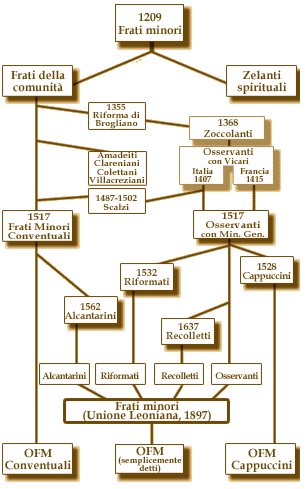
This is a simplified version of only the “First Order” branch of the Franciscan family tree.

When I tell people that I’m becoming a Franciscan friar, I have to be clear as to which type of Franciscans I mean. “Oh, like the friars at Steubenville University?” No, those are TORs. “Is that the order Benedict Groeschel started?” Nope, that’s the Franciscan Friars of Renewal. “Are you going to be on EWTN?” That’s a different group of Franciscans than mine. “Oh that’s wonderful, tell Fr. Such’n’such I said hi!” I’m not sure who that is. Maybe he’s in a different province. “Do you run Saint Anthony Press?” Sadly no, that’s Saint John the Baptist province.

These examples are endless.

The truth is, the Franciscan family is as vast as it is splintered. As of last year, my Order, the Order of Friars Minor (the one in the middle) had 14,057 friars worldwide; in the “First Order” alone, there were also 10,771 Capuchins and 4,307 Conventuals.  If you add that to the number of Second and Third Order Franciscan sisters and brothers worldwide, you’re looking at maybe 100,000 people that follow some form of the life of Saint Francis of Assisi.

But why so many groups? Why is our history filled with so many controversial reforms and divisions?

What I learned in “Survey of Franciscan History” (the course the postulants took at Saint Bonaventure University, taught by Dominic Monti, OFM) is that Francis promoted two very strong and very competing values in his life and writings.

The first of these is the freedom of the individual friar to follow his own conscience through the inspiration of God.  Francis famously said, “I have done what is mine; may Christ teach you what is yours!” There is a rugged individualism in the spirit of the Franciscans that promotes a tremendous diversity in character, prayer life, ministry, and governance. After Francis’ own example, there is a constant need for Franciscans to upset the status quo, to go against conventional wisdom of society or even an authoritative mandate, so as to be true to self.

What’s ironic about this is that Francis also put a tremendous amount of emphasis on the submission of one’s own will so as to preserve community. Throughout the Rule that Francis wrote, he demands that his followers be obedient always, not going against the wishes of the Church or Order, so as to avoid scandal and division.

Even without any knowledge of Franciscan history, I’m sure you can see a problem with this. What happens when, as is the case with every reform group, the friars no longer believe that the majority is staying true to the will of Francis? Is a friar compelled to compromise for the sake of unity, or be relentless for the sake of authenticity? When it came to issues over a friars ability to use money, the right to own property and accept donations, run parishes, and the proper attire (yes, they argued over shoes), there existed this problem. Both sides made legitimate arguments based on Francis’ Rule, and the consequences seemed inevitable: the Order split.

While I don’t see any significant schisms occurring within the Order any time soon, this is a dilemma that I will have to face (and have faced already) throughout my life as a friar. What happens when it’s time to buy a new car, appliance, piece of furniture, or whatever it may be, and I have a different perception of the vow of poverty than others in my house? What happens when a group of friars doesn’t want to wear their habits on a particular occasion, but I do? What happens when a community prays more or less often than I would like, or in a different way?

In each of these cases, there is an important question I have to ask myself: Is it better to be “right” or to be together? Sure, I could follow my own conscience, be a rebel, and live how I see fit no matter how my brothers react. There are times when this will be needed and I hope to have the courage to do so. But there will also be times when being “right” isn’t worth the consequence of being alone. Sometimes the best thing to do will be to submit my will to others for the sake of the whole. In these cases, I hope that I have the humility and “others-centeredness” to maintain a healthy fraternity.

So, is it better to be “right” or together? Such a question is nothing more than a false dichotomy. Neither are worthwhile ends in themselves because they sacrifice a critical Franciscan value for the sake of the other. It is only in striving for both, keeping contrary values in healthy tension, that I wish to live out my Franciscan life.