Renewal of Vows

I profess to live in poverty, chastity and obedience for the period of one year.

I profess to live in poverty, chastity and obedience for the period of one year.

Like the process of dating, engagement and marriage, the process of becoming a fully-professed member of a religious order takes on many stages. Last August, I professed for the first time my vow to live in poverty, chastity, and obedience in the way of St. Francis of Assisi. In a way, these vows were a test: I was testing the life to see if it was truly where I was called.

And wouldn’t you know it? Time’s up on that first year. In the Church’s great wisdom, however, the time has not come for me to make my lifetime commitment: for the next three years, all I have to do is profess vows for a period of one year as I continue to discern my place in the Order of Friars Minor.

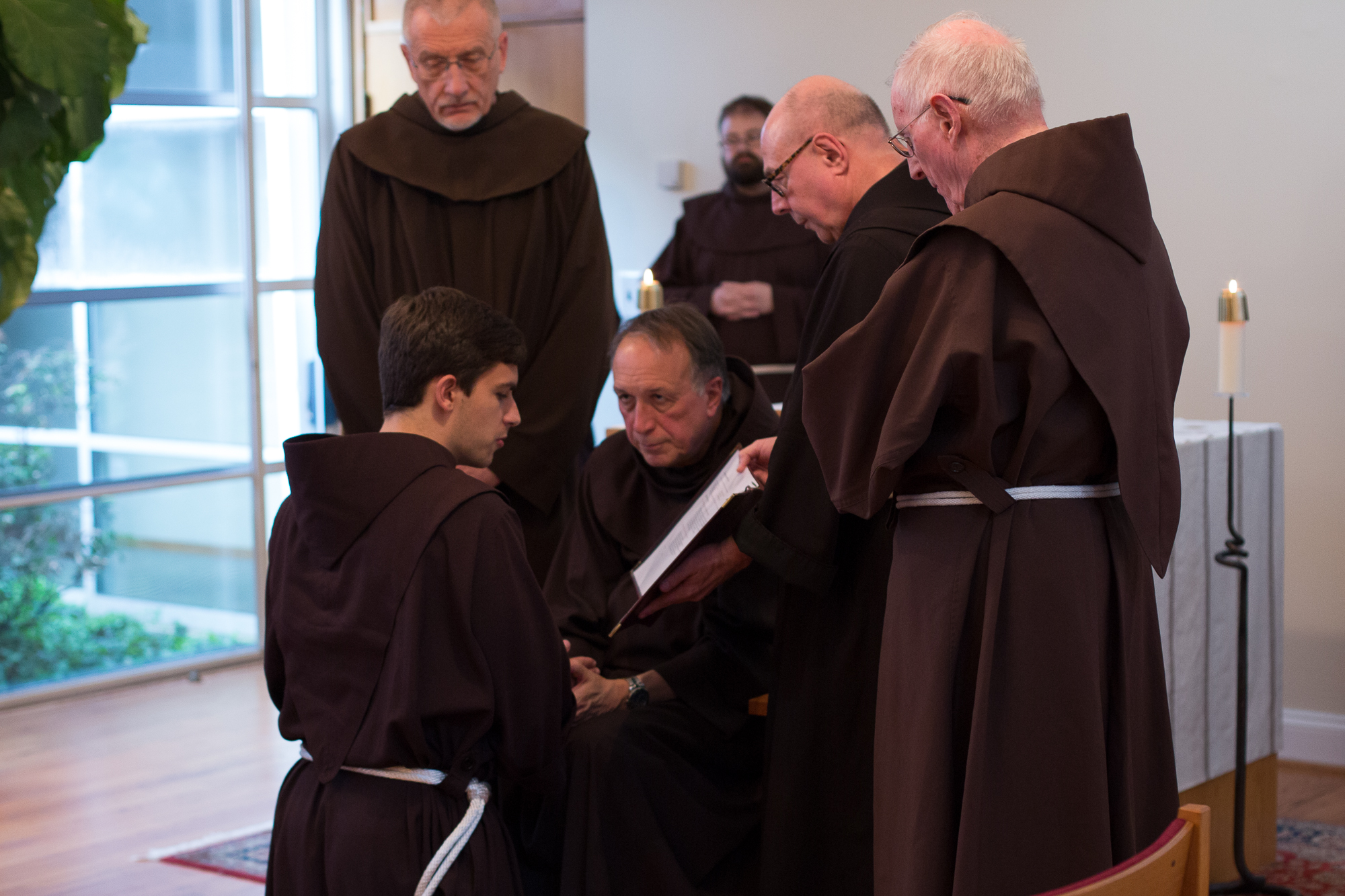
In other words, it’s like a lease to an apartment: I either have to resign the contract or move out. For now, as is fairly obvious from the picture, I have discerned that this life if for me and will continue for another year. Last evening, kneeling before our Vicar Provincial (essentially the Vice President), I spoke these words once more:

To the Praise and Glory of the Most Holy Trinity, I, Brother Casey Cole, since the Lord inspired me to follow more closely the Gospel and the footprints of Our Lord Jesus Christ, before the Brothers here present and in your hands, Brother Dominic, with firm faith and will, vow to God, the Holy and Almighty Father, to live for the period of one year in obedience, without anything of my own and in chastity, and, at the same time, I profess the life and Rule of the Friars Minor, confirmed by Pope Honorius III, and promise to observe it faithfully in accordance with the Constitutions of the Order of Friars Minor. Therefore, I give myself to this fraternity with all my heart so that, through the efficacious action of the Holy Spirit, guided by the example of Mary Immaculate, through the intercession of our Father St. Francis and of all the Saints and supported by your fraternal help, I can constantly strive for perfect charity in the service of God, of the Church and of mankind.

This I promise.

603A4757It was a quick and simply ceremony within the context of Evening Prayer, but was the result of careful discernment and conscious action. Each year we must step back, look at our lives, and ask ourselves with great conviction: “Where has God called me to be?” For the next year, I believe that God is calling me to continue in the way of St. Francis in the Order of Friars Minor, taking one step closer to formally committing myself to God and his Church.

An Itinerant Vacation

Long trip with a lot of great stops along the way!

Long trip with a lot of great stops along the way!

Home at last and back to normal. For now! My hiatus from posting last week was less than desired but not without excuse: five midterms in a week and a half kept me very busy and very tired. Such work is not without reward though, as I’ve spent the last five days on spring break. How does a friar spend spring break, you ask? Itinerantly.

Spending five nights in five different places, I made my rounds in what ended up being a great blend of business and pleasure. Starting in Lancaster, PA (the place where I grew up), I gave two talks at my cousin’s confirmation retreat, sharing about my life in the Church and how the Holy Spirit has guided me in my vocation. From there is was off to the Philadelphia suburbs to spend three nights in three different homes, catching up with family members I have otherwise been unable to see since starting formation. Finally, I finished the trip with a quick visit to our soup kitchen in Philadelphia and the night at our parish in Camden, New Jersey.

Besides being utterly exhausted (so much so that the first thing I did when I made it back to DC was to take a nap), I have to say that it was a great trip with a surprising amount of reflection to be had.

The first point of reflection is about itinerancy. Spending five nights in five beds is both a challenge and a joy. Living out of a suitcase requires one to live much more simply than normal, going without anything that isn’t a necessity. Entering into another’s home, even when treated extraordinarily well, is still an invasion of another’s space: you’re never 100% comfortable because it’s not your fridge, bathroom, bed, television, etc. that you’re using. It requires a lot of flexibility, and with such little time at each place, a lot of energy for each individual person and always feeling like you’re “on”.

For some of us as friars, itinerancy in this form will be a way of life. The Ministry of the Word, as mentioned a few years ago, is a form of ministry in which friars go from parish to parish, preaching at the masses and holding parish missions during the week. Some of our friars can do upwards of twenty or thirty of these per year, spending a lot of time on the road with new people. There are many aspects of this that are appealing to me.

For the rest of the friars, even though we don’t move from house to house that often, there is still a sense with the way we live that we are using, not owning, the things around us. When we know that we will be transferred in 3, 6, or 9 years, we are reminded that someone will be using the things we have shortly after we’re done with them, and that while we have something today, it may not be ours tomorrow.

The second point of reflection I had on this trip, and arguably the more important one, was the experiences I had speaking with relatives and friends about the Church. I come from a very large Catholic family, and like many in the northeast (and western world), many of them have encountered their fair share of struggles within and outside of the church. Having now spent two and a half years in the friars, and spending much of my day in class or indirectly focused on the theological issues of the times, it was a critical opportunity for my own ministerial development to spend time with regular people with varying degrees of affiliation with the Church.

Don’t get me wrong: I have plenty of opportunities to talk about the Church and to be with regular people throughout the day. What I find sometimes, however, is that much of our time is spent with the extraordinary cases, the ones with the best or worst situations who feel a need to seek someone out. They say the squeaky wheel gets the oil, and in this life, its mainly because we have no idea what the other wheels are thinking until they squeak! Being with family and friends this week was an awesome experience to hear where I presume a lot of Catholics are today: not particularly pleased or angered by the Church, simply unsure of a number of things and either unable or unwilling to find someone to ask. The common problem I found this week was that the Church has a twofold problem: education and public relations. The majority of people in the pews simply don’t know what they don’t know. As I think about my future in the Church, this is a big issue that I feel called to work with.

That being said, there’s no use “waiting until I’m older” to get started. In a sort of “But wait, there’s more!” sort of gimmick, my travels are just beginning: next weekend I’ll be in Athens, Georgia at the University of Georgia speaking to the Catholic Student Center about living a vocation in the Church (not just being a friar, but I’ll make sure to emphasize that option!) and in early May I’ll be going down to Raleigh to St. Francis of Assisi Catholic Church to speak at all the masses about supporting the friars (and again, maybe even becoming one!)

For me, there’s just too much out there to do to sit around. There’s a great message to be shared, and while some people will come to hear it, it may require us to be a bit more itinerant, meeting people where they are. That’s my mission for now! Off I go again!
A Life Ordained By God

Ordinations are elaborate services that include a lot of people

Ordinations are elaborate services that include a lot of people

At the beginning of Postulancy I had the privilege of attending a solemn profession of two of our brothers within the first week. In my post at the time, I mentioned that it was a great experience to have before starting because it offered a clear picture of what would be to come if I continued in the Order. Yesterday, I was afforded a similar privilege.

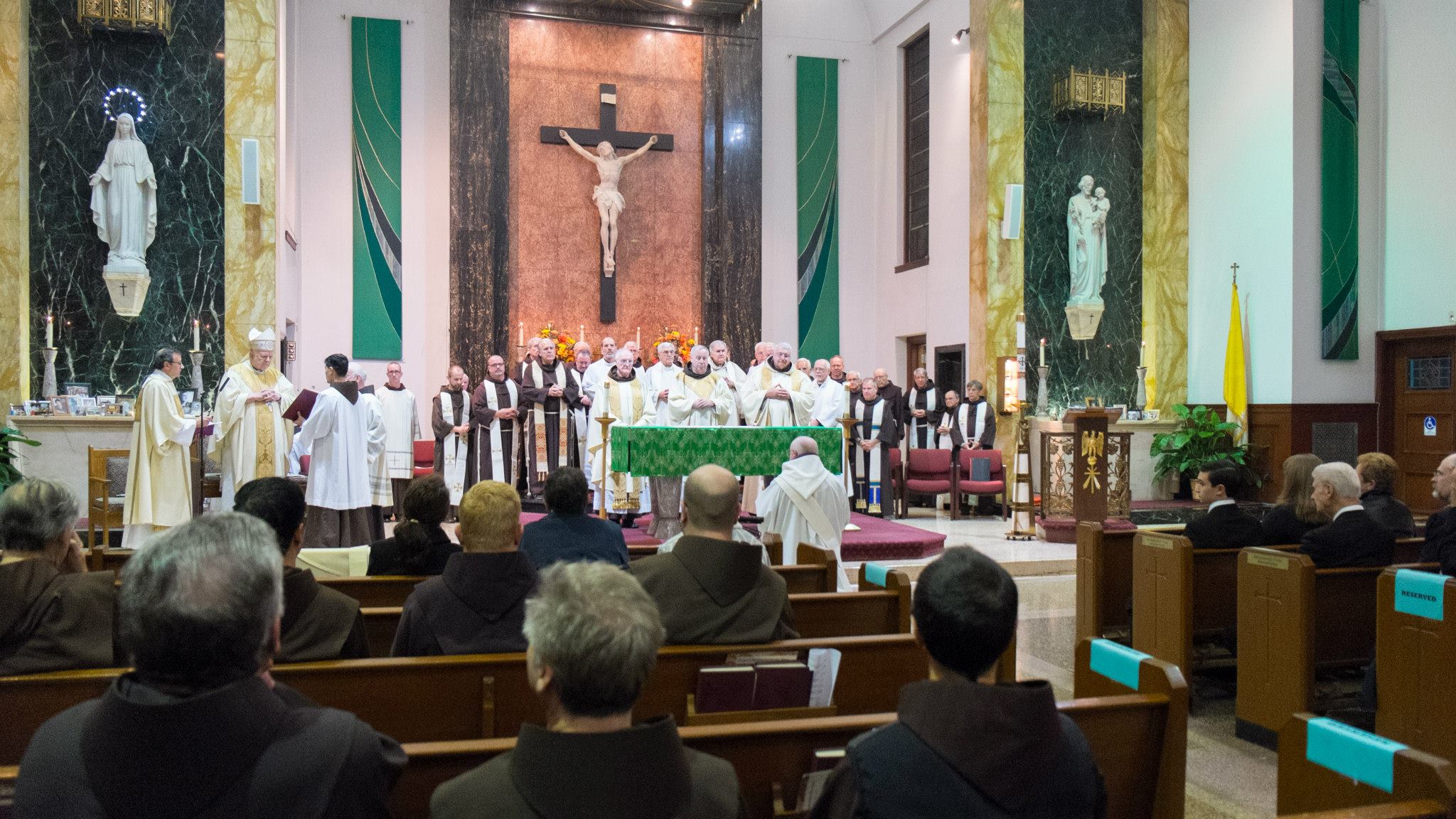
Joined by roughly forty friars, a packed church of lay people, and a bishop, the simply professed friars in this house took part in the ordination mass of Paul Keenan, ofm, yesterday at Assumption of Our Blessed Lady Church. As is usually the custom, the simply professed friars served at the mass as acolytes, responsible for carrying the cross, miter, and crosier, setting up the altar with the gifts, preparing the incense, and assisting the master of ceremonies in anything else that needed to be done (which is a lot whenever a bishop is involved!)

Like the experience I had at the solemn profession two years ago, I couldn’t have been happier and more confirmed in my vocation after this experience. Seeing Paul standing in the place where I hope to be standing in four or five years was really inspiring; thinking about Paul standing where I was a few years ago was pretty surreal; hearing the bishop speak about the role of the priest in the church, that of servant of the people, was humbling.

Beyond all of that, though, I was touched most profoundly by the presence of the friars who came from all around, on a Saturday evening, to support our brother Paul in his acceptance of this vocation. There surely cannot be a greater image than seeing four rows of friars coming up one-by-one to lay hands on the kneeling candidate, offering their blessing on him before he is officially ordained. The feeling of brotherhood was overwhelming and the emphasis on being a “Franciscan” priest was unmistakable.

As I begin my studies to one day stand where Paul stood and to walk where he now walks, I have in my mind a clear bit of inspiration for the future. The road ahead is going to be long and difficult, and it will certainly be easy to lose focus on what’s important amidst a sea of books. At the heart of it all, I must remind myself of this experience and what this call means to me.

I am called to live in fraternity in the way of St. Francis. I am called to serve my brothers and sisters. If I can remember these two things, everything else will fade away.

Formation Rolls On

As St. Francis reminds St. Anthony, sacred theology is a great thing to learn, as long as it does not "extinguish the Spirit of prayer and devotion."
As St. Francis reminds St. Anthony, sacred theology is a great thing to learn, as long as it does not “extinguish the Spirit of prayer and devotion.” Bonaventure and Aquinas, are great men to read, but we must always remember why it is we study in the first place.

Now that I’m nearly three months into my third year of formation, I can definitively say that there is a major difference between the first two years (postulancy and novitiate) and the remaining four years (simple profession) of initial formation. Rightly so, the first two years focus heavily on human and spiritual formation, breaking down personal barriers that inhibit proper growth in fraternity and prayer. This meant going to workshops on prayer, sexuality, personality, addictions, interpersonal skills, and the vows; meeting regularly with a counselor to evaluate group dynamics and personal problems; and numerous opportunities for extensive and intense prayer experiences by way of retreats.

While there are still opportunities for such experiences (we continue to go to sexuality workshops, are required to have a spiritual director, and will go on a retreat each year), the emphasis has clearly shifted from theory to practice. Unlike the first two years of evaluation and growth, the third year and beyond appears to focus much more heavily on ministry: preparation, experience, and processing.

The largest part of this, which I mentioned before without explaining in detail, is our heavy load of intellectual formation. For those of us that feel called to be ordained to the priesthood, there is a heavy academic burden that must be endured. The USCCB has developed a Program Of Priestly Formation that they believe best prepares one to be a priest in the Catholic Church. Academically, this means taking 30 credits of philosophy (with 20 credits soon to be done and each course being 3 credits, I’ll be finished by the summer), and 90 credits of theology in the form of a Master of Divinity (M.Div.) degree. For those scoring at home, that’s a minimum of four years. Courses are to be fulfilled in a wide range of categories including scripture, theology, history, canon law, moral theology, liturgy, spirituality, counseling, and preaching, clearly preparing us for a wide range of situations, but because of obvious constraints, unable to provide extensive depth into any one category.

Luckily, as I’ve learned in the past three months, our intellectual formation is not the only formation we receive in our years here. The simply professed friars meet every Monday evening for an hour and half to discuss relevant pastoral topics related to our lives. Usually led by one of the friars in the house, we begin with a presentation on a ministerial experience or skill and then spend time discussing our own experience on the matter. Topics are wide in range and scope with the intention of creating an environment for faith sharing, pastoral growth, and intimate fraternity.

Besides the daily ministry experience (of which we are required to get eight hours per week) and our supervisor meetings, we will each be assigned to a friary in our province each summer for a more intensive ministry experience. Stepping completely outside of the academic world, we’re able to apply all we’ve learned in the classroom and in our seminars to the “real world” in hopes grow in our pastoral skills and to have something substantial to bring back to the classroom the following year. Prior to our solemn profession (usually after our third year of studies), we are required to extend one of these summers into full year-long internship devoted entirely to ministry experience.

Overall, the nature of our formation is clearly different this year than it was in the previous two years as it is much more laissez-faire and dependent on the individual to develop his own formation. Please don’t misunderstand me: this does not mean that it is any less important or rigorous. What I mean to say is that there is no longer the feeling of being micromanaged with clear boundaries and high structure; we have an opportunity, now having been formed in the way of St. Francis for two years, to reengage the world with what we’ve learned in ways we see fit. It is a time of tremendous life experience as we are given the chance to try new things, to both succeed and fail, and to be stretched by a little bit of “real” stress in our lives. It’s an exciting time with a lot to do! Formation rolls on!