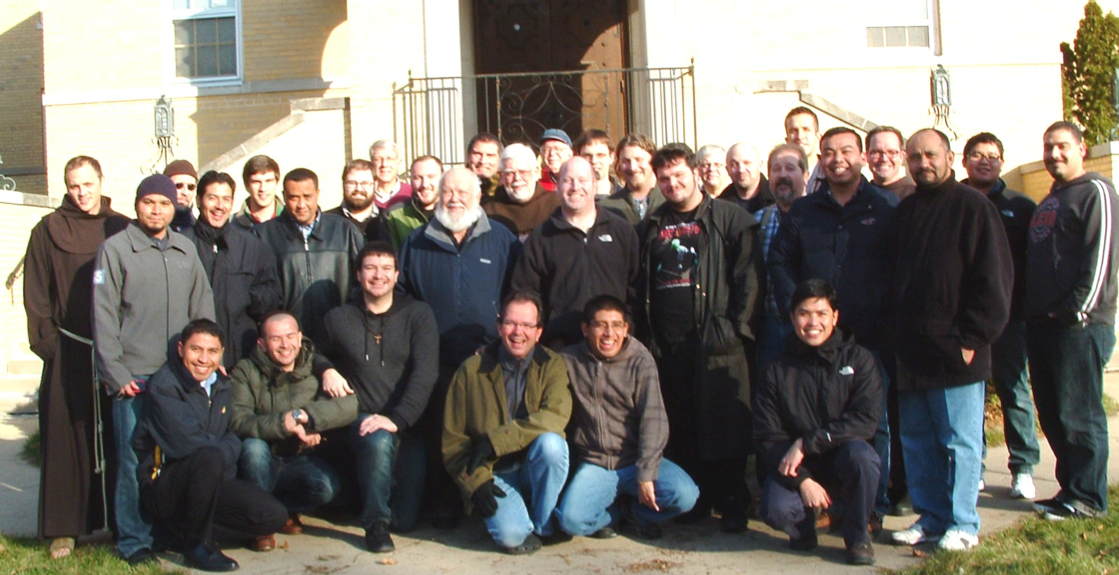
We Are The Future

This past weekend, all of friars in pre-Novitiate, Novitiate, and post-Novitiate formation, as well as the formaters and a member of the Provincial Counsel of Holy Name Province, had a grand get together at the Bon Secours Spiritual Center in Marriottsville, MD. Known as the “Formation Intersession Program,” this three day meeting is a yearly tradition of our province that seems to fulfill three main goals: 1) To allow for fellowship and interaction between the men in formation, 2) to teach the men in formation something related to Franciscan theology beneficial for spiritual and communal growth, and 3) to inform new members of the happenings of the province, both financially and statistically, in a sort of “State of the Province” address. Overall, the weekend was excellent at fulfilling each of these goals, and with the exception of the food poisoning I got Friday night, everything went really well! (Dont worry, it wasn’t that bad and I’m completely fine now!)

Getting to know our new brothers. Unlike many of the workshops we’ve attended thus far, there was actually more “free time” on this one than anything else. With most of our afternoons and nights free, we had plenty of time to chat, go out to eat, and even watch a movie on the projector one afternoon. Given that the majority of us have had at least one common formation director or formation house, we all hit it off almost immediately because a lot of our experiences (as well as a few misfortunes!) were common among everyone. Add to it a group of very humorous, brotherly, guys, and you get a weekend long laugh-fest of stories, jeers, and rivalries fit for the friars.

Besides simply having a good time, there was a serious purpose for bringing us together: we are the future of the order. Turn the calendar ahead 20-25 years and this group of men will be very core of the province, running ministries and dictating the vision for its future. As a postulant, this can no doubt be an overwhelming responsibility to focus on right now. But at the same time, I think we all realize that its a reality in our future, and it’s comforting to know that we’ll have such a strong group of men along for the ride.

Franciscan spirituality of the Trinity. What does it mean to believe in a triune God? More times that not, do we even distinguish between the three, or do we simply think of God as a homogenous, ambiguous “being”? Such a theology would not Franciscan (or even Christian for that matter). Though being of one essence, God has revealed Godself through history and scripture as three distinct beings, Father, Son, and Holy Spirit. Call me dense, but until this weekend, I had never put two and two together to realize that since each one is in its own ways distinct, so too should our relationship to each person be unique: God is Father, God is brother, and God is spouse. Each requires a different approach, thus yielding a different experience of the divine.

The “mystery” that leads from this is pretty obvious: how does one God exist in three persons while still being only one God? One way of trying to explain it is the ice, water, and vapor analogy I used in my post, “I think of it like a…”: same chemical, three different forms, all of which can exist simultaneously. But from a “Franciscan” perspective, the question itself is posed wrongly: rather than how can one God exist in three persons, someone like St. Bonaventure would ask how can three persons be one? Some will say it’s the same question, but there are different implications to both. The former, starting with one and splitting into three, must focus on the existence of God, how God is, so as to understand how God can be split in three; the latter, focusing rather on three being one, must focus on the relationship of God, how the three distinct persons must be in relationship with one another in order to be one. The relationship between the three leads one to see the self-communicating love that exists with God, leading to the statement, God is good.

The “State of the Province” address. Much like the yearly State of the Union address given by the President of the United States, were given two lectures on Saturday related to the financial and personnel situations our province was facing. Obviously these sections were a bit dry with information (and obviously quite private to non-friars, so I’ll be vague), but they were also very helpful for looking at the future. It’s not a secret that the world is changing, and with it, religious life as well. There are going to be different problems our generation will face than the ones before us did, and it’s great foresight of those in leadership today to prepare us for them as early as possible. There was nothing revealed in either lecture that was a complete surprise, nor was there anything that made me develop much anxiety about the future. Altogether, it was great to be left in the loop and to have the opportunity to ask questions and begin brainstorming with other future leaders.

Given the fact that the food poisoning was a bit unexpected, I didn’t get to take a lot of the pictures I had wanted to. Also, given the internet struggles lately, it’s been difficult to even load a picture for the title of the post, but we’re working on fixing the problem soon!
We’re Baaaaack….

After nearly 12 days in North Carolina with my family, I find myself back in the familiar (and very cold) confines of Wilmington, Delaware, refreshed and ready for another fives months of whatever the Postulancy has to offer. While at home, I spent most of the mornings/afternoons relaxed on the couch, either in front of the t.v. watching mediocre college football games or re-runs of my favorite show, 30 Rock, or catching up on a little reading and journaling. The highlight of the break was definitely the time I got to spend with my whole family playing games such as Monopoly, Spades, Cranium, and Yatzee, winning all of them of course (except for the ones I lost).

Besides relaxation and fellowship, I had also mentioned before that this would be a great time for reflection and discernment as it would most definitely bring to light the differences between the life I once had and the life I’ve recently adopted. In this way, the break did not disappoint. Though I didn’t come to any earth-changing realizations, I left my house yesterday reconfirmed in my decision to join the friars and actually a bit excited to return to Wilmington (a truly preposterous statement if you’ve ever lived a block from I-95 in Wilmington!) Here are a few of the things that I came to realize that probably influenced these sentiments:

Community prayer is important to me. In the five months since I moved to Delaware, I think I missed Morning prayer, Evening prayer, and Mass a total of ten times, all but one of those times due to traveling constraints. Praying multiple times a day in community became sort of second nature to me, a “habit” if you will. It wasn’t until I went home and forced myself to restrain from praying the Office or going to daily mass that I realized, however, that it was much more than just a programmed behavior: community prayer is a critical part of my spiritual life. Sure, I went to Mass on Sunday, and I prayed frequently over break, but I knew that something was missing.

The friars have subtly become my “other” family. For all in my immediate and extended family reading this, don’t think that I’m in any way saying that there has been a replacement of feelings from you to them! Those in my family will always have that special relationship. But having lived together now for five months, praying, learning, traveling, and working with each other, it’s hard not to see that new, intimate relationships have begun to form. I found myself on break thinking, “I miss those guys,” and “I’m excited to go back and see everyone,” in a way that somewhat resembles, but feels ultimately different than the feeling I had upon returning to college each year. It took a little time away for me to realize that these guys had subtly become my brothers.

For now, I think I’ll leave it at that. I spent some time reflecting on a few other unrelated things, but in the interest of space and organization, I’ll leave those topics for another day. Our next adventure begins Thursday afternoon when we travel down to Maryland for the Formation Intercession, a meeting of all the Holy Name Province students. It should be a great opportunity to look ahead in the formation process and hear from those in years two through five about their experiences along the way.

As a last note, thanks to all those I saw over break that shared such reaffirming words about the blog. I try not to get caught up in the comments or page statistics, but it is nice to hear that it’s more than just a tool to organize my thoughts. Thank you for all of your support along the way!

Preparing For Novitiate: Update

It hit me after posting “Preparing For Novitiate” last week that I had forgotten to mention the many online publications about the Interprovincial Novitiate I’ll be attending next year.

For starters, the 14 men in Burlington take turns posting about their experiences on a community blog, Franciscan Interprovincial Novitiate. The new blog is a great way for me to prepare for next year as it is very detailed with pictures and personal reflections. A shorter alternative can be found on their community run Facebook page, focusing more on events than personal reflections. Outsides of the community’s pages, John Aherne, OFM, one of Holy Name Province’s novices, also wrote a great post about his experience so far on the province’s vocation’s website, Be A Franciscan

Blogs are not the only way to learn about the year, however, as Holy Name Province has written a number of articles about the interprovincial experience on its newsletter, HNP Today. There’s an article about their reception as novices at the beginning of the year, as well as one about the novices receiving their habits. This is a great newsletter to stay in touch with the happenings around the province with more than 330 friars.

As I mentioned before, Holy Name Province is very connected with technology and offers a great number of resources for those discerning, even for people like me who have already joined but would like to know more. If you just cant get enough of Franciscan blogs, there are six other blogs besides mine on the province’s website that are frequently updated.

Time to Read

One of the great things about this year is that I have a lot of time to read. Here’s what I’m focusing on right now.

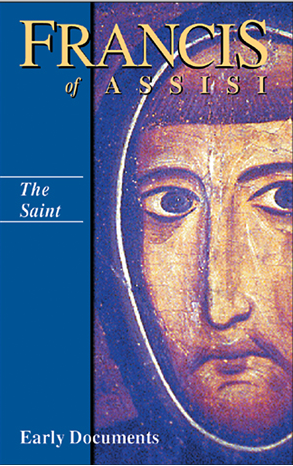
Francis of Assisi: Early Documents

This is a book that no friar should be without. Part of a three volume set, this book includes everything that Francis ever wrote, including the Canticle of the Creatures, The Admonitions, The Earlier and Later Rules, and The Testament, as well as a long list of prayers and letters written to and for members of the order. Together, it amazingly takes up the first 126 pages of the book, a fact that is quite significant when one realizes the time in which he wrote and the lack of formal education and stability in his life. The rest of the book, as well as the other two books in the series, is made up of biographies, papal encyclicals, and liturgical texts written about Francis within the first few centuries after his death.

Because Francis has probably the largest hagiography of any saint (much of which is based in folklore and legend) it’s impossible to know who Francis actually was without reading the earliest and most authentic sources. So far, I’ve read about half of the texts penned by Francis himself as well as his earliest known biography.

The Catholic Study Bible (NAB Translation)

With the early documents, this is the other text that a friar can never be without. Besides being a critical text for all Christians, Francis was very well read in the Bible and thus, his life and Rule can only be understood by reading it.

After having read Luke and Mark’s Gospels twice each, I moved to the Old Testament for an understanding of Israelite history. Beginning the tour with 1 and 2 Samuel, and I plan to continue with 1 and 2 Kings, Jeremiah, and a minor prophet before returning to the New Testament to finish the Gospels and explore a few of Paul’s letters.

For me, it was/is critical to have a plan. Since the book is so large, it can be overwhelming to even start because there is a feeling that no matter how much reading I do, it can never be finished. By picking out a few critical books (some are just more important than others in the Salvation History narrative), and reading a few pages a day, the task is much more manageable and certainly more fulfilling.

In the Spirit of Francis and the Sultan

Over the years I’ve developed a real interest in ecumenism and inter-religious dialogue, embracing the Church’s efforts for peace and reconciliation among all of the world’s peoples. It’s no surprise, then, that I’ve taken to Francis’ encounter with the Sultan as a source of great inspiration: in a time when relations between Muslims and Christians were even worse than they are today, these two men found a way to speak peacefully, respect one another, and depart as equals to one another.

Though the book recognizes that there is little historical detail to the content of their meeting, the meeting in and of itself was a great first step in relations, and there is much to be learned from it to be used in our world today. Beginning with a basic overview of the two faiths, the authors point out the many similarities that could be used as a point of contact, as well as the many differences as a point of challenge to approach with caution, all with the hopes that with greater understanding will come more fruitful interactions, and ultimately peace.

St. Anthony of Padua: Wisdom for Today

Though most famous for being the saint for finding lost things, St. Anthony of Padua is also considered one of the greatest preachers of all time. This book is a compilation of excerpts from his homilies and writings, organized and commented on by a friar in the 1970s. Using it as more of a prayer/meditation aid than an academic read, I’ve been reading a page or two of this book every few days as a starting point for reflection.

Preparing For Novitiate

Talk about a full house!

Although our primary focus for being in Wisconsin last week was an interprovincial Postulancy workshop on sexuality, we enjoyed the added bonus of visiting the Novitiate house and meeting the Novices. We weren’t given a ton of free time throughout the week, but enough that we were able to hear from the Novices about their year so far, share meals with them and the Novice masters, experience their prayer style, and get familiarized with the house and grounds.

By the end of the week, I understood why the three stages of initial formation are called pre-Novitiate, Novitiate, and post-Novitiate: the Novitiate experience is clearly the center and frame of reference for the whole process. The Postulancy year, thus, is not just a waiting or trial period, it has the crucial objective of preparing men for the intense community and prayer life of the Novitiate.

So, what exactly do they do in the Novitiate, and are we being prepared well enough?

To oversimplify the concept, the Novitiate is a year of prayer, work, study, and community, in preparation for simple vows at the end of the year. The Novices in Wisconsin pray together four times a day, have class for two hours in the morning, do chores for two hours in the afternoon, and take turns cooking meals with and for each other before being allowed two hours of free time in the evenings. They are not allowed cell-phones, credit cards, or use of the internet, they’re not allowed to travel more than 15 miles away from the house, and there is a grand silence that begins at 9:30pm each night. It is through these extreme measures that the Novices are encouraged to take great steps in their prayer and community lives, freeing them from the many distractions of the outside world to focus more attentively on those things that are at the center of our lives.

And while this is necessary for a life as a friar, this lifestyle would be too much of a shock for most people right out of the gate. What would the retention rate be like if men left their old lives one day and showed up to this one on the next? Even as someone who is quite affirmed in his vocation, I would have struggled with the transition. Thus, Postulancy.

Having now seen the life of a Novice, everything (except the traveling) that we do makes perfect sense to me now, and I see that the Postulants of Holy Name Province will be as prepared as any for next year. We pray everyday as a community either twice or three times, emphasizing the importance of prayer but doing so in a bit more casual of a way; we attend class twice a week on basic Franciscan studies, preparing us not only in content but also in structure; our weekly group meetings, both as a whole house and as the formation group, keep us in touch with the needs and attitudes of the others, helping us to find our role in community; having set meals seven days a week has enforced a sense of responsibility and community; and our lack of freedom, whether it be in time off, ability to leave, use of technology during the day, limited stipends, or chores, has been taken slowly as to help the adjustment process. Taken together, the year is a stepping stone for the next, an introduction and preparation to the rigors that lie ahead.

In all reality, the hardest thing about next year will be that which we cannot prepare: living in a house with 24 other men. Because it’s an interprovincial Novitiate, we’ll be sharing the experience with at least six other provinces, having completed seven different postulant years, with seven different levels of preparedness, and 25 different personalities. I’m not sure if anything can fully prepare someone for that type of experience. Until that day comes, I look forward to living in the moment of each day as a Postulant, while always remembering what that moment is for: preparing for the Novitiate.