Yes, But Under My Conditions

Am I trying to fool God or myself with the fine print?

As I continue to discern whether God is calling me to be ordained or not, I have come up with an analogy that describes my current disposition: I am like a potential parent that says, “I want to have a child… but only if it’s a boy.”

Like the would-be parent who is comfortable with the possibility of having a catch with his son or teaching him how to ride a bike, I have taken the big step forward over the past two years in acknowledging that there are some aspects of “being a father” that are appealing enough to me to take on the new role. Back in August, I mentioned that the sacrament of Reconciliation was one of these aspects. Besides that, I’m feel a strong calling to get involved in social justice activism (such as the ones run by our activist organization, JPIC), a ministry that needs the sacraments to remain fruitful. In this way, like the potential parent, I am very open to some of the roles a “father” might have to fulfill.

The problem with this sentiment is that it is not open to the all of the possibilities one may face. What if it’s a girl? Mentally handicapped? Doesn’t like baseball? Like the parent, there are aspects of ordination of which I am unwilling to accept at this point in my formation. What if I were assigned to an upper-middle class suburban parish so removed from poverty and hardship that it became difficult not to fall into complacency? Or, what if I were made pastor of a one-priest church, required to take on large amounts of administrative duties and left  tied down to one particular schedule and place? These are among the many hypothetical situations (along with a few theological issues that I won’t mention here) that leave me saying, “Yes, but under my conditions.”

Like a potential parent, I don’t think this is the proper disposition one can have to take on such a role. To be ordained is to say “yes” without condition, open and prepared for anything the kingdom of God needs here on earth. It means being a malleable instrument for which God can use whenever and however he pleases. To do so with conditions would be to misunderstand the role entirely; “yes, but under my conditions” is not really a “yes” at all.

As I move forward, this will be the focus of my discernment. Can I be open to all of the possibilities for which God will use me? I’ve certainly come a long way over the past few years in accepting new possibilities, and will just have to see how far that goes. I continue to thank you for all of your prayers in this process.
Time to Read

One of the great things about this year is that I have a lot of time to read. Here’s what I’m focusing on right now.

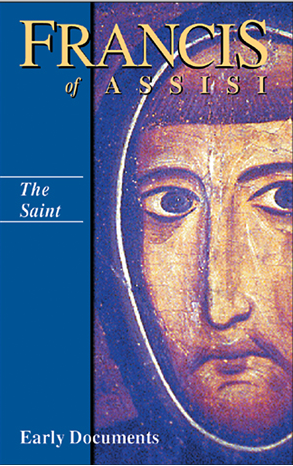
Francis of Assisi: Early Documents

This is a book that no friar should be without. Part of a three volume set, this book includes everything that Francis ever wrote, including the Canticle of the Creatures, The Admonitions, The Earlier and Later Rules, and The Testament, as well as a long list of prayers and letters written to and for members of the order. Together, it amazingly takes up the first 126 pages of the book, a fact that is quite significant when one realizes the time in which he wrote and the lack of formal education and stability in his life. The rest of the book, as well as the other two books in the series, is made up of biographies, papal encyclicals, and liturgical texts written about Francis within the first few centuries after his death.

Because Francis has probably the largest hagiography of any saint (much of which is based in folklore and legend) it’s impossible to know who Francis actually was without reading the earliest and most authentic sources. So far, I’ve read about half of the texts penned by Francis himself as well as his earliest known biography.

The Catholic Study Bible (NAB Translation)

With the early documents, this is the other text that a friar can never be without. Besides being a critical text for all Christians, Francis was very well read in the Bible and thus, his life and Rule can only be understood by reading it.

After having read Luke and Mark’s Gospels twice each, I moved to the Old Testament for an understanding of Israelite history. Beginning the tour with 1 and 2 Samuel, and I plan to continue with 1 and 2 Kings, Jeremiah, and a minor prophet before returning to the New Testament to finish the Gospels and explore a few of Paul’s letters.

For me, it was/is critical to have a plan. Since the book is so large, it can be overwhelming to even start because there is a feeling that no matter how much reading I do, it can never be finished. By picking out a few critical books (some are just more important than others in the Salvation History narrative), and reading a few pages a day, the task is much more manageable and certainly more fulfilling.

In the Spirit of Francis and the Sultan

Over the years I’ve developed a real interest in ecumenism and inter-religious dialogue, embracing the Church’s efforts for peace and reconciliation among all of the world’s peoples. It’s no surprise, then, that I’ve taken to Francis’ encounter with the Sultan as a source of great inspiration: in a time when relations between Muslims and Christians were even worse than they are today, these two men found a way to speak peacefully, respect one another, and depart as equals to one another.

Though the book recognizes that there is little historical detail to the content of their meeting, the meeting in and of itself was a great first step in relations, and there is much to be learned from it to be used in our world today. Beginning with a basic overview of the two faiths, the authors point out the many similarities that could be used as a point of contact, as well as the many differences as a point of challenge to approach with caution, all with the hopes that with greater understanding will come more fruitful interactions, and ultimately peace.

St. Anthony of Padua: Wisdom for Today

Though most famous for being the saint for finding lost things, St. Anthony of Padua is also considered one of the greatest preachers of all time. This book is a compilation of excerpts from his homilies and writings, organized and commented on by a friar in the 1970s. Using it as more of a prayer/meditation aid than an academic read, I’ve been reading a page or two of this book every few days as a starting point for reflection.

Preparing For Novitiate

Talk about a full house!

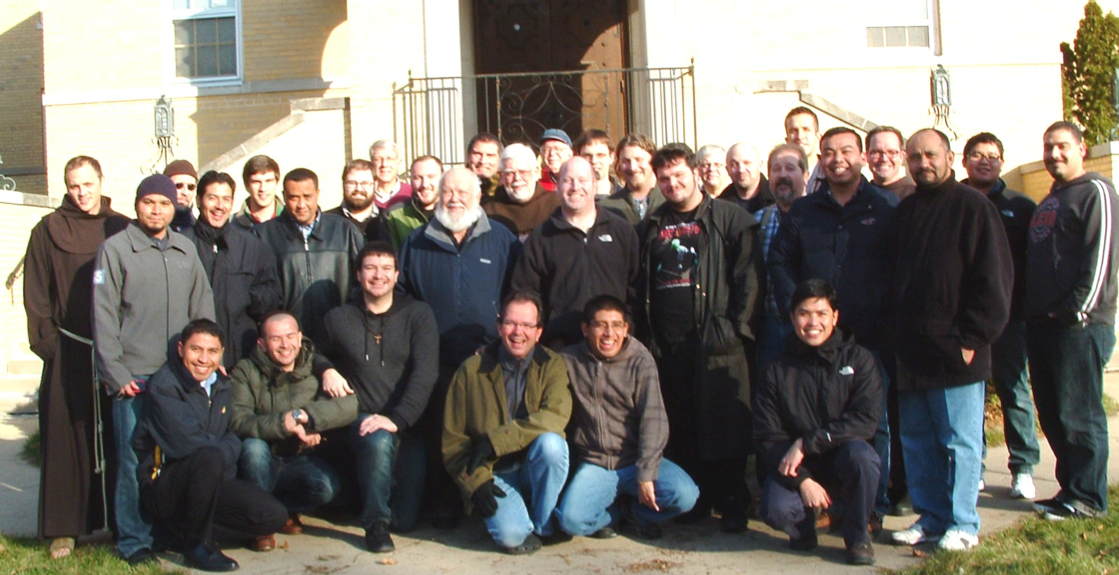
Although our primary focus for being in Wisconsin last week was an interprovincial Postulancy workshop on sexuality, we enjoyed the added bonus of visiting the Novitiate house and meeting the Novices. We weren’t given a ton of free time throughout the week, but enough that we were able to hear from the Novices about their year so far, share meals with them and the Novice masters, experience their prayer style, and get familiarized with the house and grounds.

By the end of the week, I understood why the three stages of initial formation are called pre-Novitiate, Novitiate, and post-Novitiate: the Novitiate experience is clearly the center and frame of reference for the whole process. The Postulancy year, thus, is not just a waiting or trial period, it has the crucial objective of preparing men for the intense community and prayer life of the Novitiate.

So, what exactly do they do in the Novitiate, and are we being prepared well enough?

To oversimplify the concept, the Novitiate is a year of prayer, work, study, and community, in preparation for simple vows at the end of the year. The Novices in Wisconsin pray together four times a day, have class for two hours in the morning, do chores for two hours in the afternoon, and take turns cooking meals with and for each other before being allowed two hours of free time in the evenings. They are not allowed cell-phones, credit cards, or use of the internet, they’re not allowed to travel more than 15 miles away from the house, and there is a grand silence that begins at 9:30pm each night. It is through these extreme measures that the Novices are encouraged to take great steps in their prayer and community lives, freeing them from the many distractions of the outside world to focus more attentively on those things that are at the center of our lives.

And while this is necessary for a life as a friar, this lifestyle would be too much of a shock for most people right out of the gate. What would the retention rate be like if men left their old lives one day and showed up to this one on the next? Even as someone who is quite affirmed in his vocation, I would have struggled with the transition. Thus, Postulancy.

Having now seen the life of a Novice, everything (except the traveling) that we do makes perfect sense to me now, and I see that the Postulants of Holy Name Province will be as prepared as any for next year. We pray everyday as a community either twice or three times, emphasizing the importance of prayer but doing so in a bit more casual of a way; we attend class twice a week on basic Franciscan studies, preparing us not only in content but also in structure; our weekly group meetings, both as a whole house and as the formation group, keep us in touch with the needs and attitudes of the others, helping us to find our role in community; having set meals seven days a week has enforced a sense of responsibility and community; and our lack of freedom, whether it be in time off, ability to leave, use of technology during the day, limited stipends, or chores, has been taken slowly as to help the adjustment process. Taken together, the year is a stepping stone for the next, an introduction and preparation to the rigors that lie ahead.

In all reality, the hardest thing about next year will be that which we cannot prepare: living in a house with 24 other men. Because it’s an interprovincial Novitiate, we’ll be sharing the experience with at least six other provinces, having completed seven different postulant years, with seven different levels of preparedness, and 25 different personalities. I’m not sure if anything can fully prepare someone for that type of experience. Until that day comes, I look forward to living in the moment of each day as a Postulant, while always remembering what that moment is for: preparing for the Novitiate.

Greetings From Wisconsin!

As I enjoy our afternoon off from the workshop, I thought that I would upload some pictures of the interprovincial novitiate here in Burlington, WI. Once the house of philosophy for the Assumption of the Blessed Virgin Mary province, it is now home to 14 novices and their three directors, and host to the 30+ postulants and directors here for the workshop (it’s big). More to come about the week, but here’s a preview:

20111207-140349.jpg20111207-140520.jpg20111207-140710.jpg20111207-140835.jpg20111207-140919.jpg20111207-141207.jpg20111207-141521.jpg

3… 2… 1… Liftoff!

After a long and refreshing weekend in Wilmington, we’re off on our last leg of travels for the year. New York? Washington D.C.? Assisi? If you guessed any of these likely places, sadly for both of us, you are wrong. Sitting here at gate F35 of the Philadelphia airport, waiting for flight 4095, is the word “Milwaukee.” That’s right, Wisconsin.

As a part of the effort to better acquaint us with the postulants of the other English-speaking provinces, the formations directors have decided to gather us in Burlington, WI, at the site of the interprovincial Novitiate for an information workshop on Human Sexuality. Like our trip to Cincinnati back in October, this trip will offer an opportunity to build relationships with the men with which we’ll be living next year, as well as to touch on a very important topic in formation.

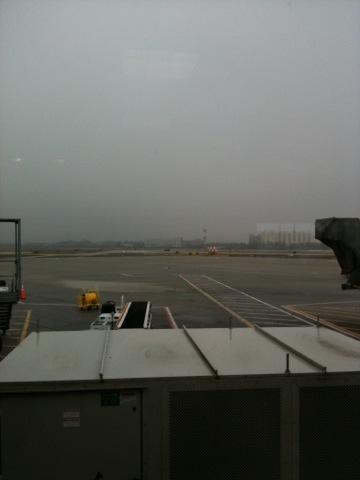
As you can probably tell from the picture, we have lots of fog and no plane… This is problematic. Assuming that this problem in remedied soon, pray for us that we have a safe trip and a fruitful week!

20111205-091744.jpg