The Clares

With the Capuchin Poor Clares in Wilmington after dinner Sunday night.

One of the things that I’ve learned this year is that I cannot truly know Francis without also knowing Clare.  She was influential in his life around the time of his conversion, was in close relationship with him throughout his religious life, and after his death, she and her order continued to protect Francis’ words and relics from distortion and abuse. Clare’s charism was that of Francis, and Francis’ charism was that of Clare.

While we haven’t devoted a lot of time to Clare in an academic sense [yet], we have spent much of this year developing a relationship with her order of sisters.

Here in Wilmington, the Capuchin Poor Clares at the St. Veronica Guiliani Monastery have been our closest companions. Not only do these sisters host us for Vespers and mass once each per week, they have also included us in two of their sisters’ renewal of vows ceremonies, and invited us to observe Francis’ death and feast in their monastery. Just last evening we were invited into their cloister for a wonderful dinner and more than an hour of laughs. As a bonus, Sister Dolores (kneeling in the front) is also our habit maker and Spanish teacher, and so is very important to many people in our province!

Because our relationship with Clare and her sisters is so important, we have found ourselves venturing great distances from Wilmington to be in relationship with them (and vice versa). The biggest of these gatherings is of course the Franciscan workshop I’ve mentioned in Finally, a Franciscan! and Acting Like Friars at the Graymoor Spiritual Life Center. You can see from the picture that we met a lot of Poor Clares from all over, and that the existence of such a gathering proves the importance of developing a relationship with one another early in the formation process.

The extent of our traveling does not end there, however, as in the past six months we have visited the Clares in Wappinger Falls, NY and Chesterfield, NJ for prayers, mass, and meals. Both of these visits were refreshing (and entertaining!) chances to share our vocational experience with others so close to us on our journey of faith, and to thank those closest to us in prayer for all of their support. I do not believe that the friars would be the way they are today had it not been for the prayers and direction of the Clares throughout our history.

And thus, our relationship must live on beyond initial formation, an outside of formal gatherings. We’ve been given the opportunity to travel as a group to meet a number of excellent monasteries, and now it is up to us to foster these relationships and continue the bond between our two orders. Edgardo and Ramon have already started: this past weekend they took it upon themselves to travel to Langhorne, PA for the solemn profession of one of their sisters. I hope to do the same over my upcoming break and make a trip to see the Traveler’s Rest, SC sisters, where there are a number of wonderful sisters there that have been praying for me and sending me letters throughout the year. How can we possibly be a Franciscan without knowing his sisters? I’m not sure, nor am I going to find out!

Living Together

Just like newlyweds, there will be conflict in new friar communities unless there is mutuality and compromise.

As I mentioned in my last post, A Life to Share, intimacy among brothers is something for which we all strive, and is something I see already present in my life. What I failed to mention in my last post is that being intimate with a brother and living together are completely different things. Ask any newly married couple having just moved in with one another or best friends from high school that decide to share a dorm room in college: living together places a strain on any relationship, no matter how close.

One of the things that our postulant director has said to us early and often is that the source of conflict in religious houses is not theology or politics: it’s kitchens and bathrooms. Domestic disagreements, he says, over how clean an area should be or who’s responsibility it is to do certain chores, is the source of all household conflict.

So far in my experience of fraternal life I would have to agree. The fact of the matter is that there are no universal standards by which one is expected to live. Because each of us were formed by different people in different settings, we each have different expectations for the way things should be, making it inevitable that conflicts will arise. The way the table should be set, the position of the toilet seat when not in use, the length of time clothes may sit in the washer/dryer, the level of dust/grime/stain/smear that is acceptable before something must be cleaned, and the time allowed to clean one’s dishes, are all examples of issues for which there is no “correct” answer; each of us answers them from our own experience before entering community life, and must attempt to integrate them into one another.

When this is not done effectively, I envision one of two things happening:

The first is that the friary can turn into a college apartment. In this setting, cleaning is only done when it is convenient or one’s threshold of disgust is met, allowing for all lifestyle choices to be acceptable. It’s a “if it bothers you, you can clean it” mentality in which the majority of people feel very comfortable in their surroundings, while those few with the highest demand for cleanliness and order are left with the majority of the responsibilities of the house. This is not a desirable living situation because it does not take into consideration the needs of all, and places an unfair burden on the few.

The opposite extreme is just as likely: in order to make those with the highest demand for cleanliness and order feel comfortable, the other guys in the house are required to maintain a pristine level of living, one that far surpasses their own needs. This method guarantees that no brother will feel uncomfortable or taken advantage of, but it also means that the whole house is at the mercy of a few individuals. This is also not a desirable living situation because it does not facilitate dialog or expect each brother to make sacrifices for the sake of all.

Now before I get myself into trouble, neither of these extremes describes the way in which we live here in Wilmington, though I do see elements of both from time to time (as I did also in college and at home.)

Like any group of people trying to live together, what’s needed most is mutuality. Each person needs to recognize that there are many right ways of doing something, and that at times, it’s not only acceptable, it’s necessary, to live by another’s standards. Sometimes that means being patient and accepting the idiosyncrasies of others, either accepting it the way it is or doing a little more work to have it the desired way, while other times it means finding a respectful way to ask a bit more of a housemate. The truth of the matter is that it is all compromise, but that compromise isn’t so bad if all parties are involved in the decision and are equally looking out for their own benefit and the benefit of the whole community.

As I continue in my journey as a franciscan friar, constantly living in fraternity, I need to recognize that I am just as guilty of annoying my fellow brothers as they are me because we come with different expectations for one another. If I fail to recognize this, and seek to live my own lifestyle at the expense of others, living together is going to be very difficult for us all. On the other hand, if I’m open and dedicated to the life of the fraternity, living together will simply be a means by which we may form and nurture meaningful, intimate relationships for the rest of our lives. I guess ultimately the question is this: do I wish to live individually by my own rules, or do I wish to give up some of my own expectations so as to live together, fraternally?

I choose to live together.

A Life to Share

Celibacy can be a bit of a deal breaker. Ask any young Catholic man or woman, active in their faith, why they are not considering some form of consecrated life, and I can almost guarantee that celibacy is one of the reasons. “I really want to get married,” you might hear. From my own experience, this was the largest hurtle to jump.

But despite what many may think, including even those going through the discernment process, I don’t believe that the problem is abstinence from sex (at least not entirely). Believe it or not, there are still many young people in this world who have not discarded chastity for the loose sexuality embraced by popular culture. (It’s not what you hear on t.v. or see in the movies, but it’s still out there, trust me!) And yet, of those who have held on to or readopted this unpopular virtue, there is an even smaller minority of people wishing to do so in the form of consecrated life. Why is this?

The reason has everything to do with intimacy, or rather, the perceived lack of intimacy in religious life. When I look back to the time when I used “I really wanted to get married” as an excuse, I believe what I was really saying was, “I really want someone to share my life with.” For much of my life, I saw marriage as the only way to do this. When I looked at the priests and religious I knew (which was only a few), all I saw were people growing in age, living alone, and frankly, looking either miserable or lonely. From this narrow experience I concluded that it must take the type of holy person that is willing to sacrifice any chance of intimacy for the sake of a worthwhile ministry, and I knew that I was not that holy person.

The first step in my transformative move toward religious life was a painful, yet inevitable one: I matured. As I grew older and developed emotionally, I began to form relationships that were much more meaningful than being “just friends” while being wholly different from my romantic partners. I had begun to realize that intimacy was much more than just romance. For an adult, this is painstakingly obvious. But for me, the realization that I could be fulfilled and sustained emotionally, spiritually, intellectually, and even physically (in a different way of course) from something other than an exclusive, romantic relationship, meant that I didn’t need to get married to have all of my needs met. It was not until this realization did the prospect of entering religious life even deserve my attention.

At some point, however, it did, and I was forced on an excruciating journey of heart and soul that tore me into pieces for many months.  Can I do that sort of work? What about my girlfriend? Do I want children? Which community? Have I lived enough to know? Little by little I grew more comfortable with idea, developed a fondess for St. Francis and became to accept almost every aspect of Franciscan life. I could do that.

There remained one final question: were these specific guys, the members of the Franciscan Friars of the Holy Name Province, guys that I wanted to share my life with? It’s one thing to understand and to like the idea of fraternity in the way St. Francis instituted it, but another thing entirely to live it with actual people. I was convinced that religious life could fulfill me in the way I sought. But would it?

The long and short of it is a resounding yes. As I’ve come to know many of the men in this province over the past five years, I have felt a distinct growth in many of them from mere acquaintances, to familiar friends, to something potentially much more. While I’m growing to understand each member as a brother owed my unconditional love and respect, I have nonetheless grown close to a few in a very spectacular way. I find myself catching glimpses of an intimacy with my brothers that is to come, fulfilling and sustaining me for whatever lies in the road ahead.

It may be true that I will never be fulfilled in such a physical way that a wife could provide: I am never going to have sex. Frankly, I’ll survive without it. But when I begin to look at celibacy through the lens I’ve described above, the abstinence from sex no longer appears to me as a restriction to be followed or a sacrifice to be endured; rather, it is the freedom, and the call to love more broadly than would ever be possible while vowed to just one person. I know that I feel called to this life, and that it is a life to share.

Easter Internships

With Easter comes new life, and new opportunities. Alleluia!

Alleluia! He is risen! I hope and pray that everyone had peace-filled Holy Week and Easter celebrations and that we’re all rejoicing in the newness of life given to us by the resurrected Christ. It can be a very crazy time of the year, especially for those in liturgical ministries, and so I hope it was also a time for prayer and reflection (and not just work!)

One of the particular things that the postulants do for Holy Week each year is to go out on a “mini internship” at one of Holy Name Province’s many ministries. Because no one place could hold all five of us at once, we went out two-by-two (-by-one) to three different locations: Sergio and I went up to Mt. Irenaeus in West Clarksville, NY, Ramon and Dennis went to St. Francis of Assisi Church in Manhattan, and Ed aided St. Paul’s Church here in Wilmington, a place with only one priest to handle all of Holy Week.

One of the things we realized almost immediately was that there was almost nothing in common with any of the three locations. Mt. Irenaeus houses six friars living on a mountain top, hosting 25-50 people at the table for intimate liturgies and inclusive meals in their home; St. Francis of Assisi Church consists of more than 25 friars living in the busiest place in the country, serving literally thousands of people per day in a much more extraordinary, yet anonymous liturgy; and St. Paul’s is run by one friar, and is a niche parish for Spanish speakers in a poor neighborhood of a small city. In terms of ministerial experiences, we could not have been farther away from one another.

And yet, when we shared with one another our experiences of the week, we described our time with the friars and their ministry in almost the exact same way. Though we had seen it briefly in our trips throughout the year, such an experience made it so clear that there is a particular charism that we as friars bring to our life and work that is identifiable no matter the ministry or location.

The most obvious of this was that each ministry was first and foremost a community. Even at St. Paul’s where there is only one friar working at the ministry, each location had at least three friars with which to share meals, pray regularly, and recreate. This is absolutely the cornerstone for our Franciscan life and mission. Unlike most other communities, we were instituted to be a brotherhood, out of which flows ministry, not the other way around. It is only after we establish a healthy, prayerful community can we begin to understand the needs of the community and attempt to fulfill them.

Thus, at all three locations we noticed that the friars collaborated constantly with the laity, choosing to lead with rather than speaking in directives, even if that the latter might be much easier. At the root of this, I believe, is a desire of friars to invite others to enter into each others’ lives, so as to not only teach, but to be taught. To do this, each community finds itself eating, praying, and socializing with the laity outside of normal “work” circumstances, treating each other as equals on the pathway to faith.

At each place, this manifests itself in different ways, but the effect is the same. Whether it’s having a planning meeting before the liturgy so that the laity can not only participate, but add their own gifts to the liturgy, as at Mt. Irenaeus, or it’s making the sacraments accessible to the people, even if it means taking three-hour shifts for 12 hours a day for confession, or saying the first reading in seven different languages, as in NYC, there is inclusivity and humility in the way the friars lead. In all of these cases, it’s not about what the friars want, but rather what the community needs. I believe that it’s this attentiveness to listen and provide that makes us successful in our ministries and inspiring in our lay movements.

* * *

Obviously there was more to the experience than I am able to share, but I do have a number of great pictures here of Mt. Irenaeus for those interested. You can also find a better description of the place there, as well as at their website, http://www.mounti.com/.

This Moment Is Sufficient

A simple meal, a breviary, and solitude. What more does one need to be with God?

After more than three weeks of analysis, decompression, and procrastination, I finally have a few thoughts on my hermitage experience.

***

I was a Franciscan hermit for nearly 95 hours. With the exception of an hour and a half a day for mass, dinner, and evening prayer, I was left a in a one-person cabin by myself. I was without a phone, computer, television, newspaper, and clock, leaving me with no way to know anything about the world outside of what my own senses could perceive. I was alone with myself. I was alone with God.

At the onset, I was very excited, but unsure of what was in store. I knew from my experience at Mt. Savior (Living In the Moment) that prayer did not have to be planned, systematized, well-constructed, or even articulated in an understandable way for it to be affective. Rather than seeing prayer as something that begins with the sign of the cross and ceases to exist with the final Amen, I needed to understand prayer as more of a constant act, a conscious state of being that both informs my every action and is informed by my worldly experiences. Every moment can be a prayer if I allow it to be. With this in mind, I closed the door, entered into solitude with this to say:

So what’s my plan? I have no idea. I’m afraid of the free-flowing, “do-whatever-I-feel-called-to-do” type retreat because it has the possibility of getting nothing done. On the other hand, too much planning (or even any at all) doesn’t leave room for God to operate. In that way, I’m going to err on the side of inefficiency. I’m going to let God lead.

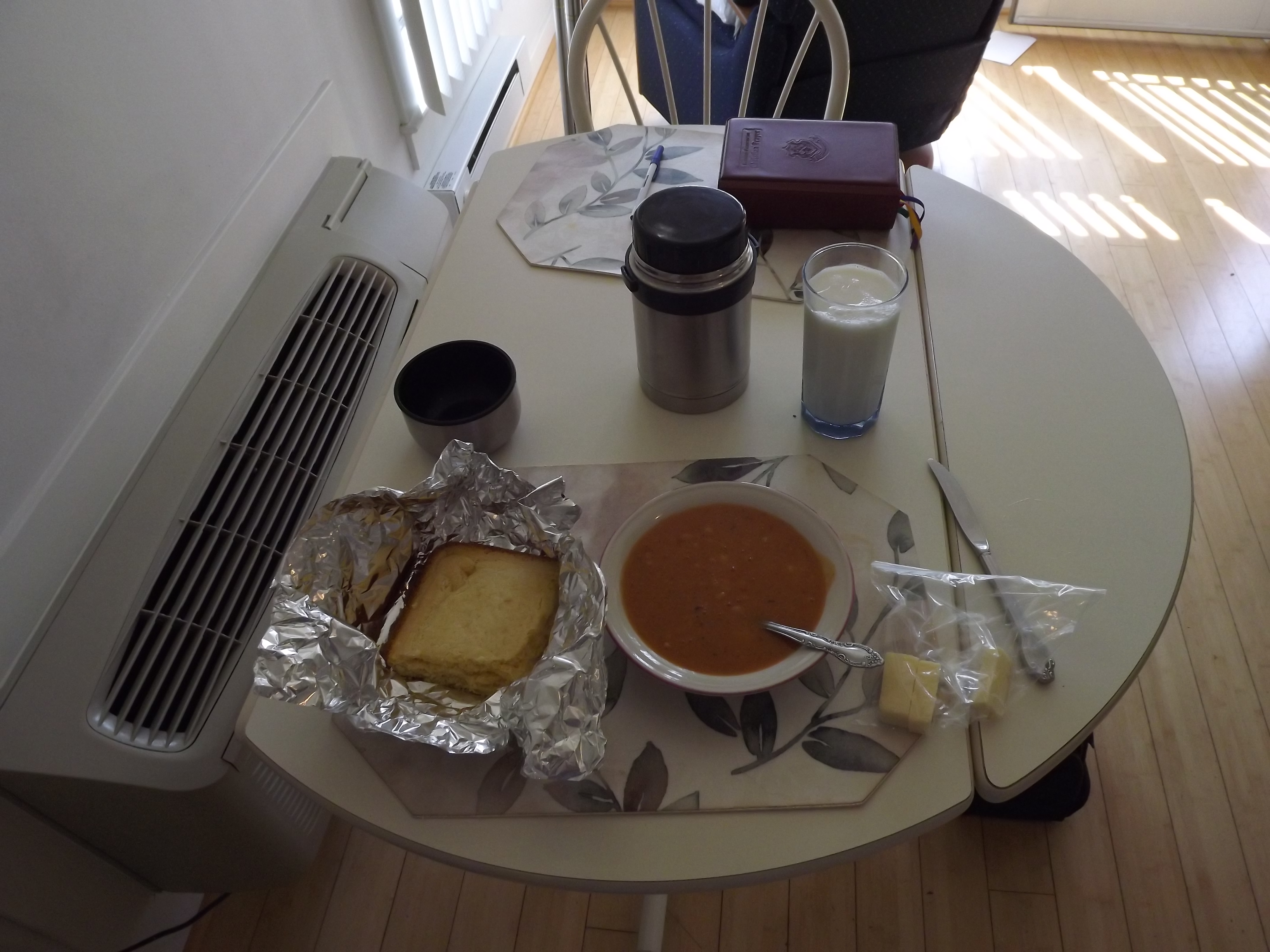
With that said, I also knew that there was absolutely no way that my IFNJ/3 personality was going to be able to survive five days of solitude without at least a framework from which to start. Each morning I woke up with the sun around 7:00 and prayed morning prayer on my porch. After a simple breakfast, I would return to the porch to gaze at nature and contemplate a few things with God for an hour or so. When the time felt right, I would come in to shower, pray midmorning prayer (which, with midday and midafternoon, only takes about 5 minutes) and head out for a hike. After a good hike it was usually time for lunch, and so I sat an ate my humble meal (pictured above) with a prayer. By this point in the day, I started getting a little itchy and needed to actually accomplish something (or I would go crazy), so I usually sat for a while and read either from the Gospels or Francis’ writings, filling in the time before dinner with “productive things.” The bell rang sometime around 4:30, and it was off to Mass, dinner, and evening prayer with my brothers, before returning ever so soon for some more solitude. Partially because I was bored out of my mind at this point of the night, and partially because I was tired, I found myself heading to bed with the darkness, what I can only guess was about 8:30 or 9:00.

It may seem like a lot of “planning” for someone who was letting God lead, but each day was somehow entirely different. One day on my hike, I prayed my own Canticle of the Creatures in the style of the Rosary, replacing each Hail Mary with a praise of God through one of his creations, followed by Francis’ prayer before the crucifix. This was completely off-the-cuff, and to no surprise, moved me in a profound way. Similarly, I decided on another day to observe each of the hours of the Divine Office, but to use my own prayers instead of the ones in the breviary so as to be more attentive to where I was being moved at that moment.

And do you know what? Even if it does seem like a lot, it took me more than twelve hours to complete it all! Do you have any idea how quiet, quiet can be when there’s nothing to do but sit and listen? Better yet, do you have any idea how much there is to hear/feel/understand/know when you’re still enough to let it happen? It’s dangerous, I tell you!

In the stillness of the moment, I was reminded of two people that I had neither spoken to nor thought about in years. What makes these individuals special is that they hurt me in a profound way a long time ago, and I have bottled my resentment towards them ever since, never seeking to let go or to seek reconciliation. Only when my heart was still enough to hear God did I realize that my subconscious bitterness towards both of them had been stinting my relationship with God, and that it was time for me to “unclench my fist” so to speak. Was it possible for me to love God while hating my brother, I asked myself. Providentially, the Gospel that afternoon was The Parable of the Unforgiving Servant (Matthew 18:21-35), a Gospel that gave me a pretty good answer. Without the openness to be still, I would have never heard in the way I needed to hear it.

Which brings me to the culminating point of this post: this moment is sufficient. Unlike in our Western, capitalistic society in which we’ve been trained to want more and to work to achieve more in the future, God offers everything that we could ever possibly want in each present moment: Himself. As C.S. Lewis correctly points out in the Screwtape Letters, “The present is the point at which time touches eternity” (#15). To be more concerned with future possibilities than with present realities is it to implicitly accept a false existence, a construct of our own imaginations that bears only a semblance of truth, over the concrete Truth presented to us by God in this moment alone. While we should always remain hopeful for the future, and plan for it in the sense that we will be open to the new possibilities that God may provide, to allow either of these to distract us from the fullness of God’s presence in our lives in this very moment is utterly useless. When I was still enough to listen, I realized that there’s nothing I need to be left wanting for. In this moment, I can know God.