The “Root” of Our Charism
Manual labor and brothers: the Franciscan way.

After a few long days of packing, traveling, and unpacking, all seventeen postulants and both directors have settled into their new home here at Saint Bonaventure University. Starting Monday, we’ll be in full campus swing, taking classes, attending communal prayers, hitting the books, and of course, spending quality time with our brothers.

But that’s not until Monday and we’ve been here since Tuesday/Wednesday. So what have we been doing to fill the time, you ask?

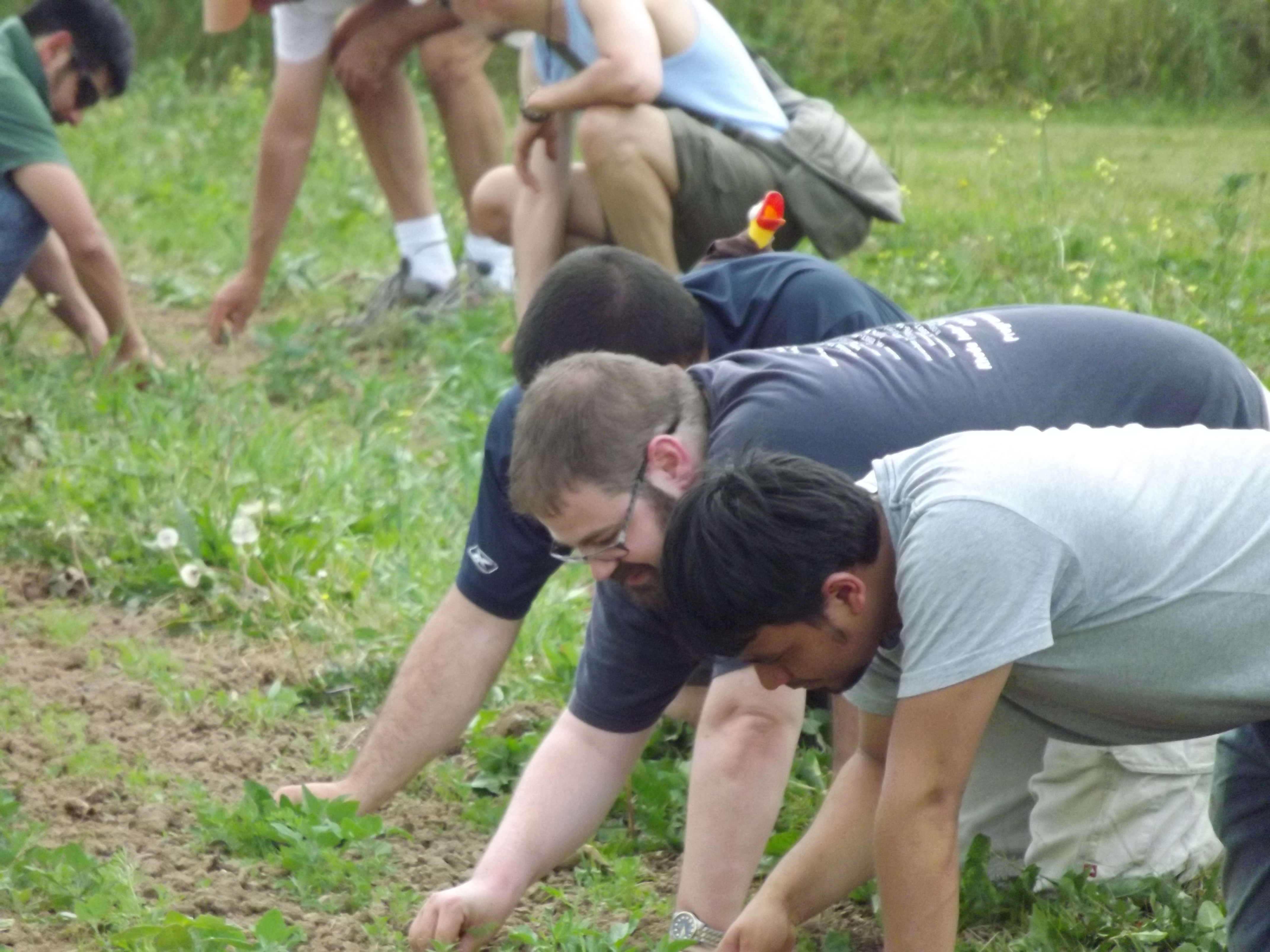
If you guessed weeding carrots at an organic farm, you’re right! As a way to get in touch with the original Franciscans that worked with their hands each day and took for wage only enough food for the day, we rolled up our sleeves and put in an honest day’s (three hours) work. We left dirty, sweaty, and exhausted two days in a row, but not without a sense of accomplishment for a job “well” done (by which I mean, “well, it’s done,” and not to indicate any quality in our work, as none of us appeared to be called to this line of work…)

That being said, as much as this type of labor would not fulfill me as a full-time ministry, there is something to be said about our ability as friars to do the “dirty work” ourselves rather than leaving it to someone else. Sure, I understand that it may be more efficient or even more cost effective to have outsiders take care of tasks around the house (i.e. cooking, cleaning, maintenance) so that we can focus entirely on our work for others in our parishes and schools. But is this the sort of trade-off we want to make? Just as Francis told Anthony he could teach theology as long as he didn’t “extinguish the Spirit of prayer and devotion,” we should not wish to approach our ministry with the risk of extinguishing our Spirit of poverty and humility.

By that I do not mean to romanticize manual labor or in any way to say that it is more fruitful to our charism than intellectual labor is. Rather, what I mean to say is that a friar or friar community that refuses to engage in any form of manual labor or “dirty jobs” for the sake of others, runs the risk of becoming lazy, developing a feeling of entitlement, and ultimately losing the sense of poverty and humility that is at the root of our Franciscan charism. I would much rather clean a toilet, cook a mediocre dinner, cut the grass in the hot sun, or clean a hundred dishes, than allow myself to feel that I deserve these things to be done for me because the community needs me in some way.

My hope, as always, is that this reflection will be taken simply as that: a reflection of what I feel to be an ideal for my life. In no way do I mean this as a criticism to those who do have cooks, cleaners, landscapers or anyone else serve them on a regular basis, whether one is a friar or not, as there are always different circumstances that call for different solutions.

What’s Next?

My new home for the next six weeks

After a five-week Vocation Vacation, a period of discernment away from religious life to determine whether or not to return to it, I have come to a very shocking conclusion: I’m going to return to Delaware to continue my formation as a Franciscan Friar. Okay, so it wasn’t all that shocking, but it is a conclusion.

So, what’s next? If there was one thing that was unanimously misunderstood among the people I spent time with this break, it was the upcoming steps in the formation process (and who can blame them?) Everyone knew that we would eventually make it to Wisconsin, but most didn’t know when that would be.

For now, Wisconsin (the second year in the process) will have to wait. For the next six weeks we’ll be attending summer classes with our fellow postulants around the country at Saint Bonaventure University. All of us are enrolled in two introductory level graduate school classes, Francis: His Life and Charism and Survey of Franciscan History, so as to formalize a lot of the information we have been learning all year.

The time together will go beyond simply our classroom experience, however, as each of us will be attending integration seminars, sharing meals, worshipping together, and living together (the true test for next year). The six weeks will be a time for academic advancement, but the true growth will no doubt occur in our ability to form and build relationships with our new brothers. This part will certainly be more difficult than the work inside the classroom, but potentially more fulfilling.

We’ve got a busy few days and weeks ahead of us, but look for more posts with a bit more regularity once we’re up and settled in Olean.

I Think It’s Time We Took A Break

Walking away for a little while helps us know we were in the right place all along.

With part one of the postulant year coming to a close, it’s time for another Vocation Vacation. Like our break at Christmas, we’ve been encouraged to break ourselves from the routine of the religious life so as to discern its effect on us (and us on it) over the past nine months. It’s a helpful reminder that we still haven’t formally committed to anything about the Order, and so are not bound by any vows in this process. Essentially, stepping away may be the best way to take a step closer. (This is not to say that we’re free from the Ten Commandments while we’re gone, but you know what I mean.)

The challenge of this break will no doubt be its length. Five weeks is quite a long time. With no money, less contacts than before, and a limited amount of responsibility, there is plenty of room to get bored. As our director told us in our last meeting, however, this is actually part of the design: with so much time and probably very little to do, it’s inevitable that we’ll begin reflecting on the year and hopefully realize how much religious life has come to mean to us.

As for me, I have little evidence to believe my director to be wrong. I will be spending one week traveling around visiting friends from college, during which I’ll be attending a Dave Matthews concert, but other than that I have four weeks without plans. I’m looking forward  to spending a lot of time with my family, possibly getting to the beach for a few days, and just relaxing without any stress or responsibility. As it will be the last time home before I’m a simply professed friar (occurs in 15 months at the end of novitiate), there are also a number of practical things I have to take care of, such as putting my finances in my parents name, getting rid of a few superfluous possessions, and taking visits to the doctor and dentist while I’m still covered under my parents insurance plan.

All in all, I’m looking forward to the time to catch up, reflect, recharge, and dream for a life to come as a friar. If I find the time, there are a few topics on which I’ve been meaning to post, so look for a few sporadic posts over the coming weeks. Otherwise, pray that I have safe travels and check back in June for the next step in the life of a friar in training!

The End As We Know It

It only feels like it is!

After nearly nine months of attending workshops, meeting friars, ministering, praying, reflecting, and so on and so forth, the postulancy year is just about over… Well, with the exception of the final three months we have yet to complete.

With all the goodbyes we’ve said over the past few days, and the fact that our bodies are naturally attuned to the academic calendar, we’ve all allowed ourselves to believe that we were approaching the end by completely forgetting about the final three months. This minor lapse in memory aside, the fact of the matter is that the postulant year will come to an “end as we know it” next Saturday.

The reason I say this is because on that day (which is the day before Mothers’ Day) we will all board flights for our respective homes for “Spring Break.” For five weeks, we’ll break ourselves from the typical routine of a religious house and be thrown back into the secular world, free to run our lives how we please and adopt any old habits we so desire.  Like our Christmas vacation, it will be both a test and an affirmation of the life we’ve chosen as friars.

Upon returning from vacation (on the day after Fathers’ Day), we’ll have one day to do laundry and repack before it’s off to St. Bonaventure University for a retreat with the other postulants and five weeks of classes at the Franciscan Institute.  Living in a community of more than twenty brothers divided into eight townhouses, we’ll forces ourselves back into the “normal” routine of the year, i.e. communal prayer, but the experience will be an entirely different one than we’re used to. It will be, in a sense, a different postulant year with different expectations and challenges before us.

Assuming that we all survive such an experience, we’ll spend the final two weeks of the summer in Wilmington, at which point our entire focus (I imagine) will be on preparing for the Novitiate.

In this way, I think it’s acceptable, even necessary, to say that the postulancy ends in less than a week. From a psychological standpoint, it brings closure to the feelings each of our subconsciouses are already recognizing, that the end is near, by allowing ourselves to feel accomplished with what has already passed. The clear end of one part, and the clear beginning of another, though completely artificial in nature, allows each of us to return rejuvenated and excited for the final three months because it is, in a sense, a new year. The temptation to coast through the final three months is almost eliminated, then, because the mindset is very different: instead of “trying to get through the last little bit of the big year,” we are “starting a new chapter in our lives.” The latter is something for which we all need to strive.

Ultimately, no matter how I explain it to my subconscious, the point I’m making to myself through this reflection is that the year is not over, and that there is still room for growth and discernment. To allow myself to believe that we’re approaching the end is to close myself to new experiences that may shape my life in unknown ways. It may be the end of the postulancy as we know it, but if we begin to see each day as a new day to be formed by God, a chance to break in the habit, what’s it matter what “year” it is?

Learning to Say Goodbye

We formed some great relationships at the Jeanne Jugan residence this year.

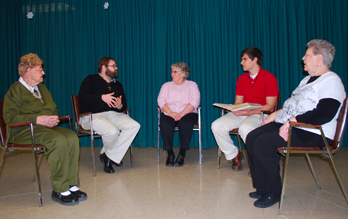
Today was our last day volunteering at the Jeanne Jugan Residence. After more than seven months of Bingo, room visits, word games, Bible study, and the like, our time came to a close with a farewell “Berry Special Sendoff” (named for the strawberry pound cake that was served). A number of sisters, staff members, and residents came to the microphone to say some kind words, and we had the chance to walk around to all of the tables to say goodbye to the men and women that we had gotten to know so well. The whole day was quite touching, and great way to end.

As I look back on the year and wonder what effect Dennis and I may have had on the residents, I come to realize that this has been just as fulfilling and revelatory for me as it has been for them. Here are two of the things that I found helpful for my future in ministry.

I will grow to love ANY ministry 

Back in September when we were assigned ministry locations, I wasn’t exactly thrilled with the prospect of working at a nursing home. Though I was open to the idea, and by no means fought it or showed any disappointment, there was certainly a part of me that wished for something else. Ugh… a nursing home?

What I came to realize was that, even though I wasn’t a part of some newsworthy effort to radically “save the world,” this ministry effected the lives of a number of individuals in a profound way, making it just as worthwhile as anything I could have done. Like the story of the person throwing back starfish into the water despite the impossibility of saving all of them, I realized that “I made a difference to that one!” and that is all that matters!

There’s no doubt that I’ll be placed in ministries throughout my life that are not my “ideal” choices. After having this experience I now know that it doesn’t matter. Every place I go there are going to extraordinary things to be done, incredible people to meet, and discoveries to be made about myself. In the end, if it’s God working through me, who am I to decide where that should and shouldn’t go? Because of this, I think it will be very difficult not to love every ministry as my own after only a short time.

No ministry is mine

This gradual love for each ministry can, however, lead to a different problem: the inability to give it up later. Transitions like the one we made today will more or less dominate the rest of our lives. As transient preachers, Franciscan friars rarely stay in one place forever. Whether it’s three, six, nine, or even twelve years, we all know that our ministry assignments will probably never be permanent, and that at some point we’ll be asked to pack up and move on.

In this way, it can be difficult to realize that no ministry is mine. More than likely a ministry existed before I got there, and most definitely will there be people left behind doing work after I leave. As attached as we may get to a particular place, ministry, or group of people, we must remember that our vocation was not to work in that specific circumstance alone; we were called to spread the Gospel wherever it needs spreading.

As I found out today, this second point is much harder than the first. Just because we live a transient lifestyle does not mean that we do not engage in deeply connected relationships; all it means is that we must cope with letting these connections go shortly after they’re developed. The important thing to remember in all this is that, no matter how difficult it may be to leave a beloved ministry now, there will always be another one prepared for us by God just up ahead. Today, I may have learned how to say goodbye to people I have come to care for greatly, but tomorrow I will begin to say hello once more to the new possibilities that this life has to offer. What a beautiful thing this is, the life of a friar.