Seeking Insecurity

CoinPoverty as a virtue is a difficult concept to define, and an even more difficult concept to get a group of friars to agree on. My concept of poverty is different from Br. X’s whose concept of poverty is different from Br. Y’s. Do we imitate the poor, or do we attempt to eradicate poverty? Is the cheapest option the best, or should we seek the longer lasting and human-conscious options that are more expensive? I present these conflicts not to trivialize or relativize the issue (as I plan on giving my own answers to these questions at some point), but to point out that “poverty” as a goal is very vague, is difficult to define, and is easily spiritualized until actions are no longer virtuous at all. In order to remain faithful to Gospel and the spirit of St. Francis, I think that additional language is necessary to focus our efforts.

One of these words that I have written about before is sufficiency. While the post itself focuses primarily on being content with the present moment, This Moment is Sufficient was stirred by a desire to have only what I needed, spiritually and physically, without any excess. Over the past year, this has been a much more helpful word in terms of evaluating my life as a friar than the word poverty. “Do I have more than I need?” is a much easier question to answer than “Is this keeping with ‘poverty?’” Asking myself this on a regular basis has helped me to live more simply, and to remove any and all things from my life that I do not need.

But with my reflections around kenosis throughout this past year, I found that an ethic of sufficiency needs additional direction in order to live a Gospel life. To be sufficient, is by definition, to have enough. To have this as a goal, while it does limit the possibility of living with excess, is to also never experience deprivation of any kind, to never feel worry or doubt about one’s livelihood, and to never relate to those who do not have enough. On it’s own, it can allow us to be too safe. Even if we live within our means and without extravagance, when we have “enough”, especially when “enough” is accompanied by security and predictability, we are allowed to live a life that is comfortable, and worst of all, complacent. When this happens, we begin to fail Gospel poverty and our communities will inevitably fail with it. With high security and predictability, there is no room for trusting God or looking to God to provide because we become the rulers and suppliers of our own wellbeing; there is no need for a sense of urgency in our work or in our communities because the status quo does not bother us; there is no opportunity for solidarity with the poor (or even with middle class) because we can no longer relate to the anxiety of not being able to make ends meet.

Our natural response, however, is to do the complete opposite. Not only do we not seek the fruits of insecurity, we do everything in our power to rid every ounce of danger from our lives, often times going to great lengths to acquire it: we work too much, we attack others as a way to defend ourselves, we store up treasures that cannot save. We believe that our youth, skills, health, possessions, and social bonds, will last forever, that they will keep us happy and safe from all harm. This is a façade. It is the acceptance of the lie that the gift is more important than the One who gives that gift. It is the acceptance of the lie that we are capable of controlling our own fate, that all that we have acquired is somehow our own to possess, and that we received it based on our own merit. It is the acceptance of the lie that we our own saviors. 

So what does “seeking insecurity” look like? First of all, it does not look like being irresponsible, frivolous, or lazy. When we seek insecurity, we’re not making bad decisions to squander away the gifts we’ve been given. One does not strengthen their relationship with the Gifter by misusing his gifts. The real virtue lies in simply accepting that insecurity is all around us. When we accept the poverty that we have absolutely no control over our fate, that all we have is freely-given, unmerited favor from God, we begin to relate to our possessions, to others, and to God in a completely different way. With this realization, all is gift, and God is the only one worth relying on. In times of great favor, we give glory to God; in times of trouble, God is the first we seek for help; at all times, we are unwilling to waste our lives acquiring, maintaining, and protecting possessions that fade at the expense of relationships that last.

Obviously, there are just as many holes in this ethic as there are with an ethic of sufficiency, but I think together they offer greater grounding in Gospel poverty than “poverty” alone. They force us to look at the issue outside of dollars and cents alone, and focus the discussion on the purpose for the virtue in the first place: relationship with God. In the end, I think that we are only truly free when we accept that we are not in control and choose to seek the One who is. That’s true insecurity worth seeking.

Kenosis: What Could I Let Go Of?

At the beginning of the year I was moved by Jesus’ Kenosis, his self-emptying of his divine privilege, to become human:

“Though he was in the form of God,
[Jesus] did not regard equality with God
something to be grasped.
Rather, he emptied himself,
taking the form of a slave,
coming in human likeness;
and found human in appearance,
he humbled himself,
becoming obedient to death,
even death on a cross.” (Phil 2: 6-8)

Jesus, the second person of the Triune God, chose to empty himself of his power, his will, his security, his appearance, and his life, in order to take on our humanity. What an act of humility! Rather than being called king and worshipped by angels, he was born into poverty, disrespected by many, and executed an innocent man. What an act of trust! Instead of being able to rely on his own authority or ability, Jesus left himself at the mercy of his Father, and remained obedient to the end. What an act of love! John tells us, “God so loved the world that he gave his only Son.

Jesus’ self-emptying is the perfect act that Francis spent his entire life attempting to imitate. It is the reason that our Order is called the Order of Friars Minor, the “lesser brothers,” and why poverty is so crucial to our charism. Our lives are an act of emptying anything and everything that could leave us feeling self-reliant, in control of our own fate, proud, or above others, in order that we may be totally reliant on God’s love and mercy.

Moved by this, I decided to make an inventory of absolutely everything that I could claim as my own. If I were to follow the example of our Lord with my own act of kenosis, what would I need to give up in order to be completely reliant on God in humility, trust, and love?

At the top of the list were all of my possessions. These were the easiest to think of and included my laptop, camera, music, pictures, and clothes, among other things. I’ve reflected before on the need to keep possessions simple and to make sure that I use them in keeping with Gospel poverty, but now I wonder what it would be like to renounce ownership or use of everything. Luke’s Gospel mentions a number of times that the disciples of Jesus “left everything and followed him.” Could I do this?

As if that question isn’t difficult enough to answer, the rest of the inventory only got harder as I went on. What about all of my legal assets? I have a driver’s license, a decent credit score, US citizenship that includes a right to vote and protections under the law, and as a religious I am tax exempt. The list goes on. I have physical assets such as good health, all of my limbs, working senses, free of any malformations, and fit enough to perform all basic tasks on my own. I have intellectual assets such as normal memory skills, basic brain functioning, and an ability to study at a university. I have social assets that allow me to keep a desirable reputation, friendships, respect from peers and superiors, and the occasional praise. Lastly, I have assets related to the Church: personally, I am in good standing, have a right to teach and preach, and have the backing of an Order, and structurally the Church is alive, it is organized, and there are many opportunities to be active in it in this country.

So I ask myself: What if, like Jesus, I was an alien in a foreign land, was an innocent man treated as a criminal, or was an outcast in society? What if I were to contract a disease that left me physically or mentally dependent on others for basic tasks? What if my reputation was ruined, people no longer liked me, or I was left without any friends? What if the Church was to reject me, the Order was suppressed, or the Church structures were to crumble? Or what if, in a much more likely situation, I was given a direct order to do something without consulting my desires?

In moments of loss, whether it be life-changing or normal day-to-day disappointments, self-inflicted or imposed, there is the possibility for the greatest gain. In recognizing the futility of all of the many things we claim as our own and divesting of ourselves the ownership, feeling of entitlement, and need for any one of them over God’s love, we become free. In these moments, we are being asked to focus less on the gift that has been taken away from us and more on the One who gave it in the first place, the One who wishes to give us even more in return. In times of self-emptying, we realize how futile it is to put our trust in money, good looks, education, or a host of other things that have meaning to us, things that do not last, and how even more ridiculous it is to fight endlessly to maintain control over them.

My goal in all of this is to free myself of any need to control, appropriate, defend with violence, or hoard any gift from God as if that gift were an end in itself. In making this inventory, I seek not to rid myself of all of God’s many gifts, but to recognize the generous bounty of God in my life and to be more dependent on him.

The image I leave with is one that I recently heard in a homily. God’s abundant generosity is like the air all around us. We are gifted freely with more life-giving air to breathe than we could ever consume, and yet, we have a tendency to hold onto this breath, to claim it as our own, and to be afraid to exhale. What good is that gift to us if we hold onto it? We will eventually suffocate, and the air will leave us whether we like it or not. What I’ve learned from Jesus’ experience of kenosis is that it is only in the exhale, the letting go of all that we have, that we are ever able to receive anything else. It is in the letting go of all that we cling to, and the trust that God will provide for us just as he did before, that we are free to love and be loved by God.

Tying The Knot(s)

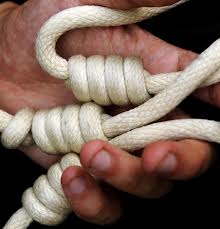
The three knots in the Franciscan cord symbolize the vows of poverty, chastity, and obedience

The three knots in the Franciscan cord symbolize the vows of poverty, chastity, and obedience

Tomorrow morning I will profess my Temporary, or “Simple,” Vows as a Franciscan Friar. What’s that mean, you ask? It means that starting tomorrow I am bound by canon law and the Order of Friars Minor to live the Rule of 1223, as interpreted by the General Constitutions and Statutes of the Order, “in obedience, without anything of my own and in chastity,” for a period of one year. For the next four years, I will have to renew them each year until I am ready to take Solemn, or “Final,” vows.

For some, especially in my commitment-fearing generation, the idea of taking vows such as these seems binding and suffocating. You mean you have to share everything? You can’t have sex? You have to do what other people tell you to do the rest of your life? That’s one way of looking at it. I, on the other hand, see it as a liberating experience.

For the rest of my life I will have a form of life to guide me. By this, I don’t mean to say that all of the sudden I will be a changed individual, completely others-centered and sinless the rest of my life, free from worry and inhibition. Rather, I mean to say that vows before God are serious reminders, inspirations, blueprints, and even excuses to act a certain way, and that, though there will not be a noticeable conversion from one day to the next, it is impossible to stay steadfast to them and also hold onto the worries of the world. What I accomplish, my career, how well I’m liked, how comfortable I am, having the right clothes, the reputation that proceeds me, and how much control I have over my life, are all worries that will eventually fade away when I recognize the significance of what I’m doing: I am consecrating my life to God. Sure, I’ll still bear the mark of a sinful human wanting to fill myself with things that do not last, but there is a part of me, if I let it out, that will never have to worry about anything more than pleasing God.

That’s why, while there are many good reasons to enter a religious order, the primary reason absolutely has to be a longing to be in deeper relationship with God. Fraternity, poverty, humility, ministry, and really cool 12th century clothing are all great, but they are not ends in themselves. Even the vows themselves, poverty, chastity, and obedience, are merely disciplines that hope to find something greater. The true end, the purpose for this life, is to love God more deeply and to seek greater communion/reconciliation with him.

When one begins to look at the vows from this perspective, there is nothing “binding” or “suffocating” about them; they’re simply liberating. Sure, financial liberty, private assets, sex, family life, independence, and professional success can all be very good things. But for me, these are all things that could distract me from giving myself fully to God. In this way, the vows are a means by which I keep unwanted distractions, although good things for others, out of my life so that I am more free to do what I really desire. Trust me when I say that taking vows is the most liberating thing that I will do in my life.

With that, I ask you to please pray for me tomorrow as I take a big step forward in my religious formation and tie the temporary knot(s) in my relationship with God. I will be away on vacation until August 19, but look for a few reflections from Novitiate while I’m gone!

Back In The Habit!

After 344 days of blog-less activity, deep in prayer and preparation in order to profess vows, I’m back! It’s been a long but fruitful year, and I have a lot to share. I’ve cherished my time here in novitiate, and believe that it has brought me much closer to God than I was before, much closer to myself than I ever thought possible, and much closer to my brothers than I ever wanted to be!

But like all things, novitiate must come to an end, and new challenges must begin. This Friday, I will take the next (and arguably biggest) step in my life as a friar by professing simple vows of poverty, chastity, and obedience. Doing so will make me a Temporary Professed member of the Order of Friars Minor, and will require that I live the life of a friar, in full, for a period of one year (more to come explaining this process).

Friday also means the beginning of my first vacation in about 14 months, and let me tell you, I’m ready! I can’t wait to see my family and friends, get back to the “real world” (by which I mean the East Coast), and just relax!

Come August 19th, I report to my new assignment in Silver Spring, Maryland, where I will attend Catholic University for 4 years obtaining my M.Div. degree. There’s a lot I don’t know about the next few years, but at this point I know that I will be very busy with school and ministry, and that the daily life will be very different than it has been for the past two years. Other than that, you’ll just have to check back throughout this year to see how it turns out.

Here’s a sneak-peak of some of the upcoming posts: Simple Vows, Kenosis, Seeking Insecurity, “This Is Not What I Signed Up For!”, The Whole Bible In Under A Year, Meat Minimalism, and My Advice For New Members. Check back here for these posts soon but in the meantime head over to the Shutterfly website for pictures from the year.

The Freedom of Letting Go

We’re all moved in and ready to let go of our old lives to live new ones as friars.

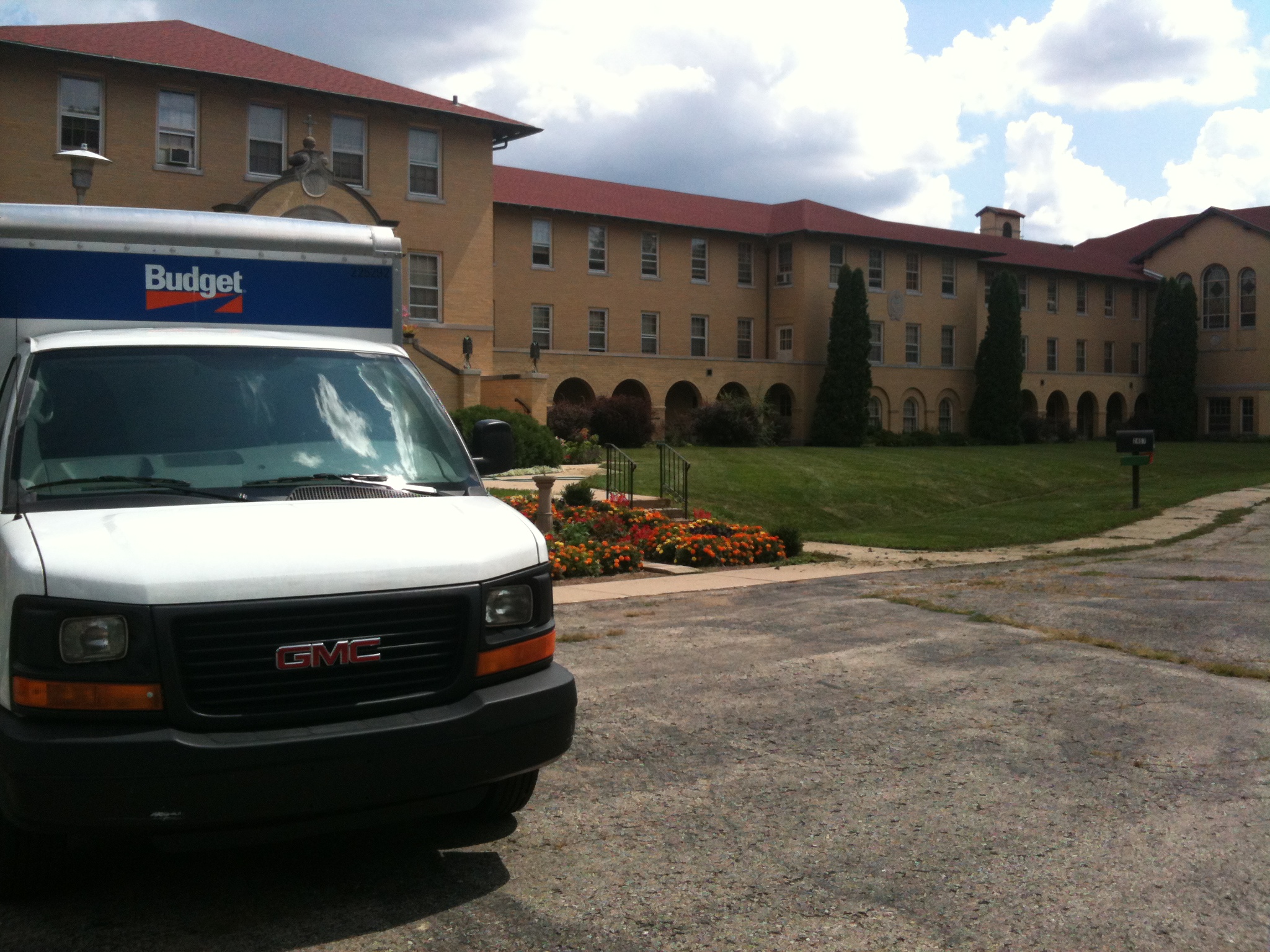
For one year, I will be without social communication such as Facebook, texting, this blog or anything that uses the internet. I will surrender the use of my bank account and credit card, and will live on a modest stipend of $50 a month giving any money I receive towards the needs of the house. I will not have almost no control over the way I spend my time, when I can leave, and where I can go. I will spend much of my time in quiet.

Believe it or not, this will be the most freeing year of my life.

For many, what I described above may seem like a prison, the complete antithesis of freedom. They see the rules and regulations as inhibitions on one’s own will, and therefore it is restrictive and potentially destructive. I see it differently. Rather than understanding freedom as the absence of external forces, i.e. freedom from a particular rule, I understand it as the presence of opportunity and ability to do what is right, i.e. freedom to fulfill a particular task.

What, then, do I have the freedom to do? More than any time in my life, I have the freedom to completely live in and for God. I have removed almost every “distraction” from my life, and have oriented my entire existence towards God. How could I be any more free? Seriously, what could I possibly worry about this entire year? I wake up in the morning, and my entire purpose is to grow closer in relationship with God by learning, devoting time, and listening. Community life ensures that I will be doing it in a Franciscan way.

I have to admit, though, I am a bit nervous about it all. This is entirely new to me in almost every way. No one likes change, especially when that change is as intense as this, and there are so many unknowns. But I guess that’s all a part of letting go; it’s not just about possessions and autonomy, it also has a lot to do with letting go of expectation that may prevent me from being completely open to the current experience. For now, we’re go with what I know.

Daily Life

Unlike last year, which was “Far From Routine,” this year will be very predictable and consistent. Being a “J” on the Myers Briggs test, I welcome this completely. Along with the prescribed activities of the day, I plan to add my own daily rituals. As I understand (and plan) it so far, here’s what a typical day looks like:

7:15    Lectio Divina (I’m going to make a habit of getting to chapel a few minutes before prayer each day to read a Gospel passage and pray about it. There’s a difference between reading the Bible academically and reading it prayerfully. As Franciscans, it’s imperative that we prayerfully read the Gospel.)
7:30     Morning Prayer
            Silent Meditation before Mass (For now, I think I’m going to leave this 10-15 minutes as quiet, unstructured prayer time. Too much planning doesn’t leave room for the Spirit to move me.)
8:00     Mass
8:45     Breakfast
9:30     Class (this will usually last two hours and will be on a variety of topics)
11:45   Midday Prayer/ ANGELUS (This only takes about ten minutes and is a wonderful break in the day to commit oneself to prayer. The Angelus is a very Franciscan prayer as well.)
12:00   Lunch (No structure, mostly foraging for food.)
1:00     Work period (We will each be given monthly jobs and expected to work 2 hours a day. Since some are easier than others, those who finish early begin to help those still working. I guess they believe that “Idle hands are the devil’s tools…)
4:00     Silent Time/Private Prayer (This can be spent a number of different ways, such as reading, studying, writing, reflecting, praying or journaling, but it must be done alone and in quiet. I think this will be a very refreshing part of the day.)
5:00     Common silent meditation in chapel (So far I’ve spent this time reading spiritual writings, but depending on what I do during the silent time/private prayer, I may use this time for more unstructured prayer or occasionally a devotional or the Office of Readings.)
5:30     Evening Prayer
6:00     Dinner
7:15     Recreation time (This can be spent however we please, such as working out, watching television, making phone calls, playing games, going for a walk, or listening to music, to name a few ideas. I don’t plan on watching a lot of television, and will instead be spending a lot of time either in our small fitness room with the many fitness-oriented friars in our house or playing games.)
9:15     Night Prayer, followed by Grand Silence (While we have no “bedtime,” the time after prayer is meant to be free from all noise, both personal and communal.)

Spiritual direction is on an appointment basis, but will probably take the place of a work period in the afternoon. On Saturdays we only have a work period in the morning, leaving us free from 1-9 to do as we please. Sundays are very solemn and relaxing, and will involve only prayer and quiet time. We’ve also been told that there will be retreats and workshops throughout the year, but with much less frequency than we did last year.

As of yet, I know little more than this. I wish I had more time to update everyone, but that will just have to wait until next year I guess.

Updates will be available

That being said, just because I can’t use the internet and tell you about my experience doesn’t mean that others won’t be doing it about me (and my classmates, of course). Here are a number of ways that you can continue to follow me in my journey outside of the blog:

Franciscan Interprovincial Novitiate Facebook page: Throughout the year, our house will post pictures, news updates, and maybe even a few reflections (we’ll see what I can do!) Unfortunately, you have to have Facebook to view it, but this will be the most updated media. I may or may not have been appointed photographer for this today.

HNP Today: Holy Name Province publishes a bi-weekly periodical about the happenings of the friars and their ministries. While we won’t be in every issue, this will offer the most detail when special occasions occur, such as when we receive our habits. You can subscribe to this by clicking here and entering your email address.

Be A Franciscan blog for vocations: The Vocations Office of our province runs a blog that publishes articles by our friars related to their vocational call and life in the Order. A few of my posts have found their way onto this website, and there’s a chance I’ll write for it once or twice while I’m here. It’s good to read either way.

And Finally, Thank You

This past year has been a wonderful experience writing this blog. I’ve enjoyed doing it, and cherish the comments I’ve received here and elsewhere. I will be praying for all of you, as I hope you will pray for me. I fully plan to relaunch the blog in a year, and will probably write a few reflections throughout the year to be posted when I get out. Until then, here are a few of my favorite posts that you could read again:

What Can’t I Live Without, Falling In Love, Why Do We Suffer? Pt. 1, 2, and 3, A Friendly Reminder, An Alternative Interpretation, Living In the Moment, What If I Fall In Love?, Mine!, This Moment Is Sufficient, A Life To Share, A Call to Sacramental Ministry, and Better to be Right or Together?

I’ve also updated the Shutterfly Photo website with pictures from Bonaventure and now here at Burlington.

And with that, it’s time that I say goodbye, and unplug myself from the internet. Thank you for following me on my journey. I will be back before you know it, but hopefully a very changed person.

Br. Casey Cole, OFM