Doing Lent Together

As Church, we follow the path of those gone before us. As Fraternity, we follow that path together.

As Church, we follow the path of those gone before us. As Fraternity, we help each other along the way.

It’s that time of year again. Lent is upon us. Put away the green vestments, get the ashes ready, and hide the chocolate, it’s time for some penance and conversion!

Lent is always an especially fruitful time of year for me, a season of intentionality and clarity. More than any other time, I am forced to look deep within myself, call to mind the ways that I have wavered from the right path, and do what I have to do to be ready for our Lord’s resurrection. It is a time of knowing deeply who I am in all of my gifts and failings, and remembering all that Jesus did/does for me (and you!)

That being said, I don’t think I have to tell you that it is also a time of great struggle, proving the adage “no pain, no gain” to be right. Fasting is the worst. Rearranging my schedule is inconvenient. Realizing that I’m not perfect, that there are times in which I am actually bad, is the last thing I want to spend time thinking about. Although I can look back and clearly see how much I have benefited from acts of penance and conversion throughout the years (from somewhat trivial things like not eating candy and refraining from “That’s what she said” jokes to praying more and developing a habit of using my resources for others) they were dreadfully painful at the beginning. Nobody likes change. It’s even harder when what’s bad for us is easy, comfortable, and feels so so good.

So why do we so often do it alone? Why do we go down the path of conversion without a guide or partner every step of the way? When you ask the majority of people what they’re doing for Lent, you’re likely to get, “Oh, I’m going to pray more,” “I’m going to donate more to charity,” “I’m going to fast on Fridays.” I’m going to do something. For most people, including myself before entering religious life, Lent was a private devotion and a personal conversion. Others at times knew what I was doing, but it was ultimately my cross to bear, no one else’s.

There are two things I want to say about this.

The first is that, as Church, we need to support one another in our conversions. As Christians, we walk together, not alone, following the path of those who have gone before us and benefiting from two thousand years of faithful living. We don’t have to reinvent the wheel; the Church has shown what is spiritually life-giving. Prayer. Fasting. Almsgiving. But these things are not to be done solely in private devotion and personal conversion. No, penance and conversion are public and communal acts that build up the community through mutual support, and evangelize others to follow the path with us. Think about how powerful of a witness it is to see someone vulnerable enough to share the ways in which s/he needs to be converted and asking the community for help, and how encouraging it must look to an outsider to see the whole community answer the call for one another.

Putting ashes on our forehead is not a private devotion but a public sign of our need for conversion.

Putting ashes on our forehead is not a private devotion but a public sign of our need for conversion.

And yet, being Church is more than simply joining an support group, as important as support may be. It is uniting in word and deed with other people of faith around a common mission. When this happens, when we truly become Church, we begin to adopt a communal identity, a “we” in belief and action. This is a tremendous step. When it happens, we no longer look simply at the ways in which “I” have sinned, but now in the ways that “we” have sinned. We begin to realize that the Church is in need of conversion and that we are all a part of that.

What does this look like? Well, there are at least three levels to look at. The first and most important is the family, the principle building block of the Church. Coming together as a household, the family must look at its life together and determine the ways in which the culture of the house could better promote the coming our Lord. Maybe there is a weekly prayer night. Maybe money is saved by not going out to eat as much and donated to a charity. From there, one looks to the worshiping community. Is there something special the community can do together throughout the season, an additional prayer service or community service day? Lastly, one looks to the Church/society as a whole. Have we, directly or indirectly, supported injustice in our world? Maybe there is something we need to change in the way we treat certain people or issues, in the way we act and are perceived publicly.

What about me, you ask? What I am doing that I need support from the community and how am I doing Lent together with others?

Personally, I hope to do three things that will touch on a few of my biggest struggles. The first is to read scripture for 15-20 minutes each day, in additional to the thirty minutes of silent prayer I have [mostly] kept since Advent. The Word of God is always right there to be proclaimed and heard, but I don’t sit with it enough. The second is to give of myself more freely to the poor and to continue to grow in my comfort with and respect for those who are homeless. The third is my fast, but it doesn’t have anything to do with food. As I have mentioned before, taking myself off the dating scene has helped me to focus less on attractiveness when entering into a relationship, shaking off the natural tendency to see women as objects. This is by no means a completed process, however, and I want to take this time to be intentional about how seriously I take the vow of chastity.

Communally, it is much more difficult to find specific things that apply to each member of the house, especially when there are twenty guys living together, but we also agreed on three things: 1) On Wednesdays and Fridays we will have soup and bread for dinner, no dessert, 2) At Evening Prayer on those days, we will read one station of the cross and reflect on it together, and 3) The house will match any donations we make out of our stipends for the CRS rice bowl. For me, these things are critically important to the life of the house. Sure, they may not cause the greatest conversion in any one of us, but there is just something so important about recognizing that we are in this together and making an effort to show it. We’re all busy people and we all have our own preferences when it comes to lifestyle, but it speaks volumes to me that we can do something with and for each other.

In this way, I think religious life is a powerful witness to the rest of the Church and the rest of the world, that we are something greater than our individual identity, that there is something life-giving about giving up personal autonomy for the sake of the group. And in a way, isn’t that what Lent is all about? Giving up what we don’t need to build up the Kingdom of God. That sounds good to me. Would you like to do it together?
Restoring Our Relationships

In Christ, we recover what was once perfect: true love in our relationships

In Christ, we recover what was once perfect: true love in our relationships

On Thursday, women took center stage in our readings mass, from the story of woman being created from the rib of man to the Syrophoenician woman convincing Jesus to heal her daughter. I’ve seen homilists go a number of directions with these readings: “God works through unexpected people” (a little condescending), “Jesus changed his mind,” (a little problematic), and “This is the way marriage should be, man and woman loving one another with man as the head” (very complicated). Having studied both readings in my scripture classes this year, I wanted to offer a slightly different perspective.

Let’s start with the often-misunderstood Genesis reading. Unlike the first creation story (Gn 1:1-2:3) in which “male and female he created them,” humanity is created in procession in the second creation story (Gn 2:4-25): God created man from the earth, and then from the man’s rib, he created woman. Many have interpreted this as a sign of subordination, including the Apostle Paul, arguing that woman came from man, not man from woman, so woman is subject to man (See 1 Cor 11:8; 1 Tim 2:13).

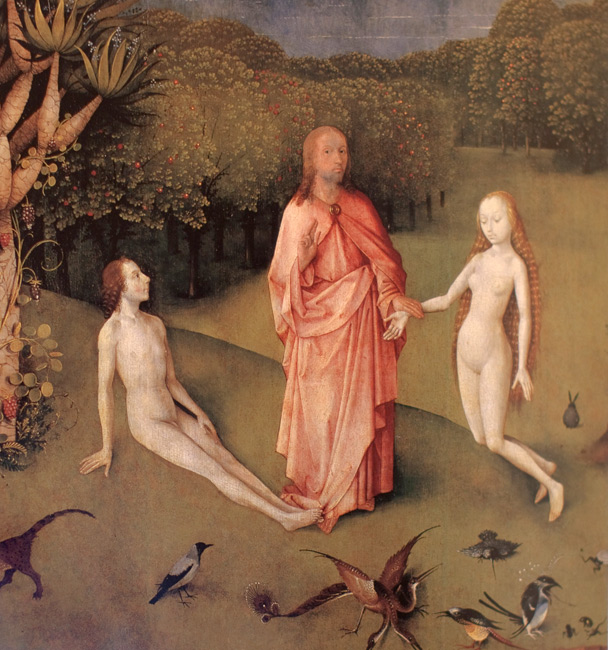
But is this really what the story is saying? In fact, quite the opposite: God has set up a radically egalitarian, perfect relationship between man and woman. In her very purpose for being created, woman was intended to be a “partner” of the man, a “helper” in the same way that God is Israel’s helper throughout the Old Testament (the Hebrew word is the same). Is God subordinate to Israel because he is its helper? Of course not! Look, then, at how the woman is made: man had nothing to do with it. He was asleep! (Typical…) Just as God created man, so God created woman. The man declares, “This one is bone of my bones and flesh of my flesh.” In other words, they are the same, of one essence, perfectly equal in their intended creation. Because of this, man has no claim over the woman, and so unlike the animals (for which he gave names to signify his authority over them), he does not “name” woman as much as he describes their relationship to one another: “for out of ‘her man’ this one has been taken.” He understands who she is in light of him and who he is in light of her. (It is not until chapter 3, after they sin, that the man names her Eve, marking the distortion of their relationship.) The passage concludes that they live naked with one another with no shame, signifying their perfect respect for one another, having nothing to hide, no distortions, and no manipulations. This is what God created.

But this is not the world we live in, is it? We live in a world of human trafficking, pornography, and sexual exploitation. We live in a very “sexist” world in which women are harassed, paid less than men, and subordinated to second class. Just this week Sports Illustrated sent me their annual Swimsuit edition. Today, “50 Shades of Grey” hits theatres. How can we look at these things as say that we are respecting each other as equals? How would we feel if it was our mother, our best friend, our sister, in these situations? We would never treat our loved ones this way, but we subordinate others all of the time, intentionally or unintentionally. We live in a world of distorted relationships, a world that has lost sense of the “partnership” God created, the perfect relationship the he intended.

Now within this distorted world, we jump to the Gospel (Mk 7:24-30), and are confronted with an odd interaction between Jesus and a Syrophoenician woman. Falling to Jesus’ feet in worship for him to save her daughter, Jesus initially refuses to help her, and then worse yet, he calls her a dog! Not politically correct Jesus! He does end up curing the woman’s daughter because of her great faith, but the reader is left a little baffled. Was Jesus serious in calling her that? If so, does that mean that Jesus’ mind was changed?

My own reflection on the passage is that Jesus’ mind was not changed. Look at what precedes it: He has already cured non-Jews, he has cured and interacted with women, and in this case, specifically went out of his way to go to Gentile territory. From the start of his ministry, Jesus understood his mission. He came to proclaim the Kingdom of God to all people. In light of the first story, Jesus came to restore the relationship God had intended between all of humanity.

So why did he call her a dog then? Was he serious? This question is a bit more complicated, but certainly understandable in a human sense. While fully divine, Jesus was also fully human. He came into the world like us, was formed as a child by cultural structures, norms related to interaction with women, and a way of speaking. If Jesus truly took on our humanity, its foolish to think that he would not be unaffected by it, at least externally. What he said, although not what we would hope for, is indicative of the subordination of women in their culture (if not ours as well.) We live in a broken world, and Jesus became a part of that.

But he didn’t come to simply experience it, he came to transform it. He came to restore relationships. Like all of us, (and forgive me if this begins to project my own experience onto Jesus), it is entirely possible that Jesus knew exactly what he was to do, restore humanity to its intended perfect relationship, and simply got caught off guard, letting his human weakness revert to the way he had seen men treat woman his entire life. I have an example. This year, I’ve started going downtown DC in my habit looking for homeless people to talk to, to find out what they need, and to offer them little things like hand-warmers and protein bars. It is clear that I know my mission: I am here to serve and respect the poor and marginalized of society. Sometimes I do it well. And yet, a few weekends ago, I was downtown with some people going to a restaurant and a homeless man reached out a cup asking for help as we walked by. Did I treat him with respect as I know I am here to do? No. I walked by, ignored him, and hoped he wouldn’t notice me. In essence, I called him a dog. I realized that my “relationships” with the ones I served were nowhere close to the type of relationship God intended. I had subordinated him to a person in need of my help, and since I had nothing that day to offer (or was too disinterested to try), I did not interact with him. In my mind, it was a one-way relationship, one in which he could not offer me anything, and so I didn’t stop. I knew my mission, I knew who I was, and yet reverted to the way I had see others treat homeless people my entire life.

While women take center stage in Thursday’s readings, I think the focus is really on how we relate to all of humanity. Do we treat each other with respect or do we degrade? Do we lift each other up to see each others as equals or do we subordinate? Do we attempt to return to what God intended or do we further the distortion, manipulation, and condescension of this world? On this Valentine’s Day, on this day that the Lord has made, I think that our only answer is Jesus, the God who came down from heaven to be equal to us and to restore us to that perfect union we once knew. It is only in relationship to him, in becoming one flesh with the one who gave of himself, that we are able to enter into relationship with those around us in the way it was always intended.

It’s a Miracle!

Jesus is a great mystery of faith

Jesus is a great mystery of faith

This year at Catholic University, I am taking a class called “Christology,” the systematic theology course devoted entirely to the person of Jesus the Christ. Among the many questions that we are being asked to investigate (Who was Jesus of Nazareth? Was Jesus God? What is his relationship to the Father? Why did God become flesh? Did Jesus have to die? Did Jesus know he was God? What do we make of the Resurrection?) there is one that has taken hold of my attention this week because, well, it perplexes me: what is a miracle?

Given the amount this word is used and its centrality to the Gospel narratives, this may come at a surprise. What kind of vowed religious doesn’t know what a miracle is? Everyone knows what a miracle is! Fair enough. It is certainly a largely understood concept in common language. But is our common definition(s) based on a) what we believe about God or b) are they largely influenced by popular religion and “Hallmark” notions? This is why I find a need for more investigation, and why I will say at the onset, that I plan to share more questions than answers in this post.

So let’s start with a common definition. What is a miracle? “A surprising and welcome event that is not explicable by natural or scientific laws and is therefore considered the work of divine agency.” So says my dictionary. Basically, there are things that God does in our world that are extraordinary and absolutely unexplainable because God has entered into our world and made something amazing happen, e.g. the parting of the Red Sea.

But is this really the definition we want to settle on? Known as the “God of the gaps” explanation, this definition relegates God to those areas that scientific study have yet to understand. But these “gaps” as it were, the filling in of what we cannot otherwise figure out, are narrowing; scientific inquiry yields much more information today than it did 2000 years ago. Also, given the fact that we don’t know everything about nature but are continuing to learn, we have to recognize that there is a huge difference between “things we can’t explain right now” and “absolutely unexplainable.” Putting things in the latter and claiming them to be miracles is first of all arrogant, but worse, it inevitably undermines the claim of miracle when in fact science is capable of explaining its cause years later.

The other problem I see is with the whole notion of God interjecting the world with something not-of-the-world. Do we believe that God is outside of our world, looking in from a far, periodically jumping in to mess with the nature that he created? Surely, the God who created the world and its natural laws is a God that continues to create and govern the worldEven if we want to posit that God is capable of transcending his own laws (He is God after all), it would seem illogical to think that this is the only way that God interacts with the world. Just because we can scientifically explain the chain of events that caused something to happen, isn’t it possible that God is ultimately the primary cause causing everything else to happen? In other words, we may be able to scientifically explain why a person was cured of a deadly disease, but God could still have been working through the doctor to come to the correct diagnosis, the pharmaceutical company to accurately produce the drug, and the nurse to administer it properly.

Understanding miracles in this way shifts the attention away from the undeniable, provable explanation of the “God of the gaps” onto the faith of the beholder. If God is ultimately the primary cause of all secondary causes, well then, it is up to the person of faith to have the eyes to see God’s work all around him/her. The beholder begins to see the world as Francis of Assisi did, not as innate objects following predictable laws, but as creation, the work of an ever-loving God that animates it into being. With these eyes, everything is a miraculous work that can overwhelm… if we have the faith to see it.

This end of the extreme also has some problems, unfortunately. With this “everything is a miracle” perspective, one has to wonder about the initiative of God. If everything fits within the laws of nature, either God is a) a micromanager that makes everything happen without any freedom allowed to creation, or b) the God of Deism, the watchmaker, who set the world in motion according to laws and then remained at a distance watching. In either case, “everything is a miracle” makes nothing a miracle: things only seem extraordinary because of our perspective, not because God has acted in a different way. God may still be its cause, but every act would be just as important as the one previous. This is not a “miracle” as we are investigating.

So what does that leave us with? A miracle could be something “unexplainable,” but we can never know that it is actually unexplainable. It could also be something entirely explainable and ordinary, but unless it catches our attention, one runs the risk of pure subjectivism not knowing which cases are “miracles” and which are ordinary natural laws (see Pat Robertson claiming that Hurricane Katrina was God’s wrath for a sinful lifestyle in New Orleans). God must clearly be the cause of all things, at least in the primary sense, but then what differentiates “miracles” from regular acts of God’s initiative?

At this point, I think it’s important to look to the experts for some guidance. Cardinal Kasper, a renowned theologian in the field of Christology proposes a theological theory of miracles in his book Jesus the Christ:

  1. Miracles can be extraordinary, unusual, and amazing, leaving them up to interpretation. Drawing on the Second Vatican Council, he says that it is up to the faith community to determine the unity between act and word so that an act of faith measures up with all that has already been received by faith in word (Tradition, Scripture, Teaching).
  2. “A miracle is the result of a personal initiative of God.” A miracle is God attempting to reveal Godself to creation, doing so in symbolic physical form.
  3. “A divine intervention in the sense of a directly visible action of God is theological nonsense.” Something that is so clear that it cannot be disputed removes the element of faith, compelling one to know not believe. God does not want to force us to know or love him. The more powerful the miracle, the more powerful our independence to reject it.
  4. All miracles have multiple interpretations. Like the previous point, miracles do not compel knowledge, but “can only be seen as the act of God by faith.” One’s faith and personhood largely influence how one will understand the initiative of God, and that is okay, for it is the purpose of miracles to “turn people’s eyes upwards, towards God.”

If after reading this post you find yourself more perplexed than you were to start, welcome to theological study! The fact is, much of our faith is a mystery, an aspect of faith that surpasses our ability to know perfectly. But that does not mean that we cannot know anything at all. With careful attention and prayer we can enter into it and be changed by it. If you can live your life in this mystery, seeking God with all your heart so to be given the eyes to see God’s work in you and in the world, there’s only one thing to say: That’s a miracle!

Light in the Darkness


This morning I had the opportunity to preach at our house mass. Here is a rough recollection of what I had to say, expanded a bit for the sake of the blog. The readings that this was based on can be found here.

Don't underestimate the power of even a candle in a dark place!

Don’t underestimate the power of even a candle in a dark place!

In light of the recent (and weak) allegations against the New England Patriots over the past week, I began thinking about some of the famous scandals I have witnessed in my life.

Mark Sanford “hiking in the Appalachian mountains”;

Lance Armstrong admitting doing steroids;

Enron going bankrupt and shredding all of its files.

In a way, stories like these are all the same: someone with a lot of power tries to abuse that power thinking that they will never get caught…until they get caught. It happens almost everyday in politics, sports, and entertainment. Clearly there are many in the world that have never heard our Gospel passage for today: “There is nothing hidden except to be made visible; nothing is secret except to come to light.” Sooner or later, it seems, justice is served. Someone is going to talk; evidence is going to leak; words are going to slip. One way or another, the secret gets out and the rest of us are left wondering, “Did he really think he was going to get away with that?” “What was she thinking?” In a way, there is a sense of comfort in reading this passage, in knowing that those who lie and cheat will always get caught; that in the end, you can’t hide from justice. Everyone gets what they deserve.

But our experience seems to show the opposite as well, doesn’t it? Crimes aren’t always solved and injustice continues. Sometimes the bad guy gets away and the truth is left hidden. I have two such examples from my life:

The first is high school Spanish class. I would sit there during daily quizzes and think, “How can I really be expected to memorize so many words each night?” It was just ridiculous for my little brain. So what did I do? Well, a little peak here… a little peak there… Maybe I’d be lucky enough to get an answer or two. One time, a student was caught cheating during a quiz, had his paper ripped in half, and was chastised for the rest of the class. Thank God it wasn’t me, I thought. But it could have been, maybe should have been. Maybe it was because I didn’t do it very often or because I wasn’t all that blatant about it, but the fact is, what he did was brought to light while what I did was kept secret.  He was labeled a cheater, and I was simply an average student. And unless you go tell my Spanish teacher, that will never change.

I faced a similar situation on my baseball team in high school. Playing for a man insistent on conditioning, we would regularly end practice by running a lap around the campus, stopping on the far side to run up and down the hill ten times. My first practice as a sophomore, I found that I was the only player that took this seriously. “What are you doing? Coach isn’t going to know. Just relax for 5 minutes and we’ll run back.” I couldn’t do it. Even if the other guys, including the senior captains, didn’t care about conditioning and working hard, I was going to do them anyway. Why? Because I wanted to get better; my success was in no way tied to what they, or coach, thought about me. Ultimately, nothing came of it. I never received an award, never gained the admiration of my teammates, and I’m sure to this day my coach still talks about how hard of a worker one of those seniors was (we heard about him for two more years after he graduated.)

And so, there are two things that I want to highlight today.

The first is that we are men called to integrity. There will come a day when, after spending our whole lives “longing to see his face,” we will stand before our God in hopes that He longs to see our face as well. No one else’s opinion matters at that point. But when we think about it, isn’t that always the case? As Francis writes in his Admonitions: “Blessed is the servant who does not consider himself any better when he is praised and exalted by people than when he is considered worthless, simple, and looked down upon, for what a person is before God, that he is and no more.” In this way, we are called to clear out the clutter from our lives, the distractions and facades we put before us, in order to know very clearly who we are before our God. It is in that moment that we are able to enter fully into the Eucharist, to receive the light and life of Christ to make all things known between us.

But it doesn’t stop there. For fear of over-spiritualizing the matter, thinking only of the life to come, it’s important to remember that our Eucharistic celebration demands that we take what Christ has given us and share it with the world. While all will eventually be revealed by God on our day of judgment, some things need to be revealed now. As God’s hands and feet, we are called to bring the light of Christ to the darkness, to challenge injustice, to stand up against the evil and corruption that dehumanizes our human family. As baptized Christians, we are all given many skills and charisms to be shared with the world: “Is a lamp brought to be placed under a bushel basket or under a bed?” Absolutely not. Our gifts need to be used for the sake of the world, to bring the light of Christ to the places of darkness

Today, may we be able to see clearly, in our lives and in our world, what the light of Christ has revealed to us.

My Choice to March

The "Pro Life March" is by far the most actively attended and supported advocacy initiative for the American Catholic Church

The “March for Life” is by far the most actively attended and supported advocacy initiative for the American Catholic Church

Each year on the anniversary of the Supreme Court ruling of Roe v. Wade, Catholics gather on the National Mall to rally and march in protest of the decision that made abortion legal in the United States, uniting around a simple message: “All life is sacred.” But this is no ordinary march on Washington. While estimating crowds has become a controversial and somewhat unreliable task in recent years, it is clear that the number of protestors should be counted in the hundreds of thousands rather than tens of thousands. In this way, the March for Life is by far the most actively attended and supported advocacy initiative for the American Catholic Church.

And yet, it remains a highly contentious, dividing issue even within that same Church. For many theologians and writers within the Church, there is as much written about why one does/should not attend the March as there is material promoting it.Take the article by fellow Franciscan Fr. Dan Horan, ofm, “Why I Do Not Support the (so-called) March For Life.” Confessing wholeheartedly that his issue is with the March itself, not Catholic moral teaching about abortion, he writes:

Among the various reasons one might choose to omit him or herself from participation, I wish to highlight three: (a) the event’s moniker is incomplete at best and disingenuous at worst; (b) the mode of protest has proven ineffective; and, following the second point, (c) the ‘march’ and its related events are a self-serving exercise in self-righteousness, self-congratulatory grandstanding.

Admittedly, there is a lot of truth in this statement (and the article as a whole), and when I read it three years ago, it was very influential in my own opinion toward marching. The fact is, the name of the March is misleading; protestors do not gather each year to express anger towards war, gun violence, human trafficking, homelessness, ecological degradation, or any other “Life” issue as defined by the Church, they gather to repeal the legal status of abortion. The fact is, protests of this kind aren’t as effective as they once were; besides the fact that it is primarily a “wedge-issue” with little hope of ever changing legislation in either direction, protests that meet regularly become commonplace and lose their political effectiveness over the years (as seen with the “School of the Americas” march at Fort Benning, GA). The fact is, some do march for the wrong reasons; there are always opportunists, in both politics and Church, that use particular issues to solidify their own influence and to encourage their own agenda without having to do much in the process. It is because of these points that I found myself with many Catholics “protesting the protest” for many years.

10931365_10204928458843997_2601931720192534161_nAnd yet, yesterday I marched. Along with hundreds of thousands of Catholics from around the country, I stood on the National Mall and listened to political and ecclesial leaders rally people to the cause. I carried a Franciscan banner and walked down the crowded street for more than an hour. I engaged strangers with my faith and vocation, prayed in public, and even sang a song or two. Despite my strong reservations, I was there marching for life.

The thing is, my opinions have not drastically changed in regards to Fr. Dan’s article; the March, for me, is still a bit odd and I think it gives a disproportionate amount of energy to only one issue (albeit a good one.) What has changed is the recognition that this is where our Church is, this is where the flock is gathering, and as a minister in the Church, there is a lot of positive energy that needs to be supported and guided. Sure, I would personally wish that this much energy was directed towards the environment or ending wars, but how can I deny that hundreds of thousands of faithful Catholics were compelled to enter the streets and voice an aspect of their faith? This movement is big but it is more than just numbers: the movement has done something well enough to inspire enormous amounts of young people to become active despite dropping Church attendance among that generation (I met students that came all the way from Notre Dame, Auburn, and St. Bonaventure, NY, and there were thousands more.) Anyone who has ever tried to organize something and failed knows how difficult it can be to get a movement going, let along amass this much support. Something is going on here, and clearly the Spirit is working.

I’ve heard it said that real-life shepherds do not “lead” the sheep as much as they follow the flock and protect it from harm. As a Franciscan training for public ministry, I think that this is a great model for leadership: remain among the sheep, follow where the flock is going, and do my best to keep it from harm, whether that be self-inflicted or external. In the case of the “Pro-life” movement, there is little argument about the narrowness of its focus and that it would be better with a fuller understanding of the rich Catholic Tradition. But there is energy that needs to be followed and encouraged; to scoff at it or discourage involvement for the sake of other movements, for which there is little passion outside of its leader, would be inappropriate and ineffective. As a ministers, it is not our job to animate someone’s soul or to tell someone what to be passionate about. This is the job of the Spirt, and clearly the Spirit is working. As ministers, it is our duty to make sure that the faithful understand the stirring of the Spirit in them through the message of the Gospel and within the context of a Church of believers. Is there room for guidance and correction in this process? Absolutely. But as I have found through this experience, the guidance and correction go both ways: the sheep must be willing to expand or change their course at the direction of the shepherd, but the shepherd must also be willing to march with the sheep when they have their sights set on something that is good and true. This is why I chose to march yesterday, and I am glad that I did.