The following is my homily for this weekend, the 18th Sunday of Ordinary time, Year B.

I’m not sure about you, but I love movies with twist endings; you know, those types of movies that pull the rug out from under you at the last second and completely surprise you. Movies like The 6th sense, The Others, Fight Club, Shutter Island, Memento, Scream, even the new Pixar movie Coco has an element of this. Movies where the main character was bad all along, the trusted character turns out to be the murderer or was dead the whole time or maybe just a hallucination of another character. You’re just left at the end of the movie going… wow! How did I miss that!?

And I think that’s the best part of it, right? Because when you go back and watch it again, you just think, “Oh my gosh. It was so obvious! It was right there the whole time, staring me right in the face!” In one of my favorite movies, they give away the twist of the movie in the very first line. The writers and director want us to figure it out, but we miss it. Hidden in plain sight, we don’t see it. 

And while that might seem like a strange introduction to a homily, it’s that sort of feeling I get when I hear our readings proclaimed today. A sense that the very thing we’re looking for has been hidden in plain sight the whole time, yet the people don’t seem to see it.

In our first reading, the Israelites are wandering in the desert, complaining about their situation, and demand a miracle. They’re going to starve to death, they say. They would rather have stayed slaves than be out in the desert, that’s how hungry they are. Hearing their plea, God sends down manna from heaven, provides them with quail to eat. God provides them with an amazing miracle, showers them with grace and new life. And how do they respond? They look at one another and ask, “What is this?” God was in their midst and they didn’t even see it.

Eventually they catch on and realize what God is doing, and by the time of Jesus this is what they expect. They want God to send down manna from heaven, they want a sign from God that God is still with them, providing for them in their great hunger. And so they demand this from Jesus: “What sign can you perform so that we may believe in you?” they ask. They have seen no manna, no quails, and so they believe, once again, that God is not with them, that they are starving in the desert. 

And you can almost picture Jesus’ puzzled face, can’t you. His confusion at their demand for a sign. “So… let me get this straight. You don’t believe in me, but you would if God sent down nourishment from heaven, bread, flesh maybe, something that would feed you and keep you alive, an extraordinary miracle that shows God’s glory… Have you not be following me for months now? Have you not seen me heal people? Have you not heard me say that I have come from the Father, that the Father and I are one? Okay, let me make this clear to you: I am the bread of life. I am manna come down from heaven. My flesh is the flesh that will nourish you. Got it…?”

Now, I’m sure Jesus was probably tiny bit less snarky than I’m portraying him, but you can definitely imagine him being a bit annoyed or at the very least confused, right? There he was, revealing the Father’s glory, performing miracles in plain sight, placing salvation right in front of their noses, and they couldn’t see it. How could they not see what was right before them?

And it makes me wonder. Looking back 3500 years to the desert, 2000 years to Capernaum, it’s very easy for us to pick on the people of the Bible, to look down on them for not seeing the twist ending of the movie that seems so obvious to us. But are we any different today? For so many years I read the Bible and was amazed by the miracles in them. In awe of how God used to interact with God’s people. I wondered why my life was so ordinary, why God didn’t call me or others like he used to. I looked for signs, demanded miracles so that I would believe. “Send me manna from heaven so that I might believe,” I’d say. “Do something extraordinary so that I won’t have any more doubts.” And I imagine that Jesus was just left shaking his head. Smiling and loving, but shaking his head.

“Don’t you hear my word spoken to you every week, calling you to follow? Don’t you see the sacrifice I offer you on this altar, my very flesh and blood to give you nourishment and strength? Don’t you see my love and grace poured out for you, the mercy and forgiveness offered each and every day?” But I didn’t. Hidden in plain sight, God was all around me but I didn’t see.

And maybe this is the case for you. Maybe you find yourself asking the same questions and wonder what to do. If that’s the case, I think the answer is really simple: we have to look harder… or maybe start looking at all. Seriously. Just. Start. Looking. It’s like when people tell me that they’re struggling with their faith. I ask them what they’re doing, what are they struggling with that they can’t get, and they say, “Well, I don’t know, nothing really.” No, you’re not struggling! You’re just not trying. You’re hoping that everything will just be easy and right without doing any work! Sometimes we tell ourselves that God is hidden, that we can’t find God, that God doesn’t perform miracles like God used to… when what we really mean is that we really haven’t looked that hard.

That was the case for me until a few years ago. The friars in my house decided to meet each week for faith sharing. Once a week we would sit down, read a passage from scripture, and answer a simple question: how did we see God working in our lives this week. At first it was difficult. At first I didn’t know what to say. But as I heard others share their stories, as I thought about it all week, really focused so that I would have something to say—in fact, actually looked—what I realized was that God was there all along, right in front of my face, hidden in plain sight, waiting to be seen. 

And then it was like he was everywhere. After I saw God once, it was like watching a movie already knowing the ending. The evidence was there, so obvious, jumping right out at me, leaving me to wonder how I missed it for all these years.

God wants you to know him. God wants you to find him. Sometimes, as simple as it sounds, all we need to do is look. For one day, maybe all this week, look for God in everything you do—in your work, in your family life, in what you do for fun—make an active effort to see God right before you, reaching out to you… and you might just find that he was there all along, hidden in plain sight.

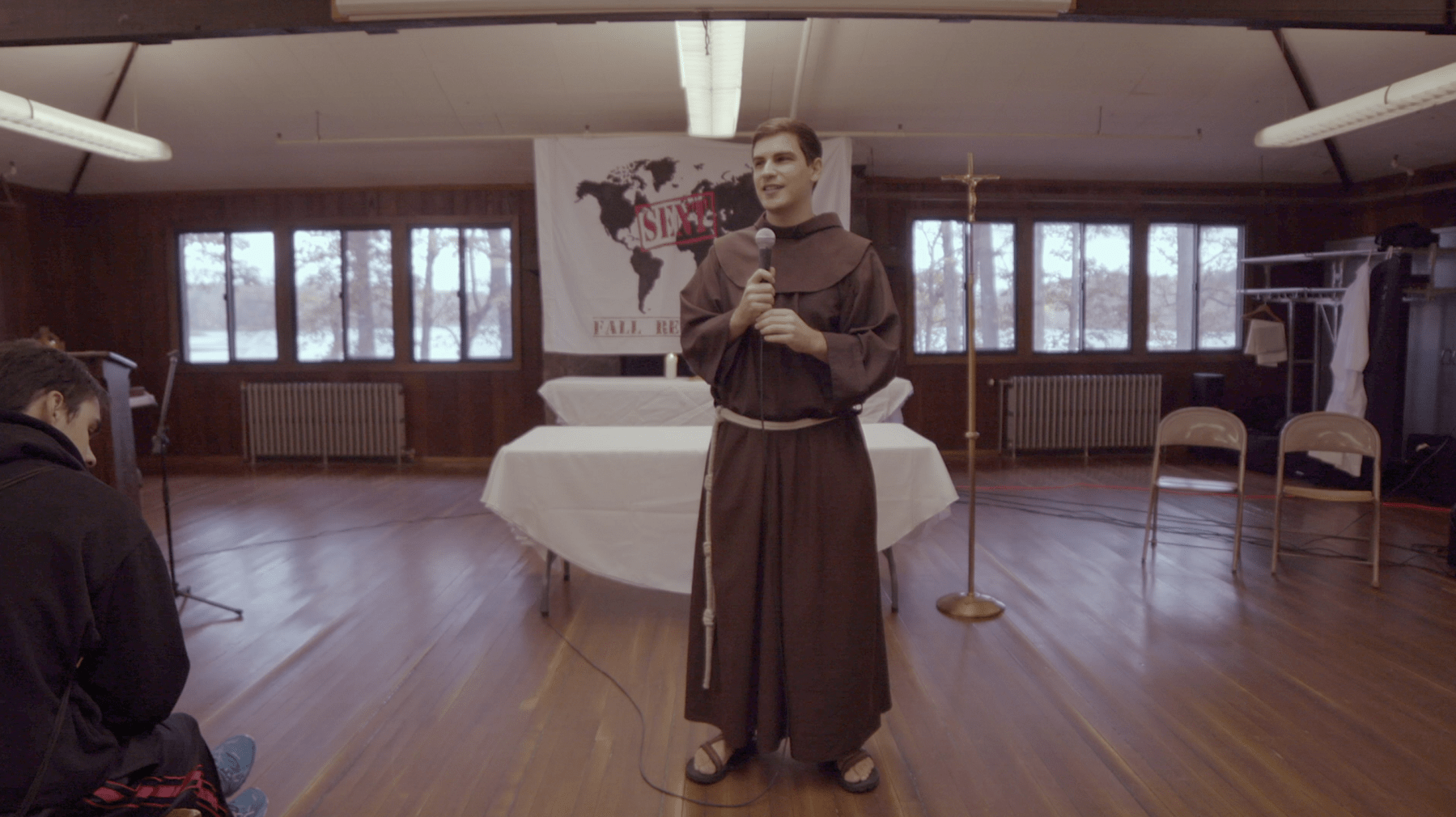
Two weeks ago, I learned of the deaths of two extraordinary men: Saul Rodriguez and Albert Hendel. In many ways, they had very little in common. Saul was a seminarian with the Capuchin Franciscans, was 31 years old, and died suddenly; Albert was my grandfather, the father of ten, nearly 98 years old, and died after a number of weeks of preparation. One represents what we would call a tragedy, while the other is the ideal situation we can all hope for.

And yet, there is a sense that even in the case of Albert, something is still tragic. Death, it would seem, is always tragic.

Why, even though we believe in the resurrection, is there still the sting of death? Why, even when someone dies after a long life with little pain, are we still upset about it? Why, in a world where death is inevitable and a faith built upon it, are we so bad at accepting death? This week’s video is my attempt to make sense of it all from a Christian perspective. I hope that you will join me in praying for the families of the deceased and for all of the deceased that go unnoticed. May we all find ourselves, one day, in the heart of God with the saints.

Since it’s a holy day of the Church… how about an unexpected blog post?! This past weekend I was privileged to be invited to speak at the Michigan State University Catholic Student Center’s fall retreat. I gave two talks, one of which was entitled, “What is the Good News?”

It was a great for sure, maybe more to come on Friday… For now, click here to watch the talk!

Identity

The following is the fourth installment of a seven-part lenten blog/video series sponsored by Franciscan Media. For the previous reflections, click here. For those subscribing by email, click here to watch the video.

Guilty by association. While a concept that does not stand up in a court of law—one cannot be charged with a crime simply by being associated with a criminal—we know that it is a very powerful force in the court of public opinion. When someone does something bad, the moral character of everyone around them is called into question.

No clearer example of this can be seen than that of social groups in high school. Cliques. Despite the fact that each and every one of us is a unique set of thoughts, feelings, and actions, transcending simple categorization or affiliation, we cannot escape the corporate identities we take on. Nerds. Jocks. Preps. Partiers. Liberals. Conservatives. Religious. And so on. In our association with others—superficial or meaningful—our individual identity is unavoidably and irreparably shaped by the people around us: like it or not, who they are, how they act, and what people think of them will tremendously influence what people think of us.

While our lives as followers of Jesus cannot fairly be compared to a high school clique, the effect it has on our identity is spot on.

In our Gospel reading this week, we hear of a man born blind. Blind since birth, everyone has assumed that he is so because of sin, either his or his parents. Jesus does not agree: the man was born blind in order reveal the glory and power of the Father. Spitting into the ground, he forms a muddy substance—truly getting his hands dirty in the man’s life—and smears it on his eyes, an act that one would expect to further inhibit sight. Instead, in a miraculous gesture, Jesus gives the man the ability to see, symbolic of the light of faith that Jesus brings to the world.

And while that is extraordinary in itself, the most interesting part of the story is what comes next: Jesus disappears and lets the formerly blind man be the protagonist. Interrogated by everyone around him, his identity, moral standing, and allegiance are all called into question. Who are you and where did you come from? How was this miracle performed? Do you accept our authority as Jewish leaders? There the man stands, with Jesus nowhere to be found, taking on the exact ridicule and questioning that Jesus faces all throughout the Gospel of John. It’s as if the man is standing in for Jesus. It’s as if the man, in some strange way, now represents Jesus in the world, taking on the identity of the one who healed him…

The story of the man born blind is meant to typify the experience of the anyone who is given the light of faith to follow Jesus. For those who enter the faith and bear the name ‘Christian,’ not only are they able to see in ways they could never see before, they unavoidably adopt everything that goes along with Jesus’ identity. A Christian, we could say, is not just one who likes “the Christ” (from the Greek christos meaning “anointed one”), but is in fact one who embodies all that the Christ does, receives the Christ into their being, and then goes out into the world as Christ themselves.

In other words, the story of the man born blind is the story of our baptism.

When we enter the font and cleansed with water, our old way of life—our blindness—is washed away. In an act of miraculous grace, we are touched by Jesus and given grace upon grace, called from an experience of death to new life.

But that’s only the half of it.

After leaving the font a new person in Christ, we are anointed by the priest with oil on the crown of our head. Yes, in the image and likeness of the true anointed one—the Christ—we are crowned with oil and anointed into His identity and mission. Although essentially the same person we were before, with the same unique set of thoughts, feelings, and actions, our association with Jesus and the indelible mark that He puts on our soul forever changes our identity: now, not only free from sin but marked by Jesus, we enter the world in the image and likeness of the one true Christ. After our baptism, we are nothing less that “christs” in the world, called to live out His threefold ministry of being priest, prophet, and king.

That is what we celebrate during Easter and what we prepare for in Lent. While it is a season of prayer, fasting, and almsgiving, a season to focus on our sinfulness and call upon God’s mercy, our ultimate focus in this season is to call to mind the identity we share in Jesus and to prepare ourselves to renew our baptismal promise to be who Christ has anointed us to be. Like it or not, when Jesus touched us and gave us the light to see, we became guilty by association, defined by and treated in the way that He is treated: Glory. Love. Ridicule. Confrontation. Praise. Persecution. Death… and Resurrection.

Hungry

The following is the third installment of a seven-part lenten blog/video series sponsored by Franciscan Media. For the previous reflections, click here. For those subscribing by email, click here to watch the video.

Chinese food is one of the many gifts from God on this earth. Cheap, easily accessible, usually sold in enormous quantities, and basically uniform in quality across the country, it’s the sort of food that I absolutely crave from time to time. Who doesn’t love a towering supply of fried meat and simple carbs?

And yet, the very things that make Chinese food so desirable—price, quantity, convenience, greasiness/saltiness—are the very things that ultimately make it unsatisfying. As much as I have craved and even went out of my way to get it, I cannot remember a single occasion in which I felt great after eating it. Bloated, lethargic, and somehow still hungry, I immediately regret the decision and swear to myself that I will never eat the food ever again.

Until the next time I’m craving Chinese food and “just have to have it.”

Naturally, it is a bizarre situation that any sane person can see is unhealthy. Why would you continually do something that is not only unhealthy, but unfulfilling and unsatisfying? Why continue to look for new answers in the same wrong places?

Now there’s a powerful question for us with implications far beyond Chinese food…

In our Gospel this week, we find Jesus asking the woman at the well this very question. Having had five husbands, and currently with a man that is not her husband, we sense a potentially unhealthy pattern in her life. The fact that she meets Jesus alone at a well—a biblically symbolic place for romantic partners to meet (see Isaac and Rebecca, Jacob and Rachel, and Moses and Zipporah)— indicates that even now, after so many failed attempts, she might be continuing to look for a new ‘lord.’

Again we might ask, Why continue to look for new answers in the same wrong places?

More than 1600 years ago, St. Augustine, a man famous for his own unhealthy behavior and failings, offered one of the great spiritual insights: in the opening chapter of his Confessions, he writes, “You move us to delight in praising You; for You have formed us for Yourself, and our hearts are restless till they find rest in You.” For him, our hearts live in a constant state of uncomfortable longing, incomplete and yearning to be filled. We are so desperate to rid ourselves of this feeling that we look to the world for the answer. What will make me happy, we ask. What will make me feel complete and full and content with who I am? There’s always something out there that we need—if we just had that one thing… our life would be meaningful and fulfilling. Food, relationships, status, power, accomplishments, luxury, comfort, fun, stability. Whatever it is, our longing hearts longs to be fulfilled.

But it never happens, does it? Like an empty stomach seeking Chinese food or a five-time divorcee seeking another husband, we are never truly satisfied. There’s always something more we want. And then something more. And then something more. As much as we might find pleasure in the things of this world, and as much as some things may be quite good for our spiritual well-being, the fact of the matter is exactly as Augustine says: “Our hearts are restless till they find rest in You.

In His encounter at the well, Jesus is inviting the woman—and each of us many years later—to give up the constant search for things that cannot fulfill and to turn to the only one who truly can: Himself. He is the living water that quenches thirst. He is the true “Lord” that will never leave us. And He wants us to turn to Him.

This week, allow yourself to have a personal encounter with the Lord.

Yes, a personal encounter. A time when your phone is turned off, the door is closed, and your heart is open to hear his voice. A time when all the other fleeting and unfulfilling desires of the world are put on hold—even if just momentarily—and you can simply be with Jesus. A time when you can simply be you, without all of the masks and fronts and public niceties that we put on, and let the Lord meet you as you are—vulnerable, open, and restless.

At first, this may seem like a daunting task. In the beginning, it may seem difficult or overwhelming, something meant only for monks and mystics. But it doesn’t have to be. Jesus didn’t test the woman’s knowledge, make her perform amazing tasks, or question her worthiness. All He wanted from the woman was a chance to talk. He just wanted to fill her hungry heart.

If you have a hungry heart, a restless heart that continues to fill itself up with things that eventually fade, then this blog and video are for you. What Jesus asked of the woman at the well is no different from what He asks of us today. He just wants to fill our hungry hearts. All of ours:

“No one should think that this invitation is not meant for him or her, since ‘no one is excluded from the joy brought by the Lord’. The Lord does not disappoint those who take this risk; whenever we take a step towards Jesus, we come to realize that he is already there, waiting for us with open arms. Now is the time to say to Jesus: ‘Lord, I have let myself be deceived; in a thousand ways I have shunned your love, yet here I am once more, to renew my covenant with you. I need you. Save me once again, Lord, take me once more into your redeeming embrace.’ How good it feels to come back to him whenever we are lost! Let me say this once more: God never tires of forgiving us; we are the ones who tire of seeking his mercy” (Pope Francis, Evangelii Gaudium, 3).