A Life to Share

Celibacy can be a bit of a deal breaker. Ask any young Catholic man or woman, active in their faith, why they are not considering some form of consecrated life, and I can almost guarantee that celibacy is one of the reasons. “I really want to get married,” you might hear. From my own experience, this was the largest hurtle to jump.

But despite what many may think, including even those going through the discernment process, I don’t believe that the problem is abstinence from sex (at least not entirely). Believe it or not, there are still many young people in this world who have not discarded chastity for the loose sexuality embraced by popular culture. (It’s not what you hear on t.v. or see in the movies, but it’s still out there, trust me!) And yet, of those who have held on to or readopted this unpopular virtue, there is an even smaller minority of people wishing to do so in the form of consecrated life. Why is this?

The reason has everything to do with intimacy, or rather, the perceived lack of intimacy in religious life. When I look back to the time when I used “I really wanted to get married” as an excuse, I believe what I was really saying was, “I really want someone to share my life with.” For much of my life, I saw marriage as the only way to do this. When I looked at the priests and religious I knew (which was only a few), all I saw were people growing in age, living alone, and frankly, looking either miserable or lonely. From this narrow experience I concluded that it must take the type of holy person that is willing to sacrifice any chance of intimacy for the sake of a worthwhile ministry, and I knew that I was not that holy person.

The first step in my transformative move toward religious life was a painful, yet inevitable one: I matured. As I grew older and developed emotionally, I began to form relationships that were much more meaningful than being “just friends” while being wholly different from my romantic partners. I had begun to realize that intimacy was much more than just romance. For an adult, this is painstakingly obvious. But for me, the realization that I could be fulfilled and sustained emotionally, spiritually, intellectually, and even physically (in a different way of course) from something other than an exclusive, romantic relationship, meant that I didn’t need to get married to have all of my needs met. It was not until this realization did the prospect of entering religious life even deserve my attention.

At some point, however, it did, and I was forced on an excruciating journey of heart and soul that tore me into pieces for many months.  Can I do that sort of work? What about my girlfriend? Do I want children? Which community? Have I lived enough to know? Little by little I grew more comfortable with idea, developed a fondess for St. Francis and became to accept almost every aspect of Franciscan life. I could do that.

There remained one final question: were these specific guys, the members of the Franciscan Friars of the Holy Name Province, guys that I wanted to share my life with? It’s one thing to understand and to like the idea of fraternity in the way St. Francis instituted it, but another thing entirely to live it with actual people. I was convinced that religious life could fulfill me in the way I sought. But would it?

The long and short of it is a resounding yes. As I’ve come to know many of the men in this province over the past five years, I have felt a distinct growth in many of them from mere acquaintances, to familiar friends, to something potentially much more. While I’m growing to understand each member as a brother owed my unconditional love and respect, I have nonetheless grown close to a few in a very spectacular way. I find myself catching glimpses of an intimacy with my brothers that is to come, fulfilling and sustaining me for whatever lies in the road ahead.

It may be true that I will never be fulfilled in such a physical way that a wife could provide: I am never going to have sex. Frankly, I’ll survive without it. But when I begin to look at celibacy through the lens I’ve described above, the abstinence from sex no longer appears to me as a restriction to be followed or a sacrifice to be endured; rather, it is the freedom, and the call to love more broadly than would ever be possible while vowed to just one person. I know that I feel called to this life, and that it is a life to share.

“Acting” Like Friars

For those of you that read Quiet Weekend, Busy Weeks and were completely confused by the picture at the bottom, I apologize. I thought that I had mentioned that earlier, but apparently I did so only on an individual basis.

At the Inter Franciscan Formation Programs held at the Graymoor Spiritual Life Center twice a year, there is a talent show on the last night of the workshop. Being the ham that I am, I took the opportunity to rouse the crowd with a fake magic show, as pictured in the other post. To my surprise, one of the sisters actually recorded it. For your viewing pleasure at my expense:

The skit was such a hit, that we were inspired to come up with another idea. Here’s what we did this past weekend. It’s a bit longer, but it’s pretty funny:

I said it in “Mission” Accomplished and believe it even more now that we’ve done these two skits: Friars working separately may be more efficient, but it won’t be more effective. It was harder to work with extra people, and it may be been a little rustier as a result, but our witness as brothers really made the difference. I hope that these silly skits will remind me that brotherhood is our first priority, and from it, ministry will follow. To confuse this order is to confuse our Franciscan charism.

“Mission” Accomplished

St. Anthony of Padua is regarded as one of the greatest preachers in the order.

Arguably the oldest and most “authentic” Franciscan ministry, the Ministry of the Word is an effective way that friars have reached the people where they are for 800 years. Today, it takes the form of a Parish Mission, in which friars travel from church to church preaching at mass, offering time for penance, and organizing a series of evening lectures on a given topic. When done well, inspiring preachers can be the spark that revives a congregation in faith and action, while being the replacement necessary for overworked pastors to take an overdue spiritual retreat.

From Saturday until Wednesday, the other postulants and I got some first hand experience of the workings of such a ministry. Instead of simply supporting our director (Fr. Ron) with our presence and prayers, we were actually given the responsibility of coordinating a significant portion of the events: each of us took part in speaking at the Sunday masses to advertise while Dennis and Ramon spoke three different times to the various youth groups, Edgardo gave the homily at the Spanish mass and coordinated a Spanish mission night, and Sergio and I took turns emceeing for Fr. Ron and each gave ten minute talks of our own.

How did we do, you ask? In terms of our programming, preaching, and message, I think we did a good job. People left with a little more joy, were a little more forgiven, and were hopefully a little more inspired for the life of the Church than when they started. By those standards, I’d say we did fairly well.

But because we’re Franciscan friars, there’s always more to it than the message itself: our witness to fraternal life. Though our programming, preaching, and message may be exactly the same as secular priests, Ph.D.’s, and most other forms of speakers, it is our ability to flow from and witness to fraternal life that sets us apart, and therefore should be the standard by which we judge ourselves. By those standards, I’d say we passed with flying colors.

Because we took the time to work together (even though it might have been more efficient to work alone), and were present and visible to our brothers when they were speaking (even though we probably could have just as easily stayed home and gotten something done), our actions were much more effective forms of evangelization than our words ever could have been. Even though Ron did the majority of the speaking, his visible relationship to us forced the congregation to recognize a collective presence, not just Ron’s. Thus, when they heard the message, whatever it was, and whoever was speaking it, I got the feeling that they heard it as our message, not just one’s own. Because we had made it so apparent to them that fraternity is the core from which we minister, I believe that they saw us as one unified entity rather than a collection of individuals. If that is truly the case, then it is “mission” accomplished.

After having experienced a parish mission first hand, I think it’s certainly possible to be more efficient in programming, preaching, and orchestrating a coherent message when working alone (not too mention much easier); but in terms of effectiveness, friars working together will always triumph because of their inherent ability to witness to the fruits of fraternal life. It is this witness that gives me the life and inspiration to continue in my journey as a friar in training, and gives me great hope for a future with my brothers.

A Friendly Reminder

Found on a New York street between Rockefeller Center and St. Patrick's Cathedral, this statue of Francis is a microcosm of his life: remind those with great wealth and power to be humble before their God through simplicity and radical obedience.

One day, a migrant worker was traveling through a town when a Rabbi spotted him and started a conversation. “Who do you work for,” the Rabbi asked. The man replied, “I do not work for anyone. I just travel from town to town and try to make a living. What about you? Who do you work for?” Surprised, the Rabbi thought to himself, I’m clearly a Rabbi. I am in charge of the Temple, the law, and all of my people. How does he not know this? As he thought, he realized that none of these were sufficient answers to the question: Who do I work for? He realized at that point that he had been working for himself the whole time, and that he should have been working for God. He said to the man, “How would you like to work for me? All you have to do if follow me around when I’m in the Temple, enforcing the law, and leading my people, and remind me for whom I work in case I forget again.”

In the first session of our workshop entitled “The Future of Religious Life,” Seán Salmon, FMS, posed this story to us with a surprising message: as women and men religious, we must always play the role of the migrant worker, not the Rabbi. Through our radical expressions of poverty, chastity, and obedience, we must always remind the Church for whom it works, unafraid to upset the status quo of the hierarchy. He reminded us of the many reforms in the Church, and how it is often religious orders that bring the Church back down to earth; bring sinners back to an uninviting institution; and push the Church ahead when it is stuck in stagnation. The day that we become unable or unwilling to remind the Church of this detail, trading counter-culture for comfort, the Gospel for an institution, the spirit of the law for the letter of the law, is the day that the Church begins to forget.

For an introduction to a workshop, I can’t think of too many more motivating messages than that! The whole time I was thinking about Francis’ message to the very corrupt Church at the time, and the example he lived each day as a reminder. He didn’t call for a violent upheaval of the Church leaders or choose to leave it to start his own: he lived what he believed to be the truest expression of the Gospel, not caring whether or not it matched the lives of the holy men and women around him. This act of “Preaching the Gospel at all times, using words when necessary” (a quote that he did not actually say), inspired thousands of people, both clergy and lay, to give up their previous lives and live a life of great reform in the Church. It is this sort of life that each and every one of us hopes to exemplify, sending a friendly reminder to those who lead that the Church does not work for itself: it works for God. Let us never allow it forget that.


The Lower Delaware Friars

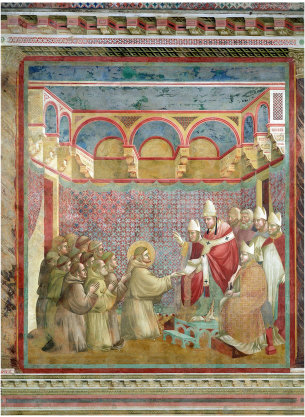
Part of Francis' great witness to the pope was his emphasis on community

Tonight, we had the privilege of hosting eight friars from our Philadelphia and Camden locations as a part of our gathering of the “Lower Delaware Friars.” Gathering three times a year, each location takes turns hosting the others for prayer and dinner as a way of connecting with the friar community at large. It was a busy and joyous evening to have eighteen people over for prayer and dinner, to catch up on our lives and to share about our ministries. I believe that it is the time we take for community, not our ministry or charism, that makes us “Franciscan.” Take this passage from chapter XII of The Life of Saint Francis by Thomas of Celano:

“Go, my dear brothers,” he said to them, “two by two through different parts of the world, announcing peace to the people and penance for the remission of sins. Be patient in trials, confident that the Lord will fulfill His plan and promise. Respond humbly to those who question you. Bless those who persecute you. Give thanks to those who harm you and bring false charges against you, for because of these things and eternal kingdom is prepared for us.”

Accepting the command of holy obedience with much joy and gladness, they humbly prostrated themselves on the ground before Saint Francis. Embracing them, he spoke sweetly and devotedly to each one: “Cast you care upon the Lord and he will sustain you.” He used to say this phrase whenever he transferred brothers by obedience.

Then brother Bernard with brother Giles hastended on the way to Sanitago; Saint Francis with one companion chose another part of the world. The other four, two by two, went to other regions.

Only a short time had passed when Saint Francis began desiring to see them all. He prayed to the Lord, who gathers the dispersed Israel, mercifully to bring them together soon. So it happened in a short time: they came together at the same time according to this desire, without any human summons, giving thanks to God.

Francis could have reached double the amount of people, and could have gotten twice as much done had he sent them individually, but fraternity was more important. It offered strength and guidance to each brother, and it was a witness to the world of the love that was possible in Christ. Because of this, it is very rare for a friar to ever live alone, and it is strongly encouraged that they work together as well.

What I find most compelling about this passage, and exemplified in events like tonight, is that time has to be made for the larger community of friars.  After sending his brothers out on mission, despite knowing that they were doing the work of God, Francis desired nothing else but to have them gathered together. There will always be too much work, meetings, baptisms, fundraisers, chores, phone calls, appointments, and so on; but part of being “Franciscan” is making community a priority, even if it means dropping one of the other things for a few hours. Tonight was a great witness to the myself and the other postulants as to the importance of community in our lives, and the great benefit it provides to all in this life.