Looking Forward to Our New Community

As I mentioned five weeks ago, the purpose of this summer experience at Saint Bonaventure University was twofold: 1) gain a more formalized and academic understanding of Francis, and 2) begin to create a brotherhood with the men with which we’ll be living next year.  So far, the latter has been the highlight, and honestly, a bit of a surprise.

Prior to this summer, the postulants from all seven provinces met three times for a workshop and community time.  The purpose, just as this summer, was to tie in something academic with fraternity opportunities so as to better prepare us for the novitiate.  Though I did not mention it in my previous posts, these were not the greatest experience for me, and I left each one with a bit more anxiety about next year. I have to live with them? I liked a lot of the guys individually, but the group as a whole was exhausting, and I had no idea how I was going to do this summer, let alone all of next year.

In these five weeks together so far, my fears have been completely unfounded, and my perspective on next year has changed dramatically for the better.

Part of this is due to the change in atmosphere.  Rather than being a short week of travelling, all seventeen of us have settled in and are able to feel comfortable in our routines.  There’s enough free time that we’re able to balance community time with personal time, something that was impossible at a four-day workshop.  The other part of this is that we’ve begun to see ourselves as one unit, not seven units together in the same place.  These factors, with the start of novitiate fast approaching, have made us more able and more open to building fraternity with one another, and the result has been fantastic.

On a personal level, I’ve loved the opportunity to just hang out with some of the guys and do fun things.  During the day I spend time at the gym either working out or playing racquetball with a few guys, and at night we watch movies, play pool, or just stay up late telling stories and laughing with one another. (We do work occasionally too.)

Because of this, friend groups are definitely developing.  The larger group allows people to branch out of their own provinces and connect with people of more similar age, language, hobby, and background.  Unlike in years past, we’re not discouraged from developing personal friendships; whereas before it was thought that such relationships would inevitably lead to exclusivity and the weakening of community, the nuanced approach seeks to develop intimate relationships between individuals so as to incorporate them back into a healthy community.  Developing these relationships has been the best part for me so far, as I’ve really enjoyed the chance to get to know a few of the guys a little more each day.

Always in the back of my mind, however, is finding a way to be inclusive with my time, and to see each one as brother.  It’s somewhat inevitable, given the age disparity and existence of three native languages, that there will be distinct friend groups.  That’s okay.  It’s even okay if I’m not “friends” with everyone.  That’s community life.  What’s not okay is being exclusive to the point of cutting off members from the community.  We don’t have to spend all our time together, nor do we even have to like each other all that much, but we need to learn how to respect each other, cooperate, live together, and view each other as brothers, called by Christ to the same vocation.  This sounds really nice, and it was very easy to write, but this will no doubt be the toughest part of community life, next year and every year.

All in all, I have to say that I’m excited for the novitiate to start.  The anxiety I once had has all but washed away, and I look forward to living with this group of men on a more permanent basis three weeks from now.  Though I know that the year will by no means be easy, nor will the community life be a walk in the park, I think that I’ve grown close enough to a number of them to know that it’s going to be a fruitful one for sure.

…and another thing!

It occurred to me only today that my last post was all about the need for flexibility and openness in developing a routine, but that I had shared nothing about the routine itself! The summer heat must be getting to my brain.

Anyway, because of the dual nature of this summer (education and fraternity), our schedule is a bit busy as times, and complicated all the time. Our main focus, I would argue, is class from 8:30-11:20 Monday through Friday. For the last two weeks we were enrolled in “Francis: Life and Charism” which focused on the early history of the order and the foundational texts; starting Monday, we will be taking “The History of the Franciscan Order” with esteemed Franciscan scholar and Vicar Provincial of Holy Name Province, Dominic Monti, OFM. (Dominic came to Wilmington twice this year to give us a workshop on the history of Holy Name Province)  Both are enriching experiences to learn about Francis in a more formalized and rigorous setting than we have been accustomed.

But while I say the academic work is probably our main focus, it wouldn’t be a true Franciscan experience without prayer and fraternity. We meet as a University community for morning prayer Monday through Thursday  at 7:15, mass Monday through Thursday at 4:30, mass on Fridays at 7:15, and night prayer at 9:00 on Wednesdays; as a house community, we meet for mass on Saturday at 8:00, night prayer Mondays, Tuesdays, and Thursdays, and evening prayer Wednesdays, Saturdays, and Sundays. (I mentioned that it was confusing!)

In addition to our prayer life, we meet once a week on Wednesdays for a house meeting in which we give an update of our lives and hear house news. On Tuesdays and Thursdays we meet for a  University run “roundtable” for men and women in formation to get away from their formators and discuss the positive and negative sides of formation.

Our afternoons are free, and so it is a great time to relax, get some classwork done, or spend some time at the fitness center. As for fun, the evenings after night prayer are usually finished with some laughs together, and a few of us have begun a weekend tradition of darts, pool, and dinner at a few of the local restaurants.

All in all, it’s been a great time so far.  It’s much harder to write an academic paper than I remember, but it feels great to be back in the classroom and working on an intellectual level.  I’ve enjoyed living with my new seventeen brothers, and look forward to spending the next year with them in Burlington, Wisconsin! (For a refresher as to what I mean by that, check out a few earlier posts about my new brothers and the novitiate.)

I’m still behind on getting pictures uploaded from campus, but I’ll post about it when I do.

A Spirit of Itinerancy

As itinerants, friars are constantly on the move: we change dwelling places, ministries, friar communities, and schedules. As I’ve alluded to here and there, the reason we do this is to avoid attachment and to remind us that all we have and use is borrowed, not owned.

If all of these consequences are true about itinerancy, there is not a more detached and sharing group of men in the whole world than the postulants (and director) of Holy Name Province: having settled into Saint Bonaventure University for a few weeks, I have now slept in twenty-one different beds since August (not including those I slept in while on breaks). That’s what I call itinerancy! On almost a bi-weekly basis, we were forced to adapt to not only new locations, but also new people, new situations, and new ways of doing the same things we were used to doing differently at home.

Herein lies what I believe to be the true benefit of becoming an itinerant: flexibility and openness. While communities that never change may be more efficient and comfortable, they run the risk of stagnation and stunted growth behind the killer of inspiration, “This is the way we do it.” Groups such as ours, ones that are always changing environments and forced to incorporate different members and situations, remain much more flexible in routine, are open to new possibilities, and can experience much greater growth.

Nothing could have prepared us better for our experience here among the other postulants. With men represented from seven different Franciscan provinces across the United States and Canada, we are now all faced with (at least) seven different ways of doing something. Prayer, chores, meals, recreation, personal time, and entertainment now have seven different voices coming together as one, each saying, “This is the way we do it.”

With no established routine or majority, there are two possible results: growth fueled by listening, respect, and compromise, or anarchy.

So far, we’ve leaned towards the former. With two of the seven directors present to facilitate, the nineteen of us have met multiple times already to discuss the needs and expectations of both self and community. So far, we’ve established a signup sheet for particular chores and responsibilities around the house and voted on a prayer schedule that works for most. So far, we’ve avoided anarchy.

The entire experience, big picture as well as here at Saint Bonaventure’s, has been something I believe will better prepare us for lives as friars. Though we will probably never move as frequently as we do this year, we will be periodically faced with situations that upset our status quo, situations that can either make or break community life in our friaries. It is my hope that I may always live with a spirit of itinerancy, flexible and free of attachments, so that I may always be open and attentive to the needs of both brother and neighbor.

[Pictures to come soon]

The “Root” of Our Charism

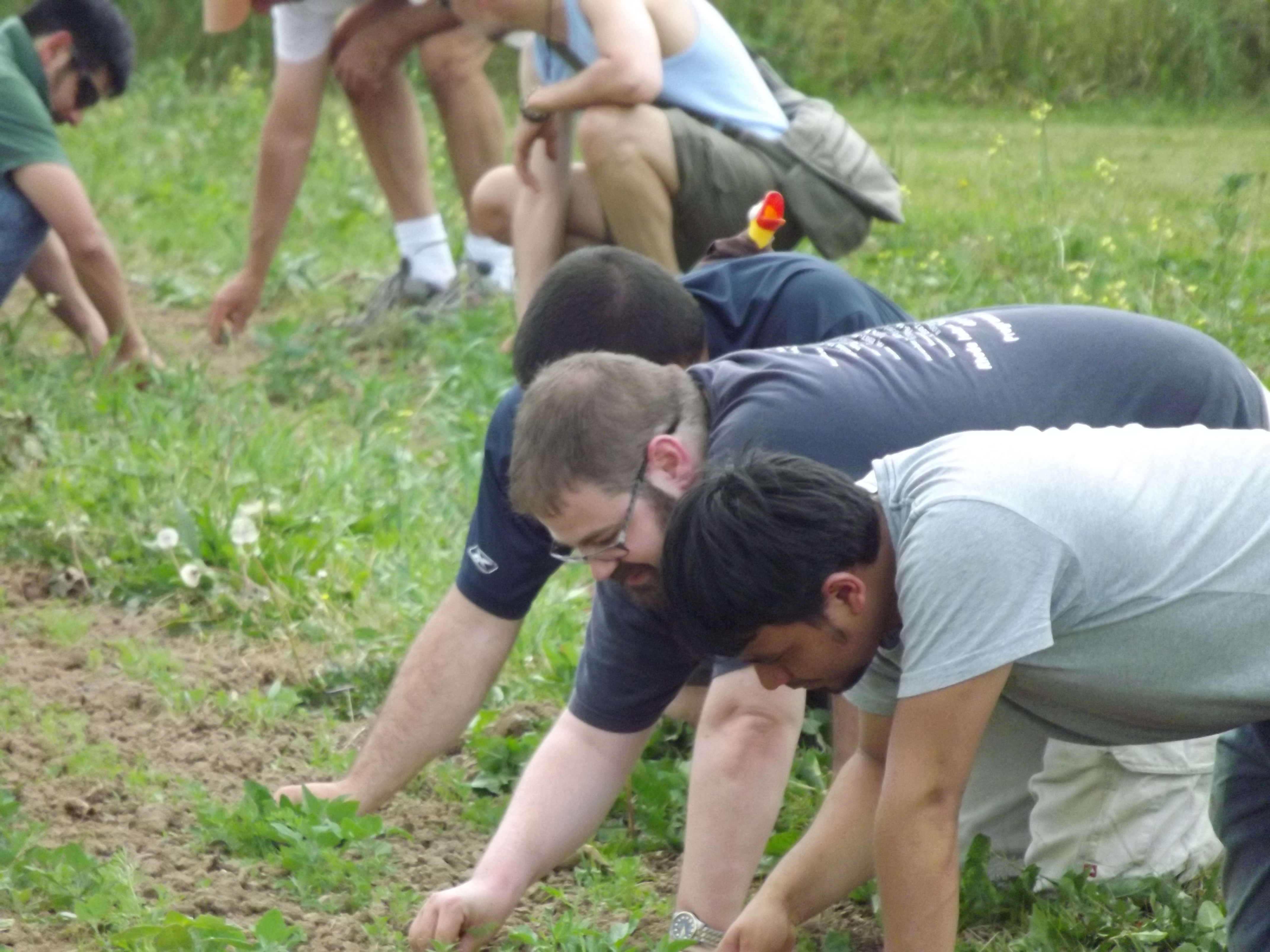
Manual labor and brothers: the Franciscan way.

After a few long days of packing, traveling, and unpacking, all seventeen postulants and both directors have settled into their new home here at Saint Bonaventure University. Starting Monday, we’ll be in full campus swing, taking classes, attending communal prayers, hitting the books, and of course, spending quality time with our brothers.

But that’s not until Monday and we’ve been here since Tuesday/Wednesday. So what have we been doing to fill the time, you ask?

If you guessed weeding carrots at an organic farm, you’re right! As a way to get in touch with the original Franciscans that worked with their hands each day and took for wage only enough food for the day, we rolled up our sleeves and put in an honest day’s (three hours) work. We left dirty, sweaty, and exhausted two days in a row, but not without a sense of accomplishment for a job “well” done (by which I mean, “well, it’s done,” and not to indicate any quality in our work, as none of us appeared to be called to this line of work…)

That being said, as much as this type of labor would not fulfill me as a full-time ministry, there is something to be said about our ability as friars to do the “dirty work” ourselves rather than leaving it to someone else. Sure, I understand that it may be more efficient or even more cost effective to have outsiders take care of tasks around the house (i.e. cooking, cleaning, maintenance) so that we can focus entirely on our work for others in our parishes and schools. But is this the sort of trade-off we want to make? Just as Francis told Anthony he could teach theology as long as he didn’t “extinguish the Spirit of prayer and devotion,” we should not wish to approach our ministry with the risk of extinguishing our Spirit of poverty and humility.

By that I do not mean to romanticize manual labor or in any way to say that it is more fruitful to our charism than intellectual labor is. Rather, what I mean to say is that a friar or friar community that refuses to engage in any form of manual labor or “dirty jobs” for the sake of others, runs the risk of becoming lazy, developing a feeling of entitlement, and ultimately losing the sense of poverty and humility that is at the root of our Franciscan charism. I would much rather clean a toilet, cook a mediocre dinner, cut the grass in the hot sun, or clean a hundred dishes, than allow myself to feel that I deserve these things to be done for me because the community needs me in some way.

My hope, as always, is that this reflection will be taken simply as that: a reflection of what I feel to be an ideal for my life. In no way do I mean this as a criticism to those who do have cooks, cleaners, landscapers or anyone else serve them on a regular basis, whether one is a friar or not, as there are always different circumstances that call for different solutions.

Living Together

Just like newlyweds, there will be conflict in new friar communities unless there is mutuality and compromise.

As I mentioned in my last post, A Life to Share, intimacy among brothers is something for which we all strive, and is something I see already present in my life. What I failed to mention in my last post is that being intimate with a brother and living together are completely different things. Ask any newly married couple having just moved in with one another or best friends from high school that decide to share a dorm room in college: living together places a strain on any relationship, no matter how close.

One of the things that our postulant director has said to us early and often is that the source of conflict in religious houses is not theology or politics: it’s kitchens and bathrooms. Domestic disagreements, he says, over how clean an area should be or who’s responsibility it is to do certain chores, is the source of all household conflict.

So far in my experience of fraternal life I would have to agree. The fact of the matter is that there are no universal standards by which one is expected to live. Because each of us were formed by different people in different settings, we each have different expectations for the way things should be, making it inevitable that conflicts will arise. The way the table should be set, the position of the toilet seat when not in use, the length of time clothes may sit in the washer/dryer, the level of dust/grime/stain/smear that is acceptable before something must be cleaned, and the time allowed to clean one’s dishes, are all examples of issues for which there is no “correct” answer; each of us answers them from our own experience before entering community life, and must attempt to integrate them into one another.

When this is not done effectively, I envision one of two things happening:

The first is that the friary can turn into a college apartment. In this setting, cleaning is only done when it is convenient or one’s threshold of disgust is met, allowing for all lifestyle choices to be acceptable. It’s a “if it bothers you, you can clean it” mentality in which the majority of people feel very comfortable in their surroundings, while those few with the highest demand for cleanliness and order are left with the majority of the responsibilities of the house. This is not a desirable living situation because it does not take into consideration the needs of all, and places an unfair burden on the few.

The opposite extreme is just as likely: in order to make those with the highest demand for cleanliness and order feel comfortable, the other guys in the house are required to maintain a pristine level of living, one that far surpasses their own needs. This method guarantees that no brother will feel uncomfortable or taken advantage of, but it also means that the whole house is at the mercy of a few individuals. This is also not a desirable living situation because it does not facilitate dialog or expect each brother to make sacrifices for the sake of all.

Now before I get myself into trouble, neither of these extremes describes the way in which we live here in Wilmington, though I do see elements of both from time to time (as I did also in college and at home.)

Like any group of people trying to live together, what’s needed most is mutuality. Each person needs to recognize that there are many right ways of doing something, and that at times, it’s not only acceptable, it’s necessary, to live by another’s standards. Sometimes that means being patient and accepting the idiosyncrasies of others, either accepting it the way it is or doing a little more work to have it the desired way, while other times it means finding a respectful way to ask a bit more of a housemate. The truth of the matter is that it is all compromise, but that compromise isn’t so bad if all parties are involved in the decision and are equally looking out for their own benefit and the benefit of the whole community.

As I continue in my journey as a franciscan friar, constantly living in fraternity, I need to recognize that I am just as guilty of annoying my fellow brothers as they are me because we come with different expectations for one another. If I fail to recognize this, and seek to live my own lifestyle at the expense of others, living together is going to be very difficult for us all. On the other hand, if I’m open and dedicated to the life of the fraternity, living together will simply be a means by which we may form and nurture meaningful, intimate relationships for the rest of our lives. I guess ultimately the question is this: do I wish to live individually by my own rules, or do I wish to give up some of my own expectations so as to live together, fraternally?

I choose to live together.